Her Mom Sent Vulnerable Newborn Photos to Friends Seconds After She Gave Birth Without Asking — Then She Called Her Out for the Betrayal
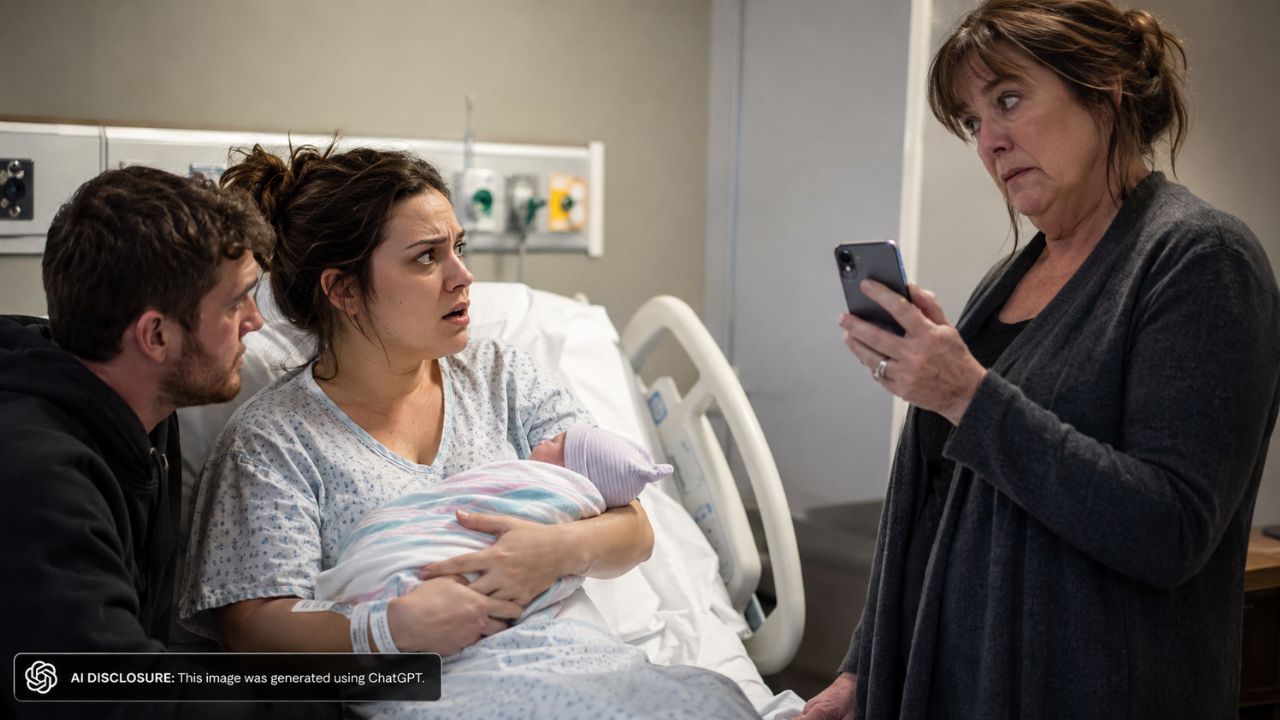
Photo credit: AI-generated image created using ChatGPT.
Childbirth has a way of stripping life down to the basics. You’re exhausted, exposed, overwhelmed, and grateful all at once. It’s also one of the few moments where a woman gets to say, without apology, “This is my space, and these are my rules.”
In the original post, an 18-year-old mom described letting her mother into the delivery room under one clear condition: don’t announce the birth and don’t send photos to anyone. The labor itself went fine, and she even asked her mom and partner to take photos and videos. But seconds after she gave birth, her mother reportedly messaged friends that she was in labor and sent pictures of the newborn—along with “very vulnerable” photos of the new mom, including her nipple as she was about to breastfeed.
She felt violated and disrespected, especially since those friends had partners and the images were shown to men as well. Now she’s asking if she’d be wrong to bar her mom from the delivery room if she has another child someday. That’s not a petty question. That’s a trust question.
Birth isn’t a spectator event
A delivery room isn’t a living room. It’s not a family reunion, and it’s not a stage for proud relatives to collect content for group chats. It’s a medical moment, a holy moment in its own way, and it belongs first to the mother and baby.
Her boundary wasn’t complicated. She didn’t say “no photos ever” or “don’t tell anyone for a week.” She said she wanted to be the one to announce, and she said don’t send birth photos around. If someone can’t handle that, they don’t get access to the room. That’s not punishment; it’s stewardship of an intimate moment.
Trust is the whole point of “support”
People talk about being “supportive” during labor like it’s automatically earned by relationship status. “I’m the mom, so I should be there.” “I’m family, so I have a right.” But support without trust is just presence, and sometimes it’s pressure.
In her account, she needed help and comfort. Her partner was working out of town at the start, and she was in too much pain to care who was watching by the time he arrived. That’s a very human situation: you’re vulnerable, you’re tired, and you choose someone you think will protect you. The betrayal cuts deeper precisely because she did what we tell young mothers to do—reach for support—and that support took advantage.
Sending those photos wasn’t “excitement,” it was a decision
A lot of families excuse bad behavior with a thin layer of emotion. “I was just excited.” “They’re like family.” “It was all girls.” None of those explanations change the action. She asked for one thing, and her mother did the opposite at the earliest possible moment.
What makes it worse is the nature of the photos. Newborn pictures are one thing; images that expose the mother’s body—especially during the first attempt at breastfeeding—cross a line into humiliation. Even if the intent wasn’t to shame, the impact matters. If you wouldn’t hang that photo on the wall at Thanksgiving, you probably shouldn’t be texting it around seconds after a birth.
“Considered family” isn’t family, and even family needs consent
Her mother defended it by saying these friends are “considered family.” Fine. People build tight circles, and longtime friends can feel closer than cousins. But that still doesn’t make them authorized viewers of someone else’s naked, exhausted, postpartum body.
There’s also a hard truth here: the more people you send something to, the less control you have over where it goes. The post suggests the images were shown to friends’ male partners, too. That’s exactly how private moments become public property—passed from phone to phone with little “oh it’s fine” comments along the way. A mother’s job in that room is to protect her daughter, not make her daughter’s vulnerability shareable.
If you’re the father, your job is to guard the room
Men can feel a little useless during labor. You’re trying to be steady while everything is intense, and you don’t want to make it about you. But there is a clear role for a husband or partner: protect the mother’s peace and enforce the plan she asked for.
In this situation, the young mom had her partner there by the end, but she also had her mother taking photos and sending messages. If you’re the man in the room, it’s worth having the awkward conversation ahead of time: no sharing, no posting, no texting images to anyone until she says so. If a relative can’t respect that, you’re not being rude by stepping in—you’re being faithful to the woman you’re responsible to protect.
Consequences aren’t cruelty; they’re clarity
Some people hear “you can’t be in the room next time” and think it sounds harsh. But what’s the alternative—let her back in and hope she suddenly becomes trustworthy? Birth doesn’t leave much margin for “maybe she learned her lesson.”
Access to the delivery room is a privilege. It’s a front-row seat to someone else’s pain, courage, and exposure. When someone proves they can’t handle that privilege, the consequence should be simple and calm: you don’t get to be there. And if she wants a path back, it starts with owning what she did without excuses, apologizing without bargaining, and accepting limits without pouting.
Boundaries with parents get real once you have your own family
One of the hardest turns in adulthood is realizing your parents don’t automatically get a vote in everything anymore. Becoming a mother and father doesn’t just add a baby; it creates a new household with its own privacy and authority. That shift can be especially rough when you’re young, because people treat you like you’re still a kid even while you’re doing grown-up work.
The young mom added an edit saying she isn’t currently pregnant again, and that she and her partner are financially stable with their own place. Whether or not anyone approves of their age, the point remains: she’s the mother, and it’s her body on the table. If her mom wants a close relationship, it has to be built on respect, not entitlement.
If you’re looking for the clean answer, it’s this: no, she wouldn’t be wrong to keep her mother out next time. Trust is earned, and her mother spent it recklessly when it mattered most. Forgiveness can be real, but forgiveness doesn’t mean handing someone the same access they already misused.
Read more from Thrive Girly:
- Mother-in-Law Expected to Sleep Over After Every Visit — Then the Mom Said Overnight Stays Were No Longer an Option
- Relatives Showed Up to the Wedding Without Being Invited — Then the Couple Refused to Find Them Seats
- Grandma Buckled the Baby Into Her Car and Left Without Telling Anyone — Then the Mom Made Sure It Never Happened Again