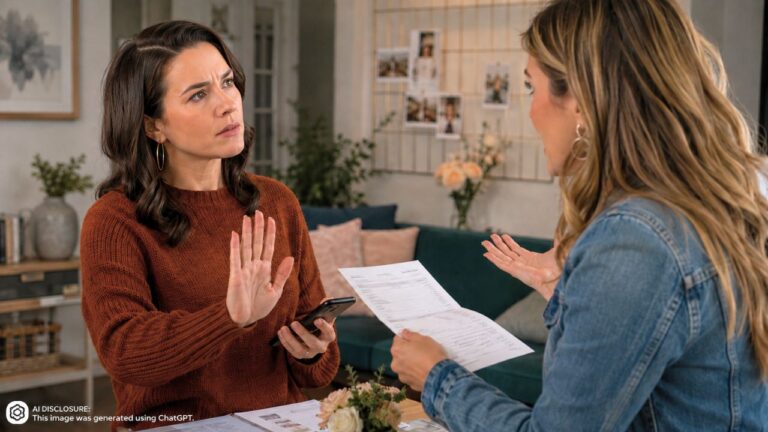
Her Future In-Laws Sent Her a Bill for Wedding Expenses She Never Agreed To — Then She Refused to Pay a Single Cent

Photo credit: AI-generated image created using ChatGPT. Illustrative only.
By the time she’d hit “book” on the destination bachelorette trip, this 23-year-old bridesmaid thought she’d done the hard part: show up, be supportive, and swallow the usual wedding-party sticker shock. She’d already shelled out $300 for the required dress and shoes, plus $1,000 for the trip itself. Not cheap, but she told herself it was part of the deal.
Then the bills kept coming. Not suggestions. Expectations. And eventually, it started feeling less like being included in a celebration and more like being handed someone else’s tab.
The costs started stacking up fast
The wedding isn’t even until October 2025, but the spending started early. As a bridesmaid for her fiancé’s older sister, she went in knowing it wouldn’t be free. She’d been in weddings before, and she had a number in her head for what “normal expensive” looks like.
In her past experiences, being a bridesmaid meant chipping in, not bankrolling. Around $1,200 total was her baseline for the whole experience. Here, she hadn’t even made it through the bachelorette planning before she blew past that.
First came the outfit requirements. Then came the destination bachelorette trip—$1,000 just to attend. She said they were told there was “no pressure” to go, which made it feel like a choice. But that choice didn’t stay neutral for long.
“No pressure” turned into pressure anyway
After some bridesmaids understandably considered skipping the trip due to the cost, her future mother-in-law weighed in. According to the bridesmaid, the message was that it was “shitty” for people to back out. And just like that, the optional trip didn’t feel optional anymore.
So she went along with it. She booked it. She accepted the hit to her budget. And she tried to mentally file it away under “this is what you do for family.”
But the part that really changed the tone came after the trip was already booked—when new financial expectations showed up that nobody had agreed to upfront.
The bachelorette surprise: covering the bride’s costs
Once the trip was locked in, the maid of honor delivered another detail: the bridesmaids would also be covering all of the bride’s costs during the bachelorette. Food, drinks, “and anything else.”
That wasn’t a small add-on. That was a whole second bill layered on top of the first one, with no real cap and no earlier discussion. The bridesmaid said it hadn’t been brought up beforehand, which left her feeling like she was being cornered into saying yes after the fact.
It also set a pattern: plans get made, money gets spent, and then the “real” expectations show up when it’s too late to comfortably opt out.
And the moment she thought, “Okay, surely we’re done,” the bridal shower conversation began.
Then her future MIL brought up the bridal shower bill
Her future mother-in-law told her that as a bridesmaid, she was expected to help pay for the bridal shower. Not help in the “bring a snack” way—help in the “cover the costs” way. The justification was that she had Googled it and found that bridesmaids are responsible, not the mother of the bride.
The bridesmaid didn’t totally reject the idea of contributing. She just didn’t recognize this version of reality. In the weddings she’d been part of before, bridal showers were usually hosted by family or a close family friend, often at someone’s home. Bridesmaids might handle games, small decorations, or a few shared items—not a fully catered event.
This time, her future sister-in-law was picturing a bridal shower with catering and elaborate décor. And the bridesmaid couldn’t ignore what it looked like from the outside: the bride choosing an event style that didn’t fit her own budget, assuming the wedding party would quietly make up the difference.
That’s where the “I want to support you” energy ran straight into “I’m planning my own wedding too.” Because she is. Her wedding is planned for mid-2026, and she’s trying to save for it—while also paying for this one.
She didn’t want to be difficult—she wanted a number that made sense
She wasn’t saying she wouldn’t contribute anything. She was saying she needed it to be within reason. The problem was that every time she thought she had a handle on the budget, another expense popped up “without any discussion,” as she put it.
And it wasn’t just her feeling it. She noted that the other bridesmaids are young, early in their careers, and feeling the pressure too. That matters, because it turns the bridal party into a group of people trying not to rock the boat—while privately doing mental math and wondering how they got drafted into funding someone else’s Pinterest board.
Eventually, she put the question out there plainly: how much is too much to ask bridesmaids to pay?
She shared her story in the original post, explaining that she’s excited for the wedding, but the price tag is starting to feel endless—and strangely mandatory.
Her fiancé backed her up, but family history made it complicated
One of the clearest details in her edit was that she didn’t bring this up alone. She talked to her fiancé, and he agreed the expectations were out of line. More importantly, he had her back on however she decided to approach it.
He even offered to speak to his family himself. But he also warned her that based on prior situations, it probably wouldn’t go anywhere. That small line hinted at a bigger pattern—one where his family doesn’t respond well to being told “no,” even when the request is unreasonable.
She also mentioned that they’ve already drawn lines with his family on other issues, to the point that they moved further away to separate and focus on building their own life while pursuing their careers. So this wasn’t their first time realizing that “family expectations” can turn into pressure campaigns.
Now, the looming question isn’t just what to do about one bridal shower. It’s what happens when she says, “I’m not paying for that,” and the people who expect compliance treat it like a personal insult.
At the center of it all is a bridesmaid who genuinely wants to show up for her future sister-in-law—but doesn’t want to start her marriage by being trained to hand over her wallet whenever someone says, “That’s what you’re supposed to do.” And with her own wedding on the horizon, she’s watching closely to see whether this family can accept a boundary… or whether they’ll keep sending the bill anyway.