Her MIL Kept Calling Herself “The Woman in His Life” Two Weeks After She Gave Birth — Then She Screamed at Her to Get Out of the House
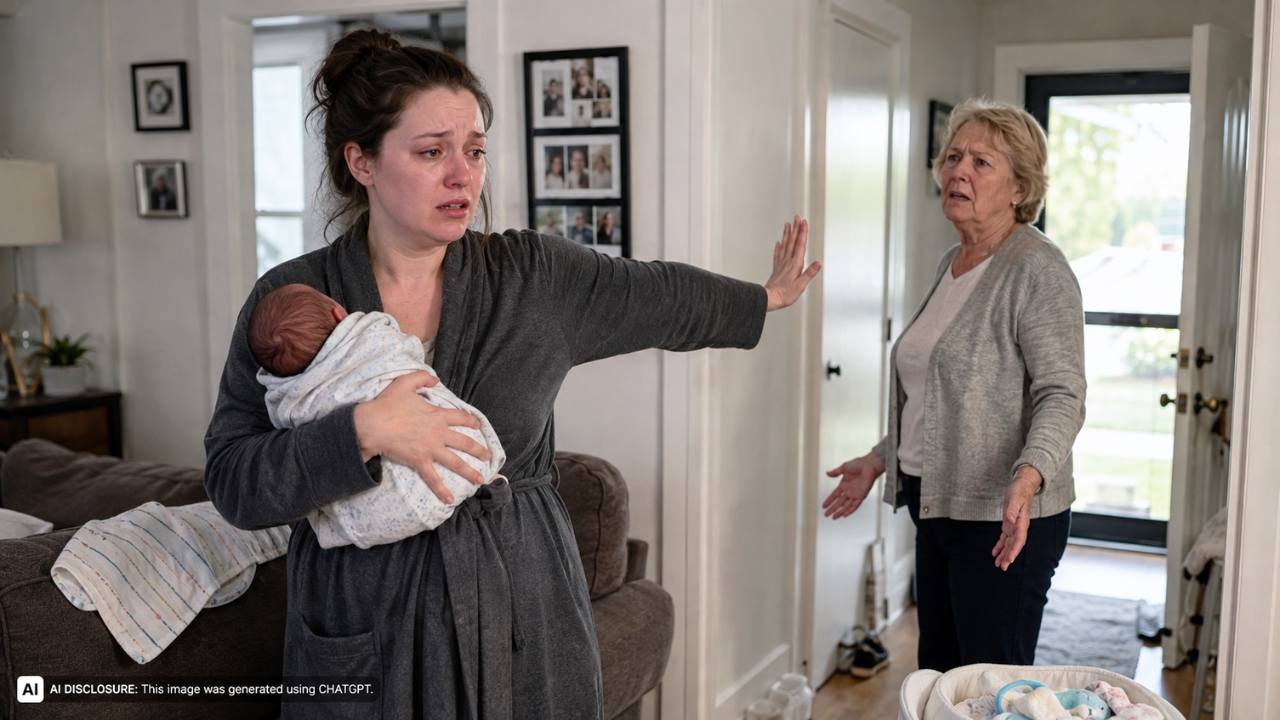
Photo credit: AI-generated image created using ChatGPT.
Two weeks after a baby arrives, everybody’s running on fumes. The mother’s body is still healing, the house is a mess no matter how hard she tries, and the days blur together into feedings, burping, laundry, and trying to remember if you drank water. It’s a tender window, and it’s not the time for family power games.
In the original post, a 26-year-old new mom describes being two weeks postpartum when her husband tested positive for COVID and had to stay out of the house. With help hours away and sleep nearly gone, she asked her mother-in-law to come over briefly so she could shower and eat. Instead, she got a string of cutting remarks—about her home, her appearance, and even how to feed and soothe a newborn—until she finally snapped and told her MIL to leave.
There’s a lot going on here: exhaustion, sickness, the raw emotions of early motherhood, and an older woman who seems to think she’s still competing for her son’s attention. It’s the kind of moment where you find out what people are really made of, and who understands their place in a family.
The “woman in his life” comment is not cute
Before the blow-up, there was already a pattern. The mother-in-law had made comments like “I’ll always be the woman in your life,” and the husband had addressed it directly, telling her she’s his mother, not his wife, and that those comments make him uncomfortable. Good on him for that—because those lines aren’t just awkward, they’re corrosive.
A mother has a lifelong role, and it’s an honorable one. But it is not a rival role. When a mom speaks like she’s in competition with her son’s wife, she’s not being “close,” she’s being possessive, and she’s dragging everybody into a twisted little triangle.
Postpartum isn’t a performance review
The new mom describes being on almost no sleep, not showering, barely eating, and trying to do everything alone because her husband was quarantining at his mom’s guest house. That’s not “being dramatic.” That’s the reality of early days with a newborn, made worse by illness and distance from help.
This is where basic decency should kick in. If you walk into a postpartum home and your first instinct is to critique the mess or take shots at the mother’s appearance, you’re not helpful—you’re indulging yourself. A decent person sees a tired mom and thinks, “How can I lighten the load?” not “Let me point out everything she’s doing wrong.”
Criticism disguised as “help” is still criticism
The MIL didn’t just make one offhand comment. She reportedly criticized the house, told the mom she looked horrible, suggested adding cereal to breast milk, floated “cry it out,” and then questioned whether she could be a good mother if she couldn’t “handle a little stress.” She even added that her son “deserves a break,” as if the woman who just gave birth is some kind of inconvenience standing between him and relaxation.
Notice what’s missing: any sense of service. No “Go shower, I’ve got him.” No “Sit down and eat.” No “You’re doing a good job.” Just contempt, dressed up as wisdom. Some people mistake bluntness for maturity, but if your words crush someone who’s already barely standing, you’re not speaking truth—you’re swinging a bat.
And the “my baby” language aimed at her adult son, plus the possessiveness over the grandchild, fits the same pattern. It’s a mother still trying to be the central figure in a story that has moved on without her permission.
Why the blow-up happened, and why it wasn’t “nice”
The mom finally broke down crying and asked her to stop. The MIL responded by calling her dramatic and making another jab, and that’s when the new mom yelled and told her to get out. Later, she called to apologize for yelling, though not for what she said. The MIL cut her off and said not to expect help again.
Could the delivery have been calmer? Sure. But “calm” is a luxury item when you’ve had almost no sleep in days, you’re starving, you’re healing, and somebody is in your home taking shots at you while you’re holding a two-week-old baby. People love to grade a reaction while ignoring the provocation. In real life, pressure finds the weak point, and if you keep poking a wound, you’re going to get a reflex.
The sister-in-law reportedly called the new mom a name and said she could’ve been nicer because the MIL was “just trying to help.” That’s a common family trick: redefine cruelty as “help,” then shame the person who finally pushes back. A man should recognize that move for what it is—control, not concern.
The husband’s job is to guard the home, even from his own mother
The husband had already shown he can set boundaries with his mom, and he backed his wife after this incident, telling her she had every right to be upset. That matters. A husband doesn’t stop being a son when he gets married, but he does reorder his loyalties. His wife and child are his primary stewardship now, and his mother is extended family.
It’s also significant that his COVID situation put his wife in a vulnerable spot. If your wife is alone with a newborn and you’re physically absent, you can’t be passive about who gets access to her and the baby. You can’t outsource “help” to someone who uses the opportunity to dominate, criticize, or stake a claim. Protection isn’t only about physical danger; it’s also about guarding the peace of the home.
If his mother wants to be involved, she has to come in the posture of service. If she can’t do that, the answer is simple: she doesn’t get the privilege of being present, especially during postpartum.
What respectful help looks like in week two
Most families don’t need a perfect script; they need basic common sense and humility. Help in the early postpartum window looks like doing dishes without announcing it, taking out trash, folding laundry, bringing food, and letting the mother rest. It looks like asking, “Do you want a shower or a nap first?” and then making it happen.
It also looks like keeping opinions on feeding and soothing to yourself unless you’re asked, or unless there’s an obvious safety issue. New parents are learning their baby in real time, and they don’t need a chorus of second-guessing. If you want to give advice, earn the right by being kind first.
And if you’re the grandmother, your lane is support, not status. Your role is to strengthen the marriage and encourage the mother of your grandchild, not to audition for “most important woman in the family.”
Boundaries that actually work
This situation won’t fix itself with a polite phone call. The new mom already tried apologizing for the volume, and the MIL responded with a punishment: “Don’t expect me to watch him again or help.” That’s not the response of someone who wants peace; it’s the response of someone who wants leverage.
Working boundaries are concrete. They sound like: “You can visit for an hour, and if you criticize my wife or our home, the visit ends.” Or: “If you speak about yourself as my wife’s replacement, we’ll take space for a while.” Or even: “You’re welcome here when you can be respectful, and not before.” The point isn’t to be rude; it’s to be clear.
If the MIL can’t handle boundaries, then limited contact is a reasonable outcome. You don’t have to maintain closeness with someone who treats your wife like a punching bag, especially during one of the most vulnerable seasons of her life.
A family works best when everyone understands order: husband and wife as a unified team, parents serving their children without control, and grandparents adding warmth without trying to run the house. In this story, a tired new mother didn’t “ruin everything” by finally speaking up—she exposed something that was already broken, and now the adults involved have a chance to decide whether they want a healthier pattern or the same old mess.
Read more from Thrive Girly:
- Mother-in-Law Expected to Sleep Over After Every Visit — Then the Mom Said Overnight Stays Were No Longer an Option
- Relatives Showed Up to the Wedding Without Being Invited — Then the Couple Refused to Find Them Seats
- Grandma Buckled the Baby Into Her Car and Left Without Telling Anyone — Then the Mom Made Sure It Never Happened Again