Dad Gave Away the Guitar He Promised Her for Decades to Her Stepbrother — Then She Cut Off the Entire Stepfamily
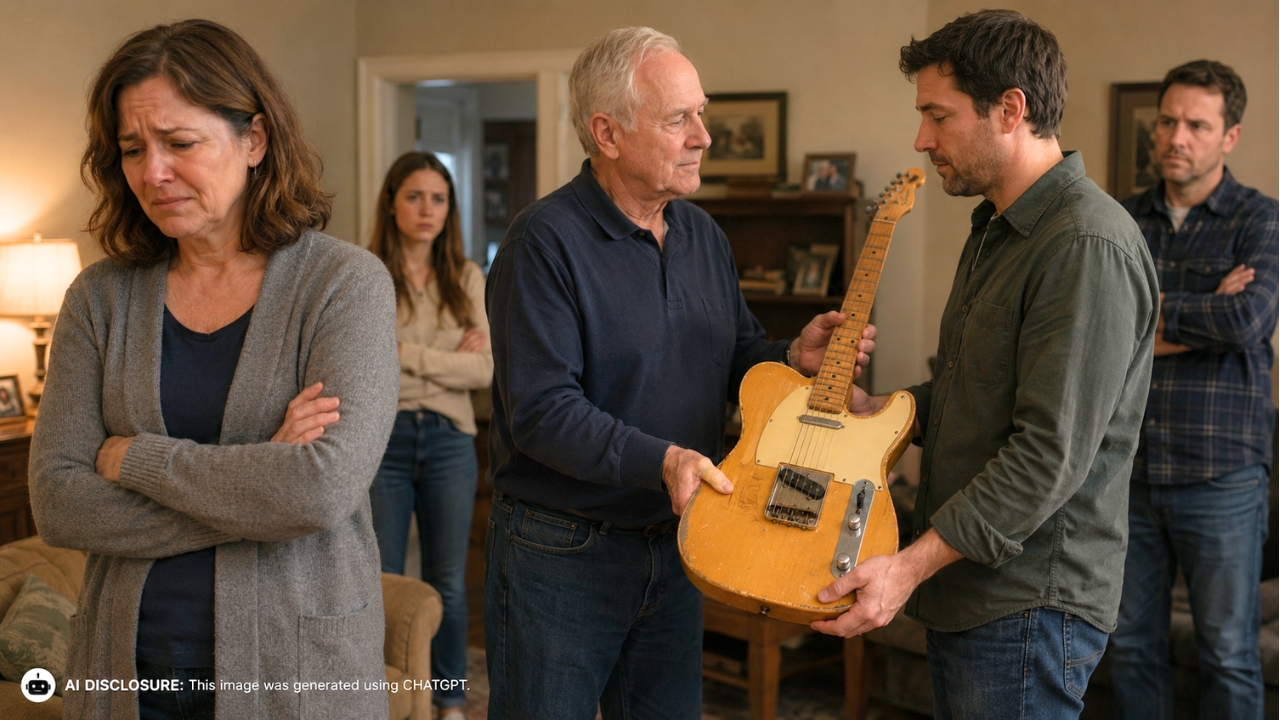
Photo credit: AI-generated image created using ChatGPT.
Some family fights aren’t really about the object. They’re about what the object represents: a promise kept, a place in the family, a father’s word being worth something. And when that word gets traded away for convenience, it doesn’t just sting—it reframes the whole relationship.
A 52-year-old woman laid out one of those situations in the original post. Her father owned an old 1960s Telecaster—nothing flashy, but meaningful—and he’d promised it to her since she was a kid. After decades of hearing “it’ll be yours,” she found out he’d quietly given it to her stepbrother instead, then acted surprised that it mattered.
What followed wasn’t just an argument about a guitar. It was the kind of slow-burn betrayal that happens when a man avoids conflict for years, then makes a “peacekeeping” decision that only proves he never intended to honor what he said.
A promise that outlived the marriage
Her parents divorced when she was 10. Her dad left her mom for a woman with older kids, and those stepkids were mostly out of the house, which matters because it shaped how the younger daughter understood her place: she wasn’t joining a brand-new blended household day-to-day. She was a kid watching her dad build a second life while promising her, at least in one tangible way, that she still mattered.
That guitar became the symbol of it. It wasn’t about money, status, or even music. She doesn’t play, and she never claimed she needed it for a gig; she wanted it because it was her dad’s, it had history, and he’d told her for as long as she could remember that it would be hers.
The fight wasn’t about skill—it was about belonging
The stepbrother, Ronnie, plays guitar. As early as when she was 16, he argued he should get the Telecaster because he would “use it.” That logic sounds clean until you remember what families are actually made of: relationships, meaning, and the long memory of promises.
He was framing it like a tool allocation. She was hearing it like a claim to her father’s legacy. When men treat sentimental inheritance like a gear swap—who’ll get the most mileage out of it—they miss the point. You don’t “earn” a father’s word by being more convenient.
They already settled it, in writing
About 15 years ago, she and her sister visited, and the family sat down to divide up items from the house. It wasn’t vague talk over coffee. They went through the home and decided who wanted what, and she says it was written down and signed by everyone.
Her request was simple: she only wanted the guitar. Not the classic cars. Not the jukebox. Not the extra stuff that turns inheritance into a scavenger hunt. They argued for a couple of hours, and then Ronnie backed off and “shut up about it.” After that, she didn’t bring it up again, partly because it was settled, and partly because her dad was still alive and she wasn’t trying to live like a vulture circling overhead.
He gave it away quietly, then minimized it
At Christmas in 2023, her father visited. He spent time with her, and there was no mention of any change. Then, while talking with her mother and sister, he casually said he’d given the guitar to Ronnie.
Her mom and sister were stunned. When they asked whether he planned to tell her, he reportedly said he didn’t think it was important. That’s the part that lands like a slap. Not because adults can’t change their minds, but because a father who respects his child doesn’t hide the ball and then act confused about why it matters.
After he left, her mother told her, and she was furious. A few days later, he called and asked if she minded that he’d given it to Ronnie. It’s hard to miss the emotional sleight of hand there: he didn’t ask beforehand; he asked after, hoping for retroactive permission so he could feel like a good guy.
The coward’s path: avoiding one conflict by creating a bigger one
Her father’s explanation was that Ronnie had been pestering him about the guitar every weekend for months. Since she hadn’t asked about it in a long time, he decided she must not want it anymore. That’s not confusion—it’s convenient reasoning to justify an easier choice.
It also reveals a familiar family dynamic. The squeaky wheel gets the grease, not because it’s right, but because it’s loud. Meanwhile, the steady, respectful child—who doesn’t harass an aging parent for “their” stuff—gets punished for having manners.
If you’re a dad reading this, that’s a warning worth taking seriously. When you reward the pushiest person in the room, you train the whole family to become pushy. And you teach the quiet one that keeping peace earns them nothing but being overlooked.
Why she cut them off
She told her father she did mind, and that he needed to get the guitar back. That turned into “a whole thing,” and eventually she told him to forget it—but never to text her again. Since then, he’s texted on holidays and birthdays, and she ignores him.
To outsiders, it can sound extreme: cutting off a parent over an instrument. But people don’t sever relationships over wood and strings. They sever relationships over dismissal, broken agreements, and the kind of disrespect that shows up as, “I didn’t think it was important,” when it was clearly important to the person you claim to love.
There’s also the signed agreement hanging over this. If the family truly put it in writing and everyone signed, then this wasn’t a misunderstanding. It was a decision to break a commitment the moment it became inconvenient, with the expectation that she’d swallow it like she’s probably swallowed other things over the years.
A man’s word, stewardship, and the quiet damage of favoritism
In a healthy family, especially a blended one, a father has to do two hard things at the same time: love everyone well and keep his word. He doesn’t get to buy peace with one child by selling out another. If he promised a guitar to his daughter for decades, and later changed his mind, the decent move would be a direct conversation, face-to-face, with humility and a clear explanation.
Scripture talks plainly about letting your “yes” be yes. That isn’t about being rigid; it’s about integrity. A dad who casually rewrites the past teaches his kids that words are just noise, that commitments are flexible, and that the most persistent person gets the prize. And if the stepbrother knew this guitar was promised and still kept pressing, he wasn’t just asking for an instrument—he was asking to be chosen over her.
None of this means a person should never reconcile. It does mean reconciliation usually requires truth-telling, repentance, and some tangible effort to make it right. A string of chipper holiday texts doesn’t cover the cost of betrayal. It can even feel insulting—like trying to skip the hard conversation and jump straight to the part where everyone pretends it’s fine.
If her father wants a relationship with his daughter, the next move probably isn’t another birthday message. It’s owning what he did, acknowledging the signed agreement and the decades of promises, and accepting that his choice did real damage. Whether the guitar ever comes back or not, that’s the kind of honesty families are rebuilt on.
Sometimes the object is small, but the meaning is heavy. A man can hand off a guitar in an afternoon and spend years wondering why his daughter won’t answer his calls. The sad part is that he was told—by the promise he made, by the agreement they signed, by the anger in her voice—exactly what it would cost if he treated it like it didn’t matter.
Read more from Thrive Girly:
- Mother-in-Law Expected to Sleep Over After Every Visit — Then the Mom Said Overnight Stays Were No Longer an Option
- Relatives Showed Up to the Wedding Without Being Invited — Then the Couple Refused to Find Them Seats
- Grandma Buckled the Baby Into Her Car and Left Without Telling Anyone — Then the Mom Made Sure It Never Happened Again