MIL Made Every Family Moment About Herself for Her Son’s Entire Life — Then His Wife Cut Her Off From the Baby
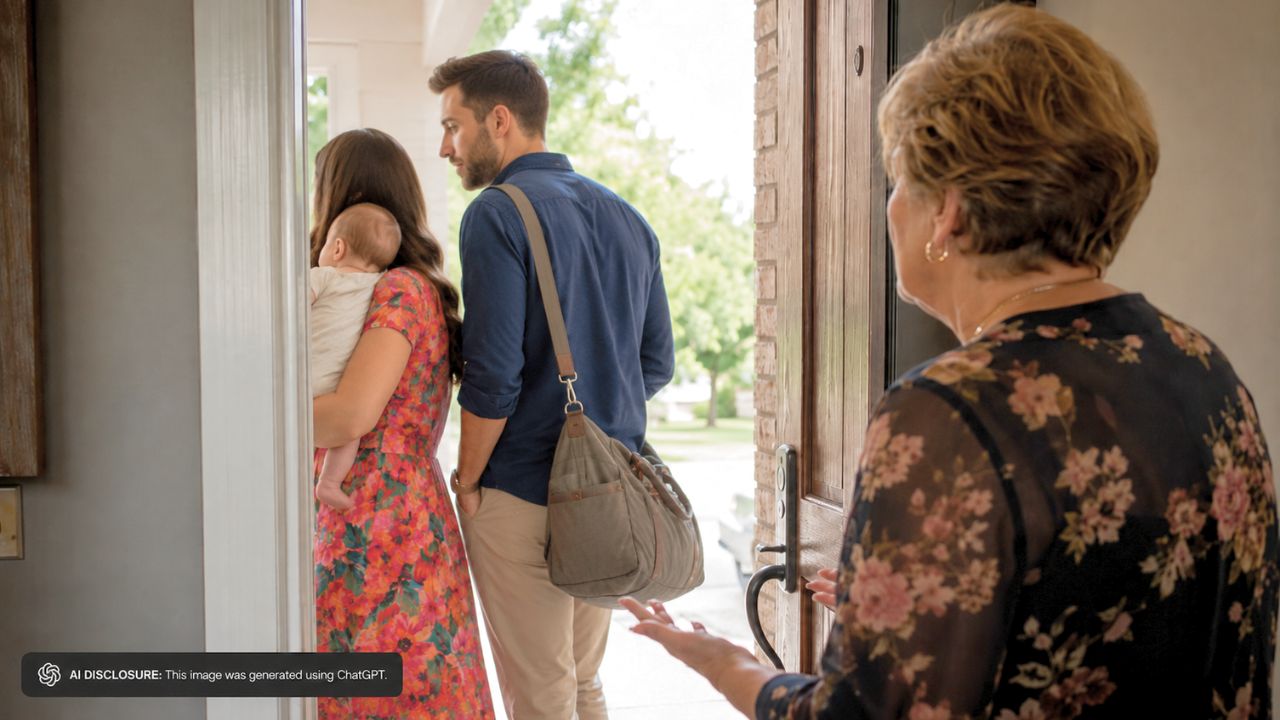
Photo credit: AI-generated image created using ChatGPT.
There’s a certain kind of family member who can walk into any room—wedding, funeral, holiday dinner, hospital waiting area—and somehow make the moment about them. Not by accident. By instinct. And if nobody ever checks that behavior, it doesn’t mellow with age. It hardens.
A young wife recently laid out a situation like this in the original post: a mother-in-law who’s been inconsistent and volatile for her son’s entire life, then expected front-row access to his new baby. The couple tried to include her anyway. After months of disrespect, criticism, and blowups, the wife finally shut the door and said no more.
If you’re a husband and father reading this, you already know the pressure points. You want peace. You want family to be family. You want your mom to be better than she’s been. But you also have a wife and a child who depend on you to lead with clarity, not nostalgia.
A lifetime of making it about her
The husband’s background matters here, because it’s not a one-off misunderstanding. According to the account, his mother wasn’t very present through his childhood. She married multiple times, traveled often for work, and moved two hours away when he was in seventh grade, leaving him primarily raised by his great-grandparents.
Those great-grandparents, the ones who actually did the steady work of raising him, both died within the last year. That kind of loss has a way of sharpening everything else. It also exposes the ugly reality: the people who show up late to the job often want the benefits of the title without the cost of the responsibility.
The examples the wife gave weren’t subtle. The mother-in-law reportedly made the couple’s short-notice wedding about her scheduling stress, and she cussed out the pregnant wife the day before the baby shower over wrinkled tablecloths—even though she volunteered to plan it. The worst detail is that two years earlier, during a vacation, she punched her own son in the face.
That’s not “strong personality.” That’s disorder and aggression. When physical violence shows up in a family story, everyone should stop pretending the usual etiquette rules still apply.
The couple tried to include her anyway
Even with the history, the couple still attempted what a lot of decent people try: give her a path to be involved, and hope the responsibility brings out something better. After their son was born, the mother-in-law asked to pick the baby up from full-time childcare (provided by the wife’s mother) a few days a week and bring him to their house before the parents got home from work.
That’s not a small thing to allow. It’s not just “visiting the baby.” It’s transportation, keys, time alone, and daily influence in your home. A couple doesn’t agree to that unless they’re genuinely trying to make space and extend trust.
For about three months, the arrangement ran, and the problems piled up. The wife described long naps that wrecked the baby’s schedule, the garage door left open for hours, messes left behind, and repeated comments criticizing their parenting choices.
It’s easy for an outsider to focus on the garage door or toys on the floor. But the bigger issue is the pattern: “I’ll do what I want, and you’ll be grateful.” That’s how boundary problems start. That’s also how they get worse.
Control tends to hide behind “help”
Criticism is rarely just criticism. It’s often a bid for authority. In the wife’s telling, the mother-in-law nitpicked hygiene (“you didn’t wipe him well enough”), blamed the parents for diaper rash, and attacked their feeding choices. Those remarks don’t sound like a concerned grandma trying to learn the parents’ system. They sound like someone auditioning to be the real decision-maker.
Then came religion. The couple had been clear they weren’t raising their child religious, yet the mother-in-law played Christian music for him while she had him and told the parents they were bad for not raising him with faith.
As a Christian man, I’ll say this plainly: you don’t smuggle “faith” into a house like contraband and call it discipleship. If your witness requires deception and disrespect, it’s not witness—it’s control dressed up in church clothes. Real spiritual leadership starts with humility, truth, and honoring the authority structures God already put in place, including the mother and father of that child.
Thanksgiving: the moment the mask slipped
Family gatherings have a way of forcing issues into the open. At Thanksgiving, in front of relatives, the mother-in-law kept commenting on the parents’ choices and bragged that she let the baby sleep as long as she wanted when she had him. That brag matters, because it wasn’t just careless. It was a public announcement that she didn’t intend to follow their rules.
The wife finally responded, pointing out the lack of respect for their home and boundaries. The mother-in-law reacted by yelling and threatening to never pick the child up again—something the parents hadn’t demanded in the first place.
This is a familiar move: “If I can’t do it my way, I’m taking my ball and going home.” It’s meant to put the parents back in a fearful, appeasing posture. Instead, the wife called it for what it was and ended the access.
When the family enables it, the problem spreads
After the cutoff, the mother-in-law’s parents reportedly sided with her and painted the wife as the villain. Their line was basically, “That’s just how she is.” That sentence has wrecked more families than money problems. It’s the anthem of people who’d rather manage dysfunction than confront it.
Even worse, the wife said her mother-in-law’s mother blamed the husband’s great-grandmother—the woman who raised him and had recently died—for the mother-in-law’s behavior. That’s a harsh deflection, especially considering the great-grandmother was the one who did the hard work when the mother didn’t.
The wife also pointed out a glaring inconsistency: the family has kept the husband’s biological father’s side away for years due to “behavior issues,” yet they excuse everything the mother-in-law does. Families often have two standards—one for the person they fear, and another for the person they can scapegoat.
At some point, you have to name the system. One difficult person can do damage, but a whole group of enablers can make it permanent.
A father’s job is to protect his home, not manage everyone’s feelings
The wife asked whether she was wrong for keeping her son away from the mother-in-law and the enabling relatives until there’s a genuine apology and a clear plan to respect boundaries. From a plain, practical standpoint, that’s not some dramatic power play. That’s parenting.
If someone has a history of violence (like punching the husband in the face), you don’t hand them unsupervised access to your child and hope it goes fine. If someone routinely disregards your rules, criticizes you, and uses faith as a weapon, you don’t negotiate your child’s stability for the sake of “keeping the peace.” Peace at that price is just quiet chaos.
This is also where a husband needs to be steady. His first loyalty is to his wife and child. Honoring your mother doesn’t mean letting her run your household, and it certainly doesn’t mean letting her bully your wife. A man can be respectful and firm at the same time, and if he can’t, his family will pay for his hesitation.
What “a plan moving forward” should actually look like
The wife isn’t demanding perfection. She’s asking for an apology and a plan. That’s reasonable, but only if “plan” means something concrete. Not “I’m sorry you feel that way,” and not “I’ll try.” It means acknowledging specific behavior: the yelling, the undermining, the disrespect, the religious manipulation, the refusal to follow the parents’ routine.
A real plan also means clear terms: visits that are supervised at first, no childcare pickups, no alone time, and no criticizing the parents in front of the child or extended family. If religion is going to be discussed, it needs to be done honestly and with permission, not by sneaking content into the child’s day and calling the parents bad.
And if the grandparents and other relatives want access too, they can stop excusing the behavior. If their best offer is “that’s just how she is,” then they’ve already told you they won’t protect your marriage or your child. You don’t need to argue with that. You just need to believe them.
A family can heal, but it can’t heal on denial. If someone wants relationship, they can show repentance the old-fashioned way: changed behavior over time. Until then, a mother and father have every right to shut the door, lock it, and focus on raising their son in a home that isn’t ruled by someone else’s tantrums.
Read more from Thrive Girly:
- Mother-in-Law Expected to Sleep Over After Every Visit — Then the Mom Said Overnight Stays Were No Longer an Option
- Relatives Showed Up to the Wedding Without Being Invited — Then the Couple Refused to Find Them Seats
- Grandma Buckled the Baby Into Her Car and Left Without Telling Anyone — Then the Mom Made Sure It Never Happened Again