Her Sister Tricked Her Into Showing Up to the Wedding Without Her Boyfriend — Then She Caused a Scene About It
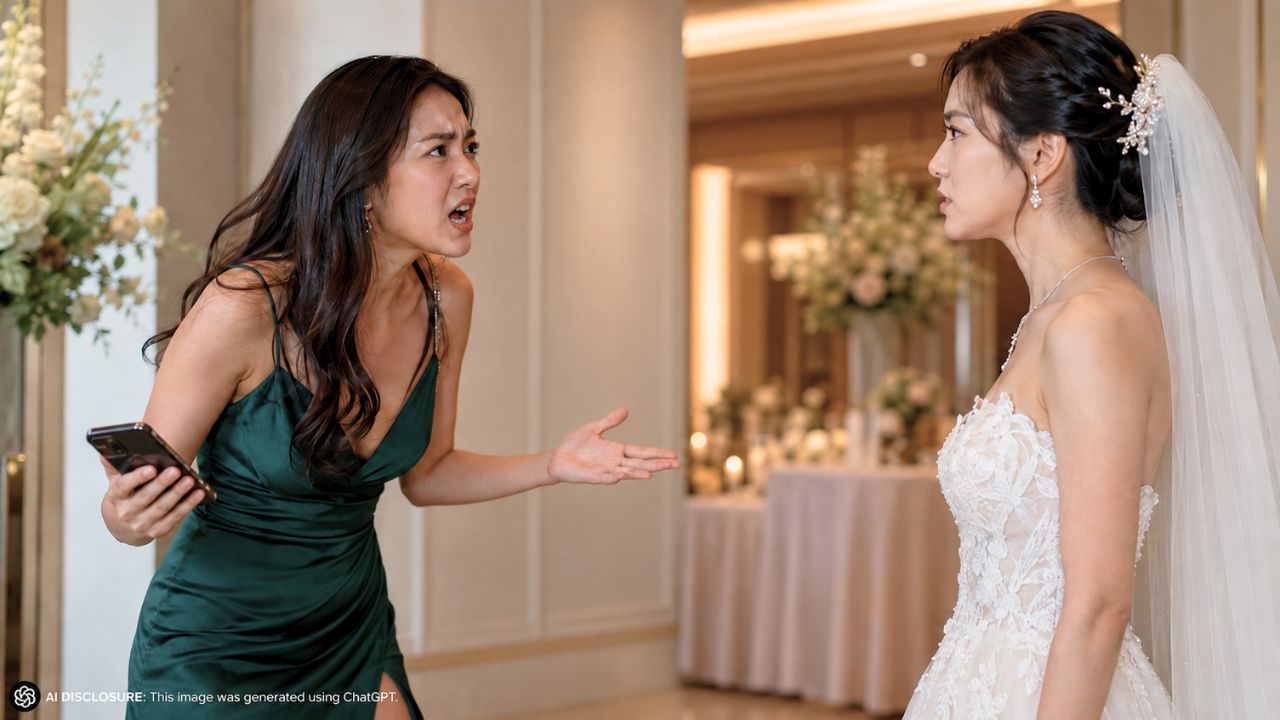
Photo credit: AI-generated image created using ChatGPT.
Weddings have a way of turning grown adults into nervous middle-schoolers. Everybody’s watching, everybody’s measuring, and a single slight—real or imagined—can feel like it’s happening on a stage. In the original post, a 30-year-old woman showed up to her older sister’s wedding alone because the invitation said no plus-ones unless you were engaged or married.
She’d been with her boyfriend Ryan for five years. They weren’t engaged, but they were serious enough that she was quietly pregnant and planning to keep the baby. She tried to talk to her sister about making an exception and got shut down. Ryan, trying to keep the peace, told her to go without him.
Then she walked into the reception and saw other guests who weren’t engaged or married sitting there with dates anyway. She confronted her sister, it got loud, family gathered around, and in the heat of the argument she blurted out that Ryan was the father of her child—effectively announcing her pregnancy. She left, and later the family blamed her for causing a scene and “ruining” the wedding, while she demanded an apology for Ryan before she’d apologize for anything.
It wasn’t about a plus-one, and everybody knows it
On paper, this is a seating chart problem. In real life, it’s a respect problem. If the rule had been applied evenly—no ring, no bring—she might’ve been disappointed, but she could’ve lived with it. What set her off was watching the rule flex for other people while her long-term boyfriend was treated like a stranger.
That kind of selective enforcement sends a message, whether the bride meant it or not. It says, “Some relationships count here, and yours doesn’t.” People can argue etiquette all day, but families don’t run on etiquette. They run on honor, honesty, and the basic courtesy of telling the truth.
The sister’s move was either cowardly or calculated
The bride told her sister the rule was firm. Then the wedding day revealed it wasn’t. There are a few possibilities, and none of them are great. Maybe she didn’t want Ryan there specifically. Maybe she didn’t like him, or maybe she didn’t like what he represents—an unmarried relationship that’s lasted longer than some marriages.
Or maybe she was trying to control the “look” of her wedding and decided this couple didn’t fit it. Sometimes families get weird about optics and start playing pretend, as if a ceremony can erase uncomfortable realities. Whatever her reason, the mistake wasn’t having a preference. The mistake was using a fake “rule” to avoid a hard conversation.
A grown woman can say, “I don’t want him there,” and accept the consequences. What she can’t do without fallout is claim it’s a universal policy while quietly making exceptions for everyone else.
Public confrontations feel satisfying for five seconds, then cost you for five years
The younger sister’s anger makes sense. A long-term partner being excluded hits a nerve because it’s not just about him; it’s about her place in the family. But walking up to the bride mid-wedding and “loudly demanding” an explanation was the moment the wheels came off.
A wedding is one of the few days where there’s a clear social contract: you don’t hijack it. Not because the couple is royalty, but because there’s no clean way to resolve conflict in that setting. There’s only escalation, embarrassment, and people picking sides while wearing formal clothes.
If you’re the one who was wronged, a public blow-up still tends to paint you as the problem. It’s unfair, but it’s predictable. The better move would’ve been to leave quietly, or even sit through the night with a tight jaw and deal with it later. Not because the bride deserved protection, but because your own dignity is worth protecting too.
The pregnancy reveal turned a valid complaint into a family spectacle
Dropping “he’s the father of my child” in the middle of a wedding argument is like tossing gasoline on a fire and then being shocked by the heat. It may have been an emotional slip, but it changed the entire scene. Now it wasn’t simply a question of fairness and respect; it was a surprise pregnancy announcement, delivered in the worst possible packaging.
That’s why the family’s reaction came down so hard. Some of them likely cared less about the plus-one dispute and more about the fact that a wedding became the backdrop for a different major life event. Even people who would’ve sympathized with her complaint might shut down once it looks like she’s competing for attention.
To be clear, she didn’t “indirectly announce” her pregnancy. She announced it. She didn’t stand on a chair and toast herself, but she put it on the table in front of witnesses, and she did it during someone else’s ceremony. That’s a hard thing to walk back.
Ryan’s response is the posture of a man trying to keep peace
Ryan told her to go without him, and later said she should’ve stayed quiet or left. That sounds like a man who understands something a lot of people learn late: you don’t win a family war by throwing the first punch at a wedding. He also said he didn’t want to be the reason her relationship with her sister and family gets ruined.
There’s something honorable in that restraint. There’s also a danger in it if it becomes a habit of letting disrespect slide forever. A good man doesn’t demand to be the center of attention, but he also shouldn’t be treated like a disposable accessory—especially if he’s about to become a father.
If he and his girlfriend are building a family, they’re going to need a shared spine. Not a loud one. Not a dramatic one. Just a steady one that says, “We’ll be respectful, but we won’t be played.”
Apologies are needed, but they’re not identical
The bride and groom expecting an apology for “ruining everything” is partly understandable. A public argument at your wedding is a nightmare. But if the bride did intentionally exclude Ryan while letting other boyfriends in, she doesn’t get to act like she’s the only injured party.
The younger sister also owes an apology, even if she was provoked. Not for being hurt, and not for wanting her partner treated with basic decency, but for the time and place she chose and for turning the volume up until everyone was involved. If she values her relationships, she should own that without adding a “but you started it” speech.
At the same time, the older sister should be pressed—calmly and privately—to explain why the rule didn’t apply to everyone. If she wanted Ryan excluded, she should say so plainly. If it was a misunderstanding or last-minute changes, she should admit the communication was handled poorly and apologize for the disrespect it caused.
What a healthier next conversation looks like
If this family wants a path forward, somebody has to stop treating the wedding day like the only thing that matters. A baby is coming. That child is going to have an aunt, grandparents, and a father who’ll remember exactly how he was treated while everybody argued about centerpieces.
The next conversation should happen off the group text and away from an audience. It should sound less like a trial and more like adults trying to rebuild trust: “You said no plus-ones, but others brought boyfriends. Why was Ryan excluded?” Then, “I shouldn’t have confronted you like that at the wedding. I’m sorry for making a scene and for revealing the pregnancy the way I did.”
From there, boundaries get set. If the family can’t respect the father of the child, they don’t get automatic access to the child. That’s not revenge. That’s stewardship. You protect the peace of your home because your home is where real life happens, long after the wedding photos are printed.
Some families learn honesty the hard way. This one may be in that season now, and it won’t be fixed with a forced apology and a fake smile. But if both sisters can admit what they did wrong—one for the exclusion and deception, the other for the public explosion—they can still move forward with a little humility and a lot more clarity.
Read more from Thrive Girly:
- Mother-in-Law Expected to Sleep Over After Every Visit — Then the Mom Said Overnight Stays Were No Longer an Option
- Relatives Showed Up to the Wedding Without Being Invited — Then the Couple Refused to Find Them Seats
- Grandma Buckled the Baby Into Her Car and Left Without Telling Anyone — Then the Mom Made Sure It Never Happened Again