Her Parents Secretly Bought Two Grandkids a PS5 and Called Everyone Else Selfish for Being Upset — Then She Called It Out at Christmas
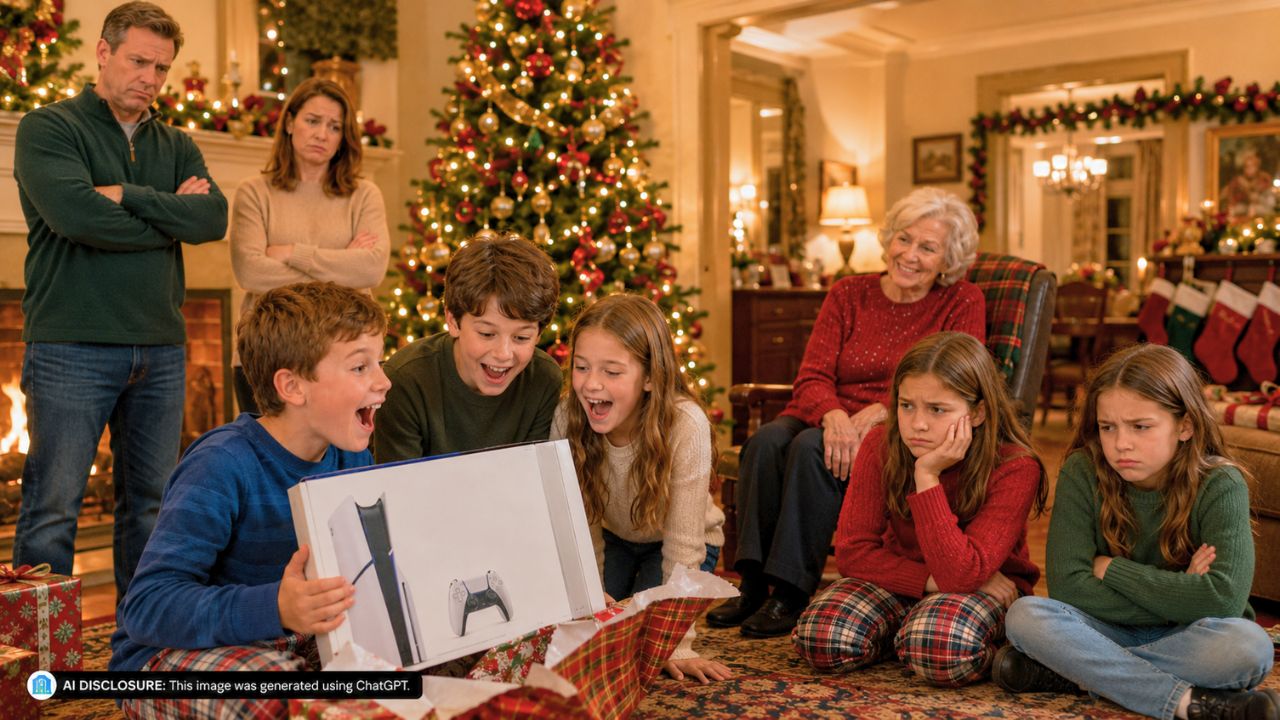
Photo credit: AI-generated image created using ChatGPT.
There’s a special kind of tension that shows up when family mixes big money, kids, and a holiday living room full of witnesses. Everybody’s trying to be generous, everybody’s trying to keep the peace, and somehow the one thing nobody wants to talk about is the thing sitting right in the middle of the floor.
In the original post, a 40-year-old mom described a Christmas dinner at her parents’ house where gifts were being handed out to nine grandchildren. Two nieces, Monica and Jill, opened a large box and found a PlayStation 5—framed as a shared present from the grandparents plus the girls’ parents. Other kids got upset, the adults tried to explain the math behind it, and the night ended with an argument and one family leaving early.
The mother who left didn’t just think the optics were bad. She believed it confirmed an old pattern of favoritism toward those two girls—extra money for trips and extracurriculars, while other siblings had struggled to afford activities for their own kids. Her parents insisted they hadn’t spent more than they spent on the other grandchildren and claimed they would’ve helped with any big purchase if asked.
A PS5 isn’t just a present in a room full of kids
Adults like to tell themselves kids don’t notice “the details.” They do. They might not understand household budgets, joint purchases, or how grandparents coordinate with parents, but they understand the scoreboard: who got the biggest thing, who got the shiny thing, who got the thing everyone talks about.
A PS5 in a big box is a statement, even if nobody means it that way. If you hand it to two kids in front of seven other grandkids, you’re not just giving a gift—you’re setting a pecking order in the minds of children who will absolutely compare. It’s not sinful for a family to pool money for a larger item, but it is naïve to pretend it won’t land differently than “two or three presents like everyone else.”
The grandparents’ explanation makes sense on paper, but families don’t live on paper
The grandparents tried to explain that they simply redirected what they would’ve spent on the girls toward the console, and the girls’ parents paid the remaining portion. They also said the girls had already expressed interest in sharing one. In a clean, spreadsheet world, that’s reasonable.
But families aren’t spreadsheets, and Christmas isn’t a finance meeting. The mom’s pushback wasn’t only about the dollar amount; it was about the public presentation. If the goal was fairness, doing it in a way that predictably stirs envy in the other kids is a strange strategy, especially when the adults know the wider family history and sensitivities.
Favoritism rarely starts with a console
The mother’s edit is the part that changes the temperature of the story. She says there were other instances: Monica and Jill receiving money for extracurricular trips and similar costs, while she and a brother had previously struggled to pay for their own kids’ activities. She says the grandparents would encourage the kids not to quit hobbies but wouldn’t offer financial help, and that they also stayed quiet when a parent was struggling to buy a gift a child really wanted.
If that pattern is accurate, then the PS5 wasn’t an isolated mistake; it was another brick in a wall that had already been built. And that’s how favoritism works in real life. It’s rarely announced with a trumpet. It shows up as “little helps” here and there, selective generosity, and excuses that sound logical to the giver while everyone else is watching the same thing happen again.
Grandparents are allowed to bless whoever they want, and no adult child is entitled to their money. But they’re not entitled to the family’s trust, either. If they repeatedly invest in some grandkids while watching others quietly go without, they shouldn’t be shocked when resentment takes root.
Calling it out in front of everyone: brave or combustible?
There’s a part of most men that respects a person who refuses to play pretend. Nobody likes the slow poison of unspoken family politics, where everyone smiles while tallying up slights. The mom believed she was advocating for her kids, and she also believed the moment needed to be named out loud because it was happening out loud.
Still, there’s a difference between telling the truth and lighting the fuse. Calling grandparents out in front of the full family—while kids are already upset and emotions are high—almost guarantees collateral damage. It’s not just the grandparents who get confronted; every child in the room gets pulled into an adult dispute they aren’t equipped to carry.
The result in this case was predictable: other kids reportedly believed her claim of favoritism, and now some children don’t want to go to the grandparents’ house. New Year’s plans were affected, and babysitting plans were apparently part of the fallout. When a confrontation happens publicly, it rarely stays neatly aimed at the target.
Adults can’t outsource their discomfort to the kids
One of the messiest parts here is that the kids are now making decisions based on adult interpretations. If a child doesn’t want to visit grandparents because they feel “less loved,” that’s not just a tantrum; that’s a wound forming. But it’s also a situation the adults helped create—either by repeated favoritism or by turning Christmas morning into a courtroom.
Parents have to be careful not to recruit their kids into adult grievances. It’s tempting, especially when you feel your children have been slighted. But kids don’t need to carry the full narrative of “Grammy and Pops love your cousins more.” They need steady love at home and parents who handle conflict with backbone and restraint.
If grandparents truly are playing favorites, the goal should be to correct the behavior while protecting the kids from becoming pawns. That usually means hard conversations away from the gift pile, not speeches over wrapping paper.
If you’re the grandparents, you can fix this without groveling
If you’re the older couple in this story, the best move isn’t to defend your accounting. The best move is to listen for the pattern being alleged and address that. Even if you believe you’ve been fair, you can still acknowledge that your choices have communicated something painful to other grandkids.
There’s also a simple leadership principle here: if you want to do a joint big gift for two kids, don’t make it a spectacle among nine. Drop it off at their house, or give each household gifts privately. And if you intend to help with big purchases for other grandkids, don’t make every family beg for it. Quietly ask your adult kids what’s going on in their homes and where you can responsibly support, then be consistent.
Generosity without wisdom can create division. Stewardship means thinking not only about what you give, but what your giving teaches.
If you’re the parent who blew the whistle, don’t confuse volume with clarity
If you’re the mom in the story, you might be right about favoritism, and you might be right that your parents’ explanation didn’t pass the smell test. But you still have to choose what kind of leader you want to be in your own home. Leaving in the middle of the holiday and turning the moment into a family referendum may feel satisfying, but it can also hand your kids a new anxiety: that family gatherings are landmines.
A better next step is a direct, private conversation with your parents where you name specific examples and request specific changes. Not “stop favoring them,” but “stop paying for their trips unless you’re willing to offer comparable help to the others,” or “if you’re doing a joint gift, don’t present it in front of all the kids.” You can also ask for honesty: “Are you helping my sister more because you think she needs it, or because you prefer her family?” That question is uncomfortable, but it’s clean.
And while you’re advocating for your kids, keep your footing. You can teach your children gratitude without teaching them to accept unfairness. You can teach them contentment without telling them to ignore what their eyes can plainly see.
Families don’t fall apart over a game console; they fall apart over years of small decisions that communicate partiality, plus one or two blowups that put the rot on display. If this family wants to get through the next holiday without repeating the same fight, the adults will have to do the unglamorous work: honest conversation, consistent generosity, and a willingness to admit that “we didn’t mean it that way” doesn’t change how it landed.
Read more from Thrive Girly:
- Mother-in-Law Expected to Sleep Over After Every Visit — Then the Mom Said Overnight Stays Were No Longer an Option
- Relatives Showed Up to the Wedding Without Being Invited — Then the Couple Refused to Find Them Seats
- Grandma Buckled the Baby Into Her Car and Left Without Telling Anyone — Then the Mom Made Sure It Never Happened Again