Her MIL Kept Two Untrained Dogs Around the Baby Against Her Wishes — Then She Told Her No More Unsupervised Visits
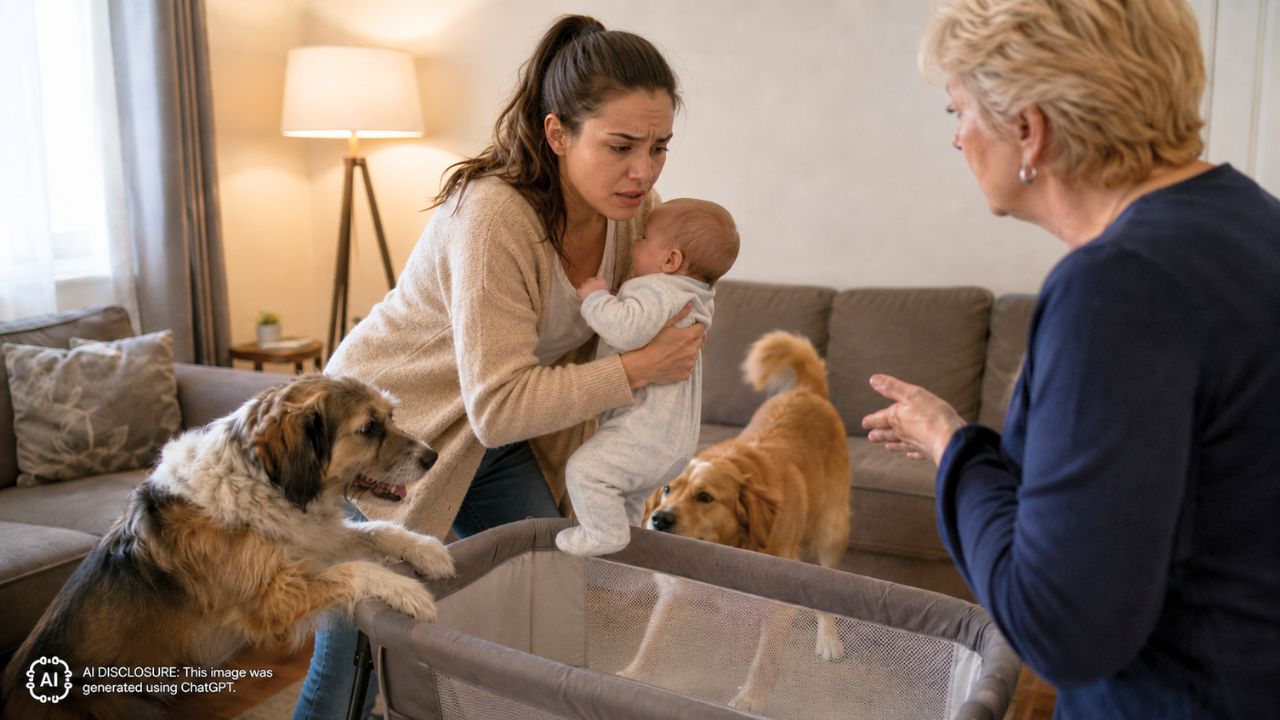
Photo credit: AI-generated image created using ChatGPT.
Every family has its friction points, but nothing exposes them like a new baby and a set of “simple” rules. A mother asked for one boundary: keep two large, untrained dogs away from her one-year-old during visits. Her mother-in-law agreed—then ignored it, and acted like the baby not getting hurt was proof nothing was wrong.
The details are laid out in the original post. The mom says her MIL has a pattern of pushing limits, but this one wasn’t negotiable. She believes dogs shouldn’t be left alone with small children, and she asked for a baby gate to keep the dogs out of the play area, or else visits would need to happen at the parents’ home.
What she walked into after an overnight visit would make any parent’s stomach drop: no gate, no MIL in sight, and the dogs alone with the toddler. When confronted, the MIL brushed it off with “well he wasn’t bit, was he?” and admitted she’d been letting the child pull tails and fur while the dogs “growl and snap,” insisting they “haven’t actually got him.” The mom responded by ending unsupervised time with grandma, and that’s when the bigger family pressure rolled in.
A boundary wasn’t the problem—disrespect was
This wasn’t a vague preference like “no sugar after 6” or “please don’t buy noisy toys.” The request was direct: keep the dogs physically separated from a one-year-old in the play space. The MIL didn’t misunderstand; she objected at the start, saying it was the dogs’ home and they weren’t used to being gated out of rooms.
That’s the moment you learn what kind of “agreement” you’re dealing with. Some people hear a boundary and translate it as a suggestion they can negotiate later through guilt, eye-rolls, or “you’re being dramatic.” The issue wasn’t merely dogs; it was a grandmother deciding she gets to overrule a parent’s safety call because she doesn’t like being told no.
“He wasn’t bit” is how preventable tragedies begin
There’s a particular kind of foolishness that shows up in family arguments: judging risk only by whether something bad has happened yet. “He wasn’t bit” is like saying, “The seatbelt wasn’t needed because we didn’t crash.” That logic works perfectly right up until the day it doesn’t, and then everybody’s apologizing over consequences that can’t be reversed.
What makes this worse is the MIL’s own description of what’s been happening: the child pulling tails and fur, the dogs growling and snapping. Those aren’t cute stories. Even if you love dogs, even if you’ve always had dogs, a growl and snap around a toddler isn’t a fun personality quirk—it’s a warning.
The mom didn’t demand the dogs be rehomed or banned from the house. She asked for separation with a gate, which is a basic, practical solution. Ignoring that and leaving a toddler alone in a room with two large dogs isn’t a “difference in parenting styles.” It’s a lapse in judgment that tells you supervision can’t be assumed.
Grandparents don’t get “rights” that outrank parents
After the mom set the new rule—supervised visits only—the MIL escalated. She texted that the mother had no right to put limits on her time with the child. Then she threatened to seek court-ordered visits, invoking “grandparent rights.”
Legal details vary by place, and the mom believes the threat won’t go anywhere. Still, the threat itself matters because it reveals the posture: not “I messed up, I’m sorry, I’ll do better,” but “I’ll use the system to get what I want.” Once someone starts talking like that, you’re no longer dealing with a misunderstanding. You’re dealing with a power play.
A grandparent can be a gift, and a wise parent will make room for that relationship. But “gift” is the key word—freely given, not demanded. A grandmother doesn’t become a third parent by emotional force, cultural pressure, or sheer stubbornness.
Cultural pressure isn’t a trump card over safety
The mom says some family members told her she was in the wrong, and that in their Hispanic culture “Abuela has more say than mom,” implying she “agreed” to that by marrying into the family and having a baby. That kind of statement can sound noble—respect elders, value family—but it gets ugly when it’s used to silence a mother about safety.
Healthy culture is never an excuse for preventable harm. Respecting your elders doesn’t mean handing them the steering wheel when they’ve shown they won’t follow the rules. If anything, strong families work because roles are clear: parents carry responsibility, and with responsibility comes authority to set limits.
If the family wants to frame it in cultural terms, there’s another angle: honor. A grandmother who wants honor should also honor the parents. Undermining a mother and then threatening court isn’t “tradition.” It’s pride dressed up as tradition.
The husband “staying out of it” isn’t neutral
One detail that should bother every married man: the husband told his crying mother he “wasn’t getting involved” and that the women should “sort it out.” Later he said he’d go with whatever his wife decided, even though he felt it was “excessive & mean.” That sounds like peacekeeping, but it’s actually abandonment wearing a polite face.
A man doesn’t get to opt out when his wife and his mother are in conflict over his child. He’s the bridge between households, and he has a first responsibility to the family he built. “Staying out of it” forces his wife to carry the heat alone, and it sends a quiet message to his mother that she can keep pushing because her son won’t confront her.
Backing your wife doesn’t require being disrespectful to your mother. It requires clarity: “Mom, we set this rule. You broke it. Visits will be supervised until trust is rebuilt.” That’s not cruelty; that’s fatherhood. If a man can’t say that sentence, he’s not avoiding drama—he’s farming it out to his wife and letting it grow.
Supervised visits aren’t revenge; they’re accountability
Some people hear “supervised visits only” and assume it’s punishment. It’s not. It’s a consequence tied directly to the behavior: if you’ve shown you can’t be trusted to follow safety rules when nobody’s watching, then someone needs to watch.
The MIL wanted overnight visits and babysitting privileges, but those aren’t entitlements. They’re earned by proven judgment and basic respect. And in this situation, the MIL didn’t just make a small mistake—she dismissed the concern, minimized the risk, and admitted behavior (growling and snapping) that most adults would immediately correct.
If the goal is a restored relationship, supervised time can be the ramp back to trust. But it only works if the grandmother stops arguing and starts cooperating. An apology would help, but changed behavior is what matters.
This is also where simple, concrete rules matter. “Dogs gated away from the play area at all times” is clearer than “please be careful.” “No unsupervised time until we agree you’ll follow the rules” is clearer than “we’ll see.” People who push boundaries thrive in vagueness.
The calm way to hold the line
If you’re the parent in this position, the temptation is to keep re-litigating the argument. You’ll want the other person to finally understand why you’re right. But a person who says “he wasn’t bit” after leaving a toddler alone with snapping dogs isn’t lacking information; they’re lacking humility.
The steadier approach is to keep the message short and repeatable: “This is the rule. It’s not up for debate. If you want time with him, it will be supervised.” You don’t need a courtroom speech in the living room. You need consistency, and you need your spouse to stop playing referee and start being a parent alongside you.
Family peace is a good thing, but not the fake peace that’s purchased by letting someone else endanger your kid. A grandmother can be deeply loved and still told “no.” In fact, the kindest thing a family can do for someone acting recklessly is to remove the opportunity to keep doing it.
There are seasons in marriage and parenting where you find out what you’re made of. This one isn’t about winning an argument; it’s about a child who can’t protect himself. A parent who draws a firm line there isn’t being excessive—they’re being responsible.
Read more from Thrive Girly:
- Mother-in-Law Expected to Sleep Over After Every Visit — Then the Mom Said Overnight Stays Were No Longer an Option
- Relatives Showed Up to the Wedding Without Being Invited — Then the Couple Refused to Find Them Seats
- Grandma Buckled the Baby Into Her Car and Left Without Telling Anyone — Then the Mom Made Sure It Never Happened Again