Half-Sister Ran the Estate and Challenged Whether Three of Them Were Even Their Father’s Children — Then the Court Ruled They All Inherit
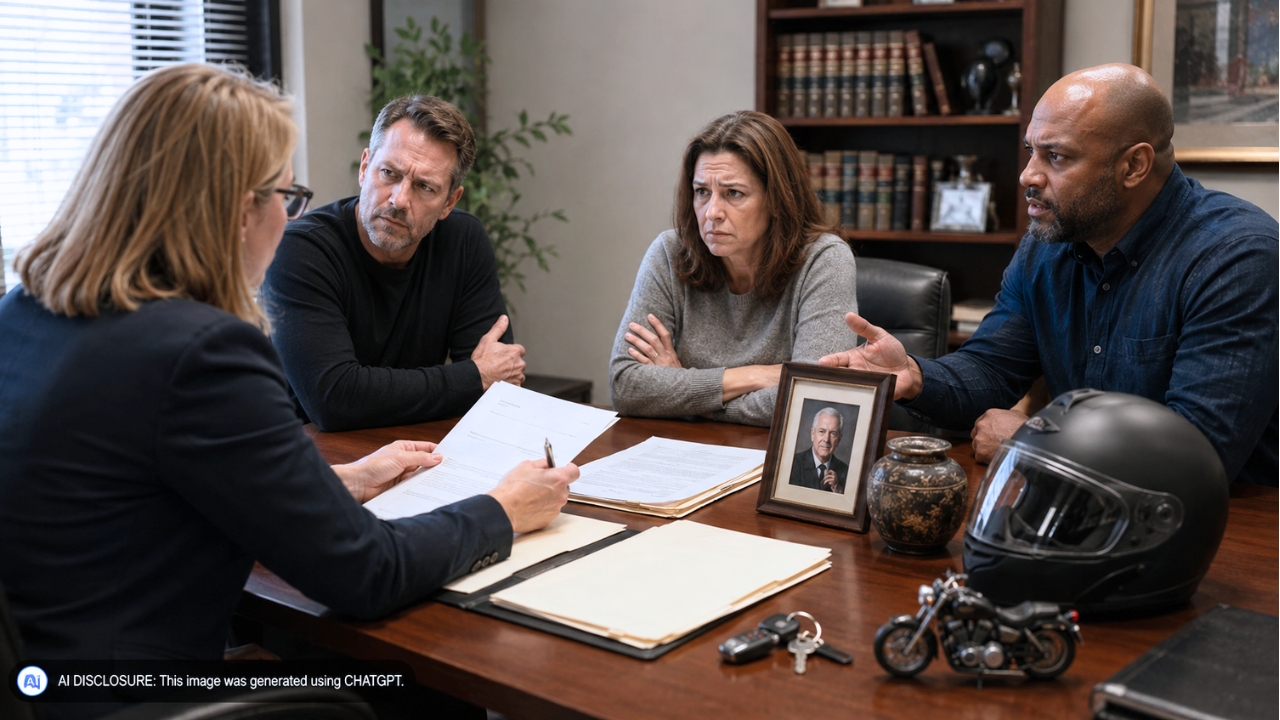
Photo credit: AI-generated image created using ChatGPT. Illustrative only.
Estate fights have a way of taking whatever grief is already in the room and turning it into suspicion, scorekeeping, and old grudges with fresh energy. One person starts handling the paperwork, another person starts taking stuff “for safekeeping,” and before long everybody’s questioning everybody’s motives. In Delaware, one family’s dispute over vehicles, trailers, and who counts as a child of the deceased ended up in the Court of Chancery.
The case, In the Matter of the Estate of Joseph L. Weddington, Jr., reads like a caution sign for any family trying to navigate an intestate death—meaning no valid will. A half-sister serving as administrator pushed to claw back property she’d already distributed, and she also challenged whether three siblings were even the decedent’s children. The court told her to unwind the property distributions, but it also ruled the three respondents proved they were heirs. The decision is laid out in the source material.
What’s striking isn’t just the legal outcome. It’s how quickly “family” can become “opposing parties” once money, titles, and pride get involved, especially when the person at the center of it all isn’t around to set the record straight.
A father died without a will, and everyone showed up with a story
Joseph L. Weddington, Jr.—known as “Jody” in the record—died intestate on March 26, 2021. The court described him warmly through witness testimony: kind, sweet, and generally well-liked. That matters because, in cases like this, people aren’t only fighting over property; they’re fighting over the meaning of a relationship.
Teresa Robinson, the petitioner, acted as the estate’s administrator. She and the respondents—Danielle Whitaker, Jone Posey, and Paul Whitaker—each claimed to be Weddington’s children. The decedent had several children with different partners, and the family tree was already complicated before anyone filed a single motion.
The respondents were among nine children born to Doreen Whitaker while she was married to Fred Whitaker, Jr. The respondents’ birth certificates listed Fred Whitaker, Jr. as their father. The respondents, though, testified those certificates were intentionally inaccurate, claiming Weddington was their biological father and Fred’s name was used so the family could receive military benefits.
How the estate was opened—and how it started to unravel
At the beginning, it looked cooperative. On May 26, 2021, Robinson and Christopher Whitaker petitioned to open the estate, listing the respondents as Weddington’s children and providing their contact information. With renunciations from several purported heirs, the Register of Wills issued letters appointing Robinson and Christopher Whitaker as co-personal representatives.
Then the practical stuff started happening—some of it too soon. The court found Robinson distributed various estate assets early in the administration, including a set of high-value personal property items to the respondents. Those included vehicles (like a 1998 Chevrolet pickup truck and a 2015 Chevrolet Trax), a 1970 Harley-Davidson motorcycle with accessories, trailers, an outdoor shed, and equipment like a power washer and air compressor. In the court record, these were labeled the “Challenged Items.”
Later, relationships soured. By November 2022, the court noted, Robinson began questioning whether the respondents were Weddington’s children at all. And once that question lands on the table, every earlier choice gets reinterpreted—every gift feels like theft, every request feels like a threat.
The court’s straightforward message: you can’t distribute first and figure out debts later
The primary issue before the court wasn’t actually paternity at first. It was whether the respondents had to return the Challenged Items so they could be sold to pay estate debts. The court’s answer was yes, and the reasoning was basic estate administration: the personal representative is supposed to collect assets, pay debts and expenses, and only then distribute what’s left.
The court found Robinson’s early distribution was improper and had to be unwound. The respondents were ordered to return the Challenged Items within 30 days of the final report. The court also noted that personal representatives who distribute voluntarily do it at their own risk, and can even become personally liable if things go sideways—even if they acted in good faith.
Still, the court didn’t let the respondents off the hook morally. It said they were wrong to refuse to return the assets upon request. In plain terms, both sides helped turn a fixable administrative mess into a multi-year court fight.
No “extra punishment” for either side: no cost-shifting, no speculative damages
Robinson didn’t just want the items back. She also sought declarations that the respondents weren’t entitled to reimbursement for retitling costs, that they should be responsible for any diminution in value, and she pursued damages if items were no longer in their possession. She also sought court approval to sell estate assets to pay debts.
The court declined to shift costs tied to the return of the Challenged Items and refused to order repayment for diminution in value. The reasoning was practical: neither side came with clean hands, and the record didn’t show the items had been materially damaged or reduced in value. Courts don’t generally hand out hypothetical relief just because people are angry and want the other side to feel it.
That’s a hard lesson for families: litigation feels like the place to get “justice” for every frustration, but judges are often focused on what can be proven and what actually fixes the estate’s administration. Not every grievance gets a check attached to it.
The paternity fight didn’t go away, so the court addressed it
Even though the return of property could be handled without deciding who was a child, the court said it would be “a disservice” to leave the paternity question unresolved. The administrator believed the respondents weren’t heirs, and the respondents asserted they were. That uncertainty affects distributions, accounting, and the long tail of resentment that can last for generations.
Because Weddington died without a valid will, Delaware intestate succession applied. The court explained that when there’s no surviving spouse, the intestate share passes to the decedent’s “issue” (children, and their descendants) under 12 Del. C. § 503. And under 12 Del. C. § 508, paternity for estate purposes can be established by a preponderance of the evidence—more likely than not.
The court credited the respondents’ evidence: testimony about the decedent living with them for years, his involvement in their lives, photographs reflecting multiple generations, and corroboration from extended family and neighbors. Notably, the court also considered testimony from Fred Whitaker’s sister, who said she understood her brother was the biological father of only four of Doreen Whitaker’s children, and that the rest—including the respondents—were fathered by Weddington.
Birth certificates mattered, but they weren’t the final word
Robinson leaned heavily on the respondents’ birth certificates listing another man as father. The court didn’t ignore that, but it also said birth certificates aren’t dispositive in this context. The court pointed to prior Delaware Chancery precedent where parentage was found by a preponderance of the evidence despite a conflicting birth certificate.
Here, the respondents offered a consistent explanation for why Fred Whitaker, Jr. was listed as their father, and they presented multiple witnesses who treated Weddington as their father for decades. One respondent, Paul Whitaker, even moved in with the decedent near the end of his life and helped care for him, according to the court record. Taken together, the court found the respondents met the “more likely than not” standard and should be treated as rightful heirs.
The court also denied, on procedural grounds, the respondents’ request for DNA testing of all alleged siblings, without prejudice to renewing it properly in an appropriate forum. That’s another courtroom reality: even if an idea sounds reasonable at the kitchen table, it still has to be requested the right way in the right place.
What the administrator has to do next
The final report directed the respondents to return specific items to the estate, care of Robinson. At the same time, Robinson’s objection to the respondents’ beneficiary status was overruled. The court ordered her to ensure the respondents are included in the estate and to continue administering the estate consistent with Delaware law.
In other words: she could be right about needing the property back, and still be wrong about who gets to inherit. That combination happens more than people expect, especially in families where history is messy and paperwork doesn’t match the way people actually lived.
There’s no neat bow on a dispute like this. The court did what courts do: it tried to put the property back where it legally belongs, pay the estate’s debts, and identify the heirs based on the evidence. The rest—apologies that won’t come, trust that won’t rebuild overnight, and the temptation to keep fighting—will be up to the family.
Read more from Thrive Girly:
- Mother-in-Law Expected to Sleep Over After Every Visit — Then the Mom Said Overnight Stays Were No Longer an Option
- Relatives Showed Up to the Wedding Without Being Invited — Then the Couple Refused to Find Them Seats
- Grandma Buckled the Baby Into Her Car and Left Without Telling Anyone — Then the Mom Made Sure It Never Happened Again