Grandmother Spread a Fraud Rumor About Her for 25 Years — Then She Finally Shut It Down
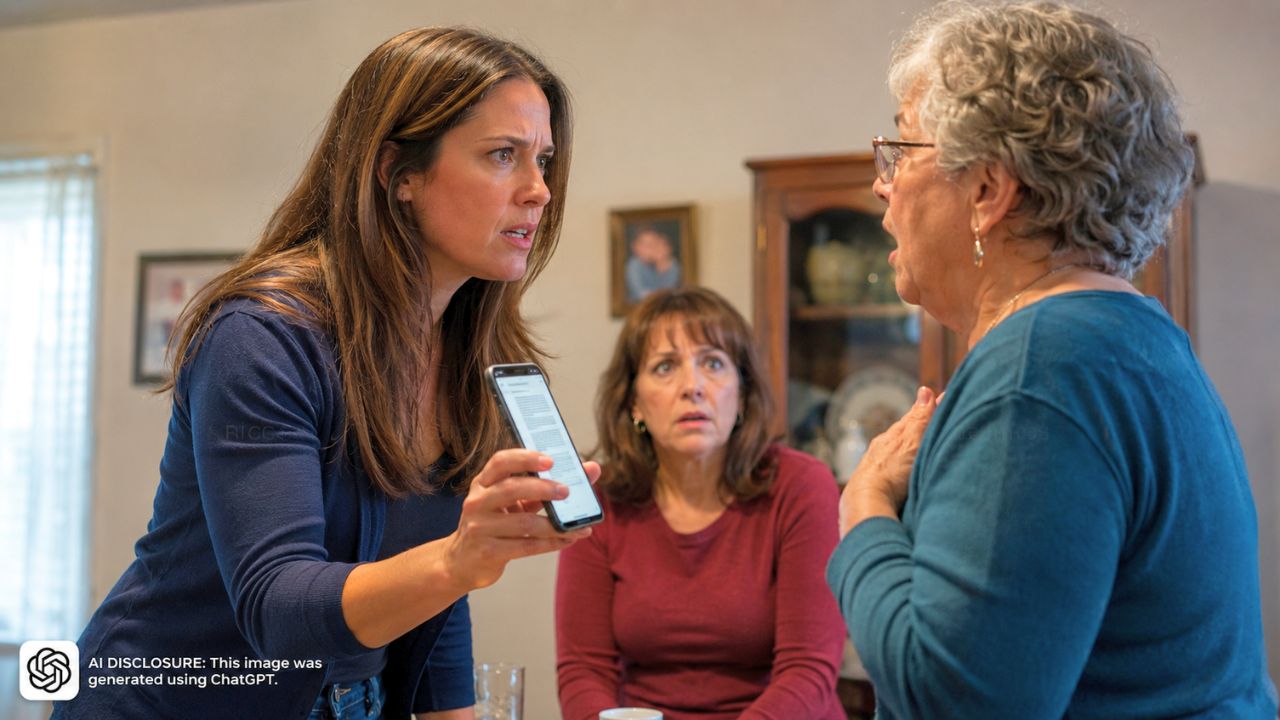
Photo credit: AI-generated image created using ChatGPT.
Some families don’t fight with fists. They fight with stories. A label gets slapped on you when you’re young, and the thing spreads quietly through holidays, phone calls, and “just checking in” conversations until it becomes the default explanation for why you’re kept at arm’s length.
That’s the ache running through the original post, where a 42-year-old woman realized a rumor her grandmother started when she was 18 never actually died. For nearly 25 years, the family carried an accusation that she helped her mother defraud her grandmother by opening a bill in the grandmother’s name. She thought it was cleared up back then. It wasn’t.
And if you’ve lived long enough, you know how this goes. People will smile, praise your life, compliment your character, and still keep one old charge in their back pocket like it’s responsible to “stay cautious.” It’s a cruel way to treat somebody, especially your own.
A misunderstanding that should’ve ended in five minutes
The original blow-up started with a piece of mail and a simple abbreviation. At 18, she was living with her grandmother after a falling out at her mother’s home. Her mother was moving and needed utilities set up, using her daughter’s name because the daughter would eventually live there again.
The paperwork was mailed to the grandmother’s address and labeled “Her Name C/O Grandmother’s Name.” The grandmother saw “C/O” and interpreted it as “co-owner,” not “care of.” The woman says she tried to explain immediately: the account wasn’t in her grandmother’s name, and the grandmother’s name was only part of the address line. Her grandmother wasn’t interested in hearing it and stayed angry for years.
That part matters because it shows how small the spark was. A basic misunderstanding, maybe mixed with suspicion and pride, turned into something that should’ve been corrected with one calm conversation and an apology. Instead, it hardened.
The long shadow of a family rumor
Decades later, during a visit prompted by her daughter’s high school graduation, the grandmother praised her and then added a sting: “even though you and your mother did what y’all did behind my back.” That sentence told her the accusation never left. It also explained a lot about why the wider family relationship always felt off.
She called her stepmother to see whether the rumor had traveled. It had. The stepmother said she initially believed it too, though over time she realized the woman didn’t seem like someone who would defraud anyone, especially family. Her father, she was told, was the only one who defended her from the start.
That’s what rumors do: they don’t just accuse you of one act. They rewrite your biography. Suddenly you’re not “the cousin who moved away” or “the niece who’s busy.” You’re “the one who did that thing,” and people feel justified treating you as a permanent question mark.
Why this kind of thing hits so hard
She described four days of spiraling after learning the truth: crying, not eating, barely sleeping, and trying to hold herself together through her daughter’s graduation party. That detail is easy to skim past, but it’s the heart of it. It’s not only the original accusation that hurts. It’s the years of social distance and quiet exclusion suddenly getting an explanation.
A man can relate to that even if the details differ. You think you’re just dealing with normal family drift, or your own imperfections, or the fact that life gets busy. Then you find out there was a story running behind your back for years, shaping how people saw you. That’s not small. That’s a theft of relational ground you never knew you lost.
She also spoke to cousins who knew about the accusation but never believed it. That helps, but it doesn’t erase the fact that others apparently did believe it, and no one thought she deserved a fair, direct conversation. Silence can be its own form of agreement.
The confrontation: clearing your name without burning the house down
After learning the rumor still got repeated, she decided to confront her grandmother to end it for good. She says she wasn’t disrespectful at first, but she was emotional, pleading again that she would never do that to her grandmother. The grandmother reportedly denied saying it at all, then shifted blame to the woman’s mother, then circled back to the original accusation.
At some point, the woman raised her voice and “unloaded,” describing what the rumor had done to her and the ripple effects in the family. The grandmother claimed she had “the bill” to prove it, but when asked to produce it, she shut that down. The discussion kept looping: denial, blame-shifting, and the same question—how did the mother get the information if the daughter didn’t provide it?
This is where a lot of us get stuck. We want the conversation to behave like a courtroom: evidence, facts, admission, closure. But family conflict often behaves like pride: it circles and protects itself. When someone’s been wrong for 25 years, the idea of saying, “I misunderstood, and I hurt you,” can feel impossible for them to swallow.
Elderly relatives don’t get a free pass to rewrite reality
She left the conversation feeling terrible because her grandmother is elderly, and she didn’t want to hurt her. That’s an honorable instinct. Respect for elders is part of maturity, and for a lot of believers it’s also spiritual obedience in plain clothes.
But age isn’t a permission slip for ongoing accusation. It doesn’t sanctify manipulation, and it doesn’t make dishonesty harmless. If anything, the closer someone gets to the end of life, the more urgent it is to deal cleanly with the truth. An old person can be wrong. An old person can be stubborn. An old person can also be called to repentance, gently but clearly.
There’s also a practical side: if a grandmother repeats a damaging rumor long enough, it becomes a family tradition. It can shape how younger cousins learn to treat one another. A matriarch’s words carry weight, and that means her careless words carry weight too.
Distance isn’t revenge; sometimes it’s stewardship
After the blow-up, she asked whether she’d be wrong to keep her distance for good. She said she never wants to feel that way again, and she doesn’t want to keep being accused and manipulated. In an edit, she said she planned to keep distance from her grandmother and anyone else who insists on believing the worst about her.
That sounds less like revenge and more like stewardship. You’re allowed to protect your home, your peace, and your integrity. If a relationship requires you to accept a false accusation as the price of admission, it isn’t really a relationship—it’s a place you go to be diminished.
Distance can be temporary or permanent, loud or quiet, depending on what wisdom calls for. It can look like shorter visits, visits with a witness, refusing to discuss the topic again, or stepping away from events where you’ll be treated like a suspect. The point isn’t to punish. The point is to stop feeding a machine that runs on your humiliation.
What a decent family member should’ve done
One of the most revealing details is that the rumor apparently spread, and many people accepted it without proof. If a family wants to act like family, somebody has to be willing to say, “Hold on. Do we know this is true?” Somebody has to pick up the phone and ask the hard question directly, not as an interrogation but as a chance for clarity.
Her father defending her stands out because it’s so basic and yet so rare: loyalty paired with judgment. He didn’t defend wrongdoing. He defended his child’s character because the accusation didn’t fit. That’s what leadership looks like inside a family—especially from the men. If we won’t do that work, then the loudest, most suspicious voice in the room gets to define reality.
And if you’ve ever let a rumor drift because “it’s not my business,” it’s worth thinking about. Passivity has a body count in families, just not the kind you can tally.
The woman walked out of the house after telling her grandmother she loved her, even while her grandmother protested and wanted a hug. It’s a brutal moment, but it also sounds like a line finally drawn. You can love someone and still refuse the story they’re trying to staple to your name.
Read more from Thrive Girly:
- Mother-in-Law Expected to Sleep Over After Every Visit — Then the Mom Said Overnight Stays Were No Longer an Option
- Relatives Showed Up to the Wedding Without Being Invited — Then the Couple Refused to Find Them Seats
- Grandma Buckled the Baby Into Her Car and Left Without Telling Anyone — Then the Mom Made Sure It Never Happened Again