Her In-Laws Kept Showing Up Unannounced the Moment She Got Off Work — Then She Told Her Husband His Parents Were Being Rude
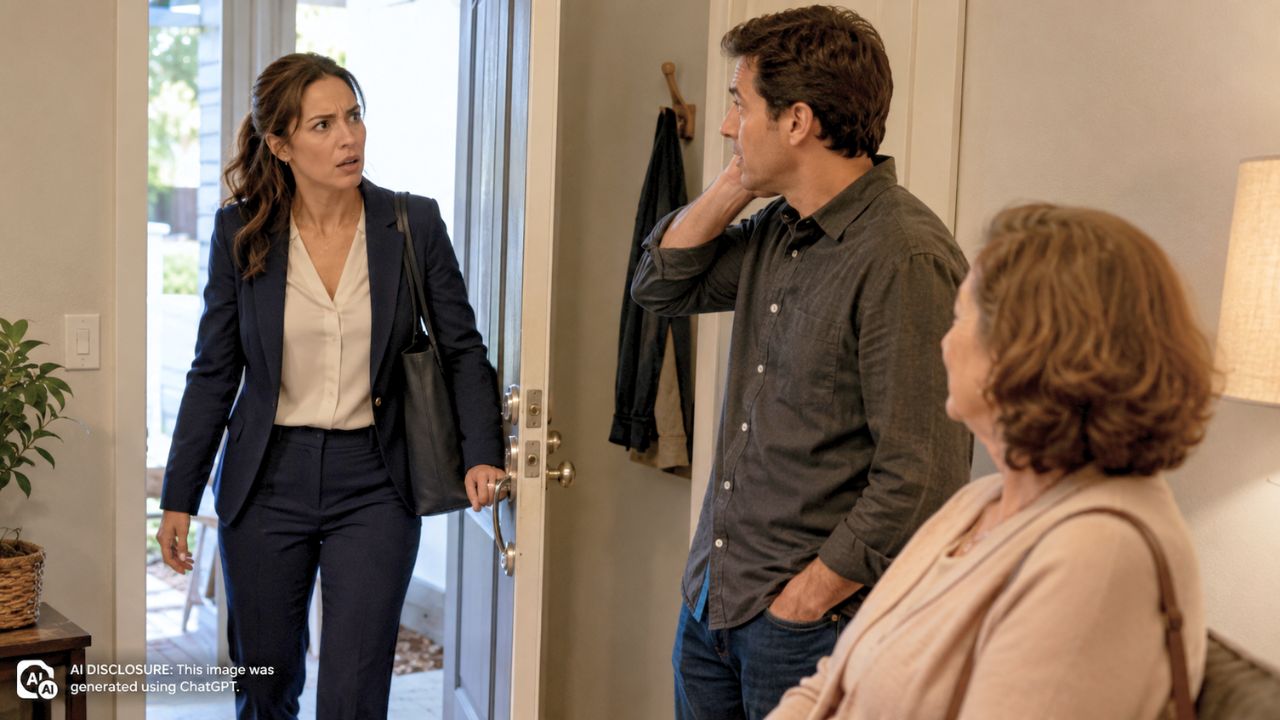
Photo credit: AI-generated image created using ChatGPT.
There’s a particular kind of exhaustion that hits when you close the laptop after a long workday, walk toward the shower, and realize you’re still not “off.” Not because your boss is calling, but because someone has decided your home is a public lobby the moment the clock hits quitting time.
A woman described exactly that in the original post: she works from home and repeatedly deals with her in-laws showing up unannounced, sometimes during her workday and sometimes immediately after she gets off at 5:30 p.m. On the day in question, she’d had a brutal day and jumped in the shower, only to hear her dogs going wild because someone was on the porch. When she and her husband checked, her in-laws were sitting outside, peering in the windows, having rung the doorbell, banged on the door, and even yelled at the dogs—without any heads-up.
She told her father-in-law they needed to call or text before showing up, especially since this had already been said several times. His response was a half-acknowledgment—“I guess I could have called”—followed by, “don’t blow a gasket.” She shut the door and didn’t let them in, and her husband agreed it was rude not to call.
Unannounced visits aren’t “family time,” they’re boundary problems
Some families operate with a wide-open-door mentality, and if everyone genuinely agrees to it, fine. But “we’re family” isn’t a magic phrase that cancels basic courtesy, especially when someone is working from home and running a household. Dropping by without warning turns the homeowner into the bad guy for not being available, and that’s backwards.
There’s a difference between closeness and entitlement. Closeness is welcomed; entitlement is assumed. If you’re showing up repeatedly after being asked to call first, you’re not being spontaneous—you’re ignoring a reasonable request because you don’t like it.
Work-from-home doesn’t mean “open for visitors”
Plenty of people still treat work-from-home like it’s halfway between employment and a casual day off. But being physically at home doesn’t mean you’re mentally free, emotionally present, or dressed for company. It also doesn’t mean you can pivot from spreadsheets to hosting like you’ve been waiting for guests.
The woman in the story wasn’t lounging; she was coming off a long day and trying to take a shower. That’s a normal human routine, not a sign that she’s available to entertain. If someone doesn’t respect the difference between “home” and “available,” they’re going to keep stepping on toes until somebody finally pushes back.
Peering in windows and banging on doors isn’t normal behavior
It’s one thing to stop by and realize nobody’s answering, then leave a quick text and head out. It’s another thing entirely to ring the bell, bang on the door, stir up the dogs, and sit on the porch looking through windows while you wait. Even if the intent isn’t sinister, the behavior is intrusive.
A home is supposed to be a place where you can breathe. When people feel comfortable pressing their face to the glass because they think you “should” answer, that’s not closeness—it’s a lack of respect for privacy. And if the dogs are protective, it’s also a good way to create unnecessary chaos and stress for everyone involved.
The father-in-law’s comment was a power move
“I guess I could have called” is not an apology; it’s a shrug. And “don’t blow a gasket” isn’t peacemaking—it’s a jab meant to reframe her perfectly reasonable boundary as emotional overreaction. It’s the kind of comment that tries to put a woman back in her place without directly saying, “We’ll do what we want.”
Men do this more than we like to admit: we minimize, tease, or needle as a way to avoid accountability. The problem is, it escalates conflict because it communicates contempt. If you want to keep a relationship healthy, you don’t respond to a clear request with sarcasm and tone-policing.
Her husband did something right, but he can’t stay on the sidelines
It matters that the husband agreed it was rude not to call. A lot of marriages get strained because a spouse won’t back their partner when their own family is out of line. In this case, he at least validated the issue, and that’s not nothing.
But agreement in the moment isn’t the same as leadership over time. If this has been happening “several times” and the boundary has been stated “several times” and still ignored, then the next step can’t be left to the wife to enforce alone. His parents are his responsibility to manage, and if he doesn’t take point, she becomes the perpetual gatekeeper while he stays the “nice” one. That’s a fast track to resentment.
Respectful families don’t require access to prove loyalty
A healthy extended family can handle the sentence, “Please call or text before you come over.” That’s not rejection; it’s basic order. People with good intentions might forget once, maybe twice, but they don’t make a habit of ignoring it—and they certainly don’t act offended when reminded.
Sometimes parents struggle with the shift from being the center of their adult child’s life to being part of the wider circle. They still feel like the old rules apply: they can drop in, they can inspect, they can be received. Marriage changes that. A man leaves the role of “son under authority” and becomes a husband with a household to steward. It’s not unloving to set limits; it’s part of building a stable home.
What a clean boundary looks like in real life
The practical fix here isn’t complicated, but it does require unity. The couple needs a clear policy: no unannounced visits, and no entry if someone shows up without texting or calling first. Not as punishment, but as consistency. If you cave after somebody bangs long enough, you teach them that persistence works.
It also helps to remove the emotional fog from the moment. A calm message from the husband—sent when nobody is standing on the porch—can do more than a frustrated exchange at the door. Something simple: “We love seeing you, but we need a heads-up before visits. If you come over without checking, we may not answer or we may not be able to host.” Clear, direct, respectful, and firm.
If the in-laws push back, the couple shouldn’t get sucked into a debate about feelings. The issue isn’t whether they “meant anything by it.” The issue is whether they’ll honor the home and the people who live in it. Courtesy isn’t complicated; it just requires humility.
Refusing to entertain unexpected guests after a long workday isn’t rude. It’s normal. A home needs margins, and a marriage needs a couple to protect those margins together, especially when outside family acts like access is a right instead of a privilege.
Read more from Thrive Girly:
- Mother-in-Law Expected to Sleep Over After Every Visit — Then the Mom Said Overnight Stays Were No Longer an Option
- Relatives Showed Up to the Wedding Without Being Invited — Then the Couple Refused to Find Them Seats
- Grandma Buckled the Baby Into Her Car and Left Without Telling Anyone — Then the Mom Made Sure It Never Happened Again