MIL Refused to Hand the Crying Newborn Back for Feeding — Then the New Mom Demanded the Baby Back and Got Him
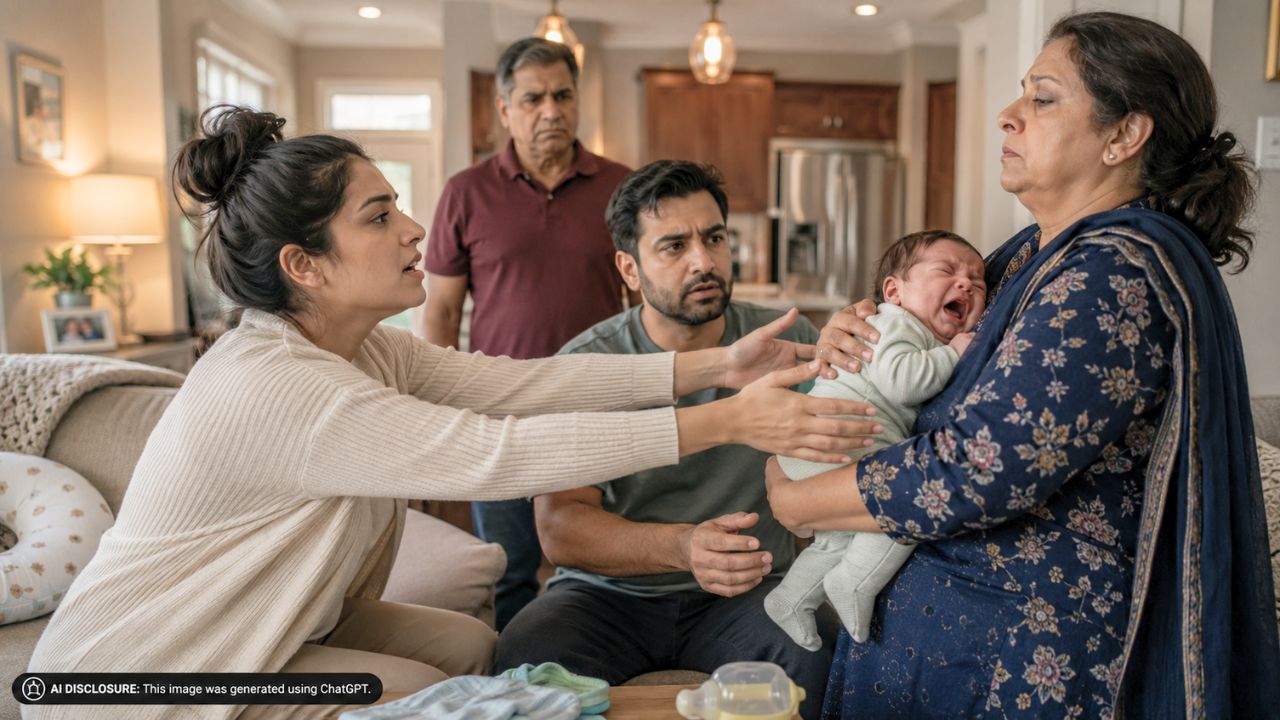
Photo credit: AI-generated image created using ChatGPT. Illustrative only.
There’s a special kind of tired that comes five weeks into new parenthood. You’re running on scraps of sleep, your house doesn’t feel like your house anymore, and every opinion within a ten-mile radius seems to have a seat at your kitchen table.
In the original post, a new mom describes that exact pressure-cooker season while her husband’s parents are staying with them. Her mother-in-law has developed a pattern: she takes the newborn, holds him for long stretches, and then refuses to hand him back when it’s time for feeding. The baby cries, the mom asks, and the grandmother turns it into a power struggle where Mom has to “beg” for her own child.
One night around 10 p.m., the baby started crying while the grandmother held him on the couch with the husband and father-in-law nearby. The mom asked for her son so she could feed him, the grandmother refused, and the husband piled on—calling his wife “whiny,” accusing her of using feeding as an excuse, and insisting she ask his mother nicely. The mom finally snapped, demanded the baby back, and got him—then watched her husband go comfort his mother while he later yelled at his wife for being disrespectful.
A newborn isn’t a family trophy, and hunger isn’t up for debate
A five-week-old baby needing to eat every couple hours isn’t a preference or a negotiable schedule. It’s basic care, and it’s not something a grandparent gets to “grant” after they’ve had their fill of cuddles. When a baby cries and Mom says, “I need to feed him,” the correct response is to hand the baby over, no speeches required.
Plenty of grandparents are loving and helpful, and plenty of new moms appreciate an extra set of hands. But help has a posture to it: it strengthens the parents instead of competing with them. The moment a grandmother turns feeding time into a test of loyalty, she’s no longer supporting the family—she’s trying to run it.
The real problem wasn’t the tone; it was the pattern
Yes, the mom admits she spoke sharply. She called her mother-in-law annoying and overbearing, and that landed like a slap in the room. But it didn’t come out of a calm conversation that suddenly went sideways; it came after repeated refusal to return a crying baby and a husband who acted like his wife needed to earn permission to mother her own child.
If you only evaluate the final sentence, you’ll miss the months of small cuts that led there. Exhaustion doesn’t make a person righteous, but it does make pretense harder. When someone has been pushing your boundaries day after day—especially around your newborn—eventually you stop performing politeness and start defending what’s yours to steward.
Her husband chose his mother’s comfort over his wife’s dignity
The husband’s role here is the part that should make a man sit back and think. While his baby cried and his wife asked to feed him, he criticized her, accused her motives, and tried to force her to “ask nicely” as if she were a child seeking a favor. Then, after the baby was finally handed over, he went to comfort his mother and returned to yell at his wife for making her cry.
A man can love his mother and still understand that his home has a new order now. Marriage means you leave and cleave—your first loyalty is to your wife and the family you’re building together. That doesn’t require being rude to your parents; it requires being clear with them. If your mother is overstepping, you don’t let your exhausted postpartum wife fight that battle alone while you sit on the couch grading her attitude.
“He’s not an object” was a clever line used for the wrong purpose
The husband told his wife their son “isn’t an object” and she doesn’t “own” him. In a vacuum, that sentence can sound mature. In this context, it’s a deflection dressed up as principle.
The mom wasn’t treating her baby like property; she was trying to feed a crying newborn. The grandmother was treating the baby like a possession—something to hold onto, to control access to, to use as leverage in an emotional tug-of-war. When a man uses high-minded language to shut down his wife’s basic maternal authority, he’s not protecting the baby; he’s protecting the pecking order that benefits his mother.
Grandparents can be a blessing, but only if they respect the parents
Multi-generational family life can be beautiful. It can also be a mess when boundaries are weak and everyone pretends it’s “just love” while the new parents quietly drown. A grandparent staying in the home should be asking, “How can I make this easier?” not “How much time can I get with the baby before Mom breaks?”
If a grandmother wants more baby time, the way to get it is to serve the mother. Bring her water. Make sure she eats. Offer to hold the baby after a feeding so Mom can shower or nap. The fastest way to lose trust is to block feeding, minimize Mom’s role, and then play the victim when Mom finally raises her voice.
What a steady husband should do in the moment
If you’re the husband in a situation like this, the right move is simple and immediate. When your wife says, “I need the baby to feed him,” you stand up and say, “Mom, hand him to her now.” You don’t negotiate. You don’t ask your wife to perform politeness while she’s running on fumes. You lead your household by protecting the most vulnerable people in it—your wife and your newborn.
Then you follow up when things are calm. You tell your mother you’re grateful for her love, but she is not to refuse the baby’s mother again, and she is not to make feeding time a contest. If she can’t accept that, the visit changes shape—shorter stays, a hotel, or a firm end to the trip. A man doesn’t get to outsource hard conversations to his exhausted wife and call it peacekeeping.
If you’re the new mom, firmness is not the same as cruelty
It’s worth saying plainly: you can be firm without being ugly, but firmness is not a moral failure. In that home, the mom tried repeated requests and got stonewalled. She was told to wait while her baby cried. She was insulted by her husband. Under that kind of pressure, a sharp sentence is not the core offense.
Still, once the baby is fed and everyone’s breathing again, it helps to tighten your words so you don’t hand your opponents an easy distraction. “Hand him to me now” is a complete sentence. “I’m his mother, it’s time to feed him” is calm and immovable. You don’t need to win the poetry contest—you need your baby in your arms when he needs you.
And if your husband is speaking to you with contempt—calling you names, telling you to be quiet, accusing you of loving your baby less—don’t treat that like normal marital static. That’s a serious crack in the foundation, and it won’t heal by pretending it didn’t happen.
A home with a newborn should feel like a shelter, even if it’s chaotic. In this story, the mother didn’t just demand her baby back; she demanded her role be respected. She got the baby in the moment, but the bigger question remains whether her husband will grow into the kind of man who protects his wife and child—or keep retreating to the guest room to comfort the person causing the problem.
Read more from Thrive Girly:
- Mother-in-Law Expected to Sleep Over After Every Visit — Then the Mom Said Overnight Stays Were No Longer an Option
- Relatives Showed Up to the Wedding Without Being Invited — Then the Couple Refused to Find Them Seats
- Grandma Buckled the Baby Into Her Car and Left Without Telling Anyone — Then the Mom Made Sure It Never Happened Again