Her Friend Refused to Budge on a $450 Bridesmaid Dress She Couldn’t Afford — Then She Backed Out of the Wedding Party
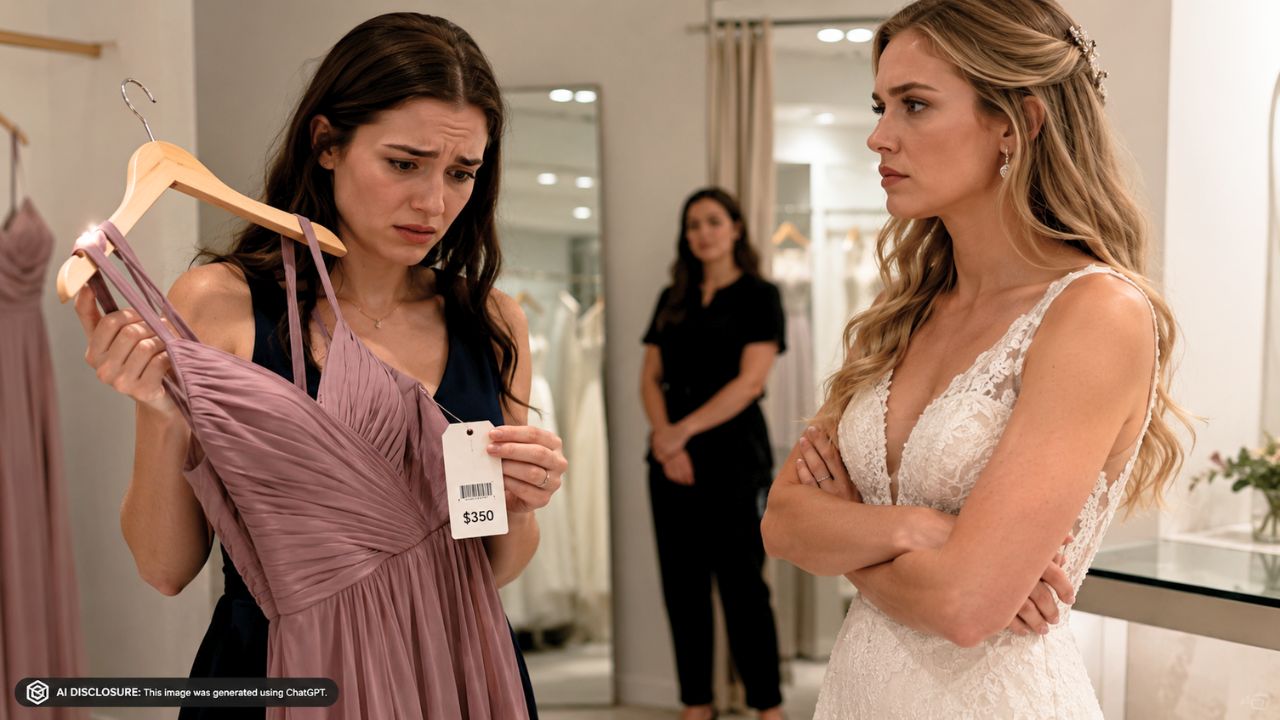
Photo credit: AI-generated image created using ChatGPT.
Weddings have a funny way of turning good people into stressed-out project managers. Everybody’s trying to keep the peace, keep the look, keep the timeline, and keep Grandma from starting a feud over seating charts. Somewhere in all of that, basic decency can get treated like an optional add-on.
In the original post, a 27-year-old woman was asked to be a bridesmaid for her friend Jenna’s wedding. She was excited until she found out the bridesmaid dress Jenna chose would run over $450 before alterations, shoes, and accessories. With a modest-paying job, student loans, and an unexpected car repair, she told the bride early that the dress was out of reach and asked if there was any flexibility.
Jenna stayed firm, saying it was the dress she’d always dreamed of. As the order deadline approached, the bridesmaid bowed out of the wedding party rather than wreck her finances, while still offering to attend, help where she could, and support the marriage. Jenna took it as betrayal, other bridesmaids started icing her out, and someone even suggested she should’ve put it on a credit card “like everyone else.”
A $450 dress isn’t just a dress
People talk about “just one day” like the bills only last 24 hours. A $450 dress is $450, and that’s before the hidden costs start lining up like groomsmen at the barbershop. Alterations, shoes, accessories, hair, makeup, travel, and whatever pre-wedding events are expected can turn one outfit into a full month of financial stress.
For someone already carrying student loans and dealing with an unexpected car repair, that kind of expense isn’t a cute inconvenience. It’s rent, groceries, debt payments, or the difference between stability and another month of digging out. There’s nothing noble about celebrating love by pressuring your friends into bad stewardship.
Dream weddings still require grown-up math
A bride is allowed to have preferences. A wedding is a real event with real costs, and aesthetics matter to people. But adults don’t get to treat their “dream” like a blank check drawn on somebody else’s bank account.
Part of maturity is learning the difference between “I love this” and “I can reasonably ask other people to fund this.” If a certain dress is non-negotiable, there are only a few honest options: the bride pays for it, the bride chooses people who can comfortably afford it, or she accepts that someone may step down. Anything else is basically saying, “My vision matters more than your wellbeing,” just with nicer fonts on the invitation.
She tried to handle it early and respectfully
The most important detail here is that she didn’t wait until the last minute and make it everybody’s problem. She told Jenna early that the dress was way out of budget and even offered solutions: paying in installments or finding a similar, more affordable option. That’s not selfishness; that’s someone trying to stay faithful to a commitment without pretending money isn’t real.
And when it became clear there was no flexibility, she made the tough call and stepped back before the order deadline. She didn’t ghost. She didn’t blow up the group chat. She offered to still attend and support the wedding in ways she could actually afford. That’s what responsibility looks like, even when it’s awkward.
The bride’s reaction says more than the price tag
Calling someone a “bad friend” because they won’t endanger their finances for your photo lineup is a rough look. It frames friendship as a financial transaction: prove you love me by spending money you don’t have. That’s not loyalty; that’s leverage.
Weddings can bring out insecurity, and it’s possible Jenna felt embarrassed or rejected. But even if emotions are high, this is where character is supposed to show up. If you’re about to make vows about sacrificial love, it’s worth practicing a little of it before the aisle, starting with the people closest to you.
“Put it on a credit card like everyone else” is how people stay broke
The line about putting it on a credit card lands like a punch because it’s so normal now. Folks talk about debt like it’s a rite of passage, like interest payments are just part of being in the group. That kind of thinking keeps people chained to payments for things they barely remember buying.
Going into debt for a bridesmaid dress is especially backward because there’s no lasting value to justify the cost. You’re not investing in education, transportation, or something that helps you earn. You’re financing a matching outfit for someone else’s event, and the bank is the only one sending thank-you notes afterward.
There’s also a quiet cruelty in the assumption that “everyone else” can absorb that hit. Maybe they can. Maybe they can’t and they’re just smiling through it. Either way, it’s not a standard to follow; it’s a warning sign that the whole group may be confusing appearances with actual health.
Friendship doesn’t require financial self-harm
Sometimes people use the word “friendship” when they mean “compliance.” A real friend doesn’t want you panicking over bills so they can have a certain shade of fabric in the ceremony. A real friend might be disappointed, sure, but they’ll also understand that obligations don’t disappear because someone else is getting married.
There’s a Christian principle sitting quietly under this: stewardship. You don’t get to be careless with what you’ve been given just to avoid somebody’s disapproval. Paying your obligations, living within your means, and refusing to take on unnecessary debt isn’t stingy; it’s disciplined.
And if the friendship can’t survive a respectful “I can’t afford that,” it probably wasn’t built on something sturdy. That’s painful to admit, but it’s better to learn it now than after years of being pressured into things you never had the budget or bandwidth for.
How this could’ve been handled without the cold shoulder
There were several exits here that didn’t require shaming anyone. Jenna could’ve kept the dress and offered to cover part of the cost for bridesmaids who needed help. She could’ve chosen a more flexible option: same color, different styles, a price cap, or a retailer with a wider range. Or she could’ve said, kindly and plainly, “I understand if you need to attend as a guest,” without turning it into a loyalty test.
On the bridesmaid’s side, stepping down before orders were placed was the cleanest move available. If there’s anything left to do, it’s a calm follow-up conversation: no arguing about who’s right, no explaining it ten different ways, just a clear statement that she cares about Jenna and can’t take on that expense. Sometimes people need a second pass to hear what you already said.
As for being iced out, that may or may not thaw. Group dynamics can get weird around weddings, and some bridesmaids will mirror the bride’s mood to stay in good standing. That doesn’t make it right, but it does explain the behavior. If this friendship is going to continue, it’ll require someone choosing maturity over momentum.
If you’re the one who can’t afford the uniform, backing out respectfully isn’t a moral failure. It’s an act of honesty in a culture that’s gotten comfortable with pretending. A wedding party is an honor, not a debt sentence, and nobody should have to choose between friendship and financial stability just to stand in a line for fifteen minutes.
Read more from Thrive Girly:
- Mother-in-Law Expected to Sleep Over After Every Visit — Then the Mom Said Overnight Stays Were No Longer an Option
- Relatives Showed Up to the Wedding Without Being Invited — Then the Couple Refused to Find Them Seats
- Grandma Buckled the Baby Into Her Car and Left Without Telling Anyone — Then the Mom Made Sure It Never Happened Again