Stepsister Caused a Scene Over Her Wedding Seating Assignment — Then the Bride Stopped Helping Her Family Out for Good
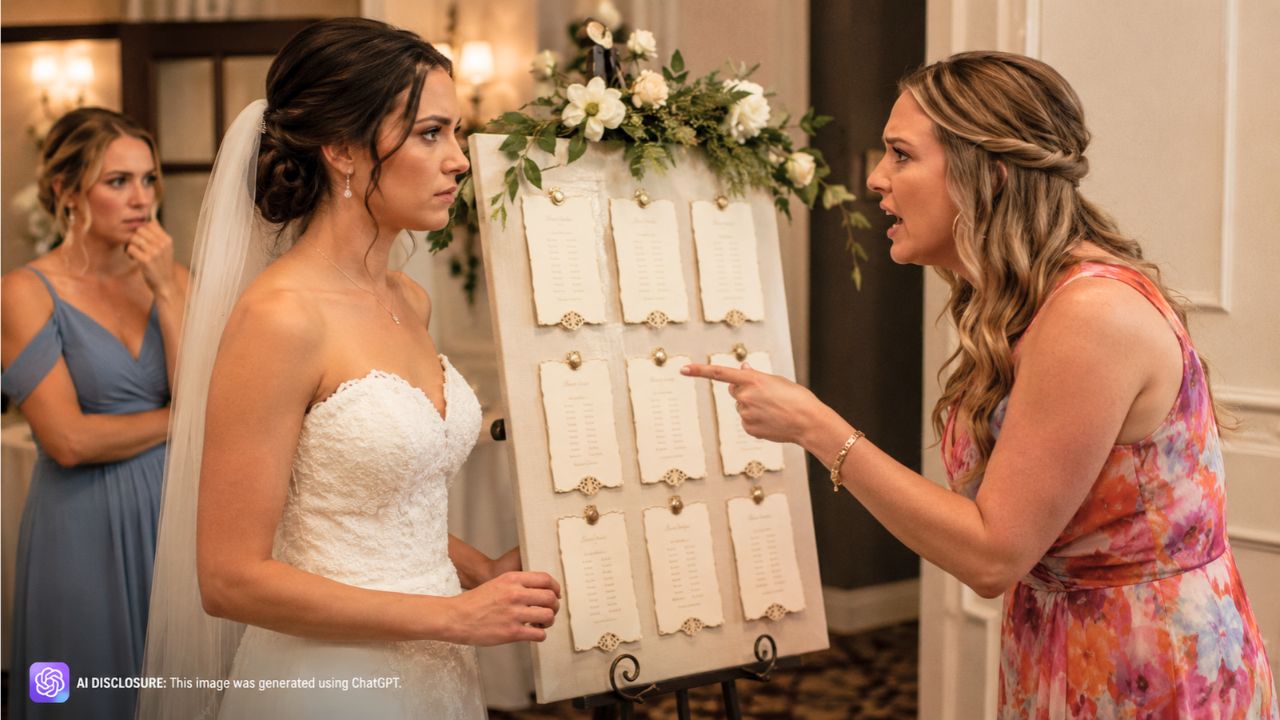
Photo credit: AI-generated image created using ChatGPT. Illustrative only.
Weddings have a way of exposing whatever a family has been politely ignoring. You can keep the peace at birthdays and cookouts for years, but put people in formal clothes, assign them seats, and ask them to act like adults for six hours, and the cracks start to show.
In the original post, a 31-year-old bride describes a day that was mostly beautiful and also needlessly chaotic. Her mom’s long-time partner has a daughter her age—a “stepsister” in the loose sense—and that woman arrived pregnant, freshly abandoned by her boyfriend, and apparently ready to make the seating chart a public referendum on her emotional state.
The bride did what most reasonable people would do: she seated the stepsister with peers—her sister, her cousin, other early-30s guests. Instead of shrugging and sitting down, the stepsister cried loudly, yelled, and stomped her feet in front of everyone. The bride, already overwhelmed and managing ADHD, told her sister privately that if the stepsister couldn’t calm down, she wanted her to leave because she felt close to breaking down herself.
A seating chart isn’t a family hierarchy
Seating plans are logistics, not theology. They’re meant to keep conversations flowing, servers moving, and awkwardness to a minimum. Placing a 30-year-old at a table with other 30-year-olds isn’t an insult; it’s normal hosting.
What the stepsister seemed to want wasn’t a different chair—it was a different status. Her reaction suggests she read the assignment as rejection, or worse, as a statement that she wasn’t “real family.” But adult life includes a basic discipline: you don’t turn your private interpretations into a public scene, especially at somebody else’s wedding.
Pregnancy and heartbreak don’t excuse bad behavior
The bride had compassion for her stepsister’s situation. She understood the woman was pregnant and had recently been left by her partner, and she tried to be considerate. Compassion, though, isn’t the same as surrendering your entire event to someone else’s emotions.
The stepsister’s father—mom’s partner—responded by getting angry at the bride and insisting she should “understand” because of the pregnancy and abandonment. Notice what he didn’t do: correct his daughter’s behavior. He treated her outburst like a weather system everyone else should adjust to, and that’s how you train a family to tiptoe around the loudest person in the room.
The worst part wasn’t the tantrum—it was the mother’s choice
Weddings are pressure cookers, but the bride describes a particular sting: her mother came to her during the wedding to criticize her handling of the situation. Not later, not quietly after the honeymoon, but during the day—when a good mother’s job is to protect the couple’s peace as much as possible.
This is where a lot of men will recognize the dynamic, even if the characters are different. You grow up learning which adult can’t be challenged, which sibling must be appeased, which partner gets prioritized, and which kid will “understand” if they’re asked to swallow one more disappointment. The bride later wondered if she’d become the person expected to absorb everyone else’s mess because she was the one most likely to keep the peace.
To her credit, she also shared an important clarification: she believes her mom loves her, and her mom has apologized. The deeper wound is that her mom struggles to stand up to her boyfriend and his daughter, and because of that, she didn’t stand up for her own child on a day that mattered.
Changing the seats fixed the optics, not the problem
The seating chart was changed in real time. The stepsister ended up sitting between her dad and the bride’s mom, and another couple had to squeeze awkwardly at the end of the table. The crisis was “solved” the way a lot of families solve things: give the disruptive person what they want so everybody can breathe again.
But this kind of solution comes with a bill. It teaches the family that emotional outbursts work. It also teaches the bride and groom that their event—and by extension their boundaries—are negotiable if someone throws a fit in public.
Later, guests told the bride they thought the stepsister’s reaction looked childish and attention-seeking. Even without those comments, you don’t need a jury to know a grown adult’s foot-stomping display at someone else’s wedding is out of line. A fragile season might explain a behavior, but it doesn’t make it acceptable.
Why the lawn-mowing detail matters
After the wedding, the conflict didn’t resolve, and it resurfaced while the bride was in a clinic for ADHD and OCD treatment. During another argument with her mom, she said—out of frustration—that her husband would no longer mow her mom’s partner’s lawn when they went on vacation, something he’d regularly done as a favor.
On paper, that sounds like a small thing. In real life, it’s a boundary with teeth. Favors are relational currency, and in families with uneven power dynamics, the “helpful” person becomes the one who silently pays to keep the peace.
Then came the part that tells you exactly what kind of system this is: the mom’s partner contacted the husband directly to ask him to do it anyway. The husband refused, and he gave a reason that should make most men nod: he recognized unhealthy patterns from his own childhood and didn’t want to tolerate or enable them.
Being cut off is sometimes a control tactic
The mom’s partner became angry, and the couple wasn’t invited for Christmas. They’re treated as if they’re no longer part of the family. That kind of response isn’t about grass or holiday schedules; it’s a message: comply, or lose access.
Now, sometimes families need distance for legitimate reasons, and it’s wise to admit we’re only hearing one side. Still, the pattern here is consistent: the boyfriend defends his daughter’s outburst, demands others accommodate her, bypasses the bride to pressure the husband, and then punishes the couple socially when they don’t fall in line.
A mature family can handle a “no” without retaliation. A controlling family treats “no” like betrayal. If you’ve ever watched a grown man sulk because he couldn’t get his way, you know how quickly “family” can become a leash instead of a refuge.
What a steady response looks like from here
The bride’s lingering question was whether she was wrong for wanting the stepsister removed and for pulling back help afterward. Her initial instinct—“calm down or leave”—wasn’t cruel; it was a reasonable attempt to keep her wedding from being hijacked. If anything, the mistake was letting the pressure of the moment and the accusations afterward convince her she’d committed some great offense.
Going forward, this couple’s best strength is unity. A husband who won’t be triangulated—who won’t be pulled into separate conversations and guilted into private compliance—is a gift to a marriage. And a wife who’s learning she can’t keep everyone happy, especially at the expense of her own home, is learning a hard but necessary kind of wisdom.
If reconciliation is possible, it will require more than an apology. It will require the mom to stop outsourcing her courage to her daughter, and it will require her partner to take responsibility for his daughter’s behavior instead of recruiting the whole room to manage it. Until then, pulling back favors and limiting access isn’t spite; it’s stewardship of a marriage, a home, and a nervous system that’s already been through enough.
Family pressure has a way of making you feel selfish for wanting basic respect. But basic respect is the minimum fee for being close, not a luxury item you earn by over-functioning. If a seating chart tantrum can trigger exile at Christmas, the problem was never the seating chart.
Read more from Thrive Girly:
- Mother-in-Law Expected to Sleep Over After Every Visit — Then the Mom Said Overnight Stays Were No Longer an Option
- Relatives Showed Up to the Wedding Without Being Invited — Then the Couple Refused to Find Them Seats
- Grandma Buckled the Baby Into Her Car and Left Without Telling Anyone — Then the Mom Made Sure It Never Happened Again