MIL Kept Pushing to Bottle-Feed the Baby She Wasn’t Allowed to Touch — Then the Mom Threatened to Go No Contact
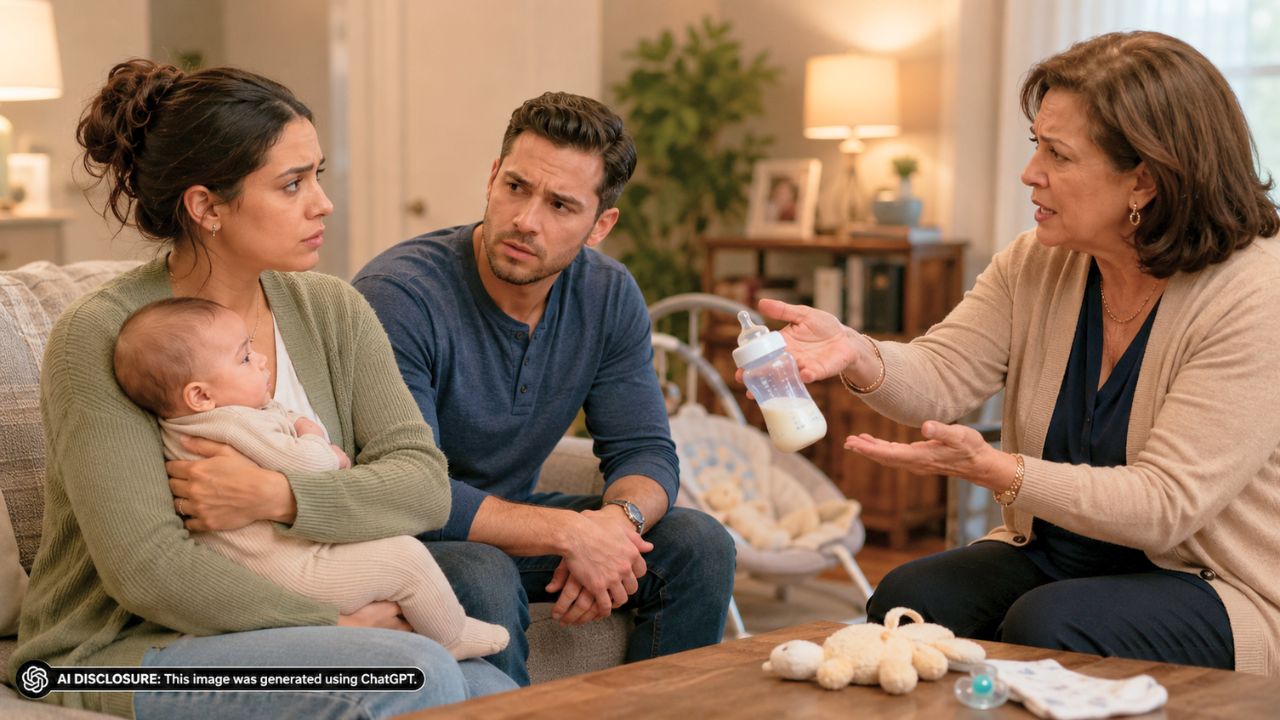
Photo credit: AI-generated image created using ChatGPT. Illustrative only.
A new baby has a way of exposing every weak seam in a family. People get sentimental, territorial, and strangely competitive over who gets to do what—especially grandparents who feel like they’ve been demoted from “parent” to “visitor” and don’t like the new job description.
In the original post, a mom of a five-month-old says her mother-in-law has visited more than 30 times and seems fixated on two tasks: changing the baby’s diaper and bottle-feeding. The parents shut down diaper changes after an uncomfortable moment where the grandmother changed the baby without permission and took longer than expected, leaving both parents uneasy. The bottle-feeding request kept coming even though the mom strictly breastfeeds and doesn’t pump because she doesn’t need to.
The latest blow-up started with an unannounced visit while dinner was being made. The mother-in-law made comments about food, suggested the mom “go pump real quick” so she could feed the baby, and the mom finally snapped—threatening no contact if it was brought up again. The husband kicked his mom out, then turned his anger on his wife, saying he was tired of being stuck in the middle and asking why she couldn’t pump “one single time” just to stop the conflict. Later, he apologized, but the distance lingered.
Unannounced visits aren’t hospitality—they’re pressure
Showing up without calling isn’t a cute “I was in the area” move when there’s a baby in the house. It’s a power play, even if the person doing it would never call it that. New parents are already juggling naps, feeding, work, basic chores, and the simple need to breathe for five minutes without an audience.
Then add the food angle: asking “what are we having?” and sulking when there isn’t a spare plate. That’s not help, and it’s not closeness. It’s a person inserting themselves into the home as if the home is still theirs, and daring the couple to correct them.
The diaper issue isn’t about minutes—it’s about consent
The mom later clarified the diaper change wasn’t a ten-minute ordeal; it was closer to a few minutes, but it involved the grandmother changing the baby without permission at a moment when the mom wasn’t right there. The grandmother also defended herself with “being thorough,” which may be true, but it didn’t address the bigger problem: she did it without being asked and after the parents had already formed instincts about what felt off.
Parents don’t need a courtroom level of proof to set rules around their infant. If something makes both mom and dad uncomfortable, that’s enough to tighten the circle. It doesn’t mean anyone is being accused of something criminal. It means the parents are acting like parents, which is their job.
And practically speaking, once a grandparent ignores a boundary, every future request gets filtered through that memory. Trust doesn’t reset just because someone insists they meant well.
Breastfeeding boundaries are real, and “just pump” isn’t a small ask
A lot of people talk about pumping like it’s pressing a button on a coffee maker. It isn’t. Pumping takes time, equipment, storage, cleaning parts, planning your day around output, and sometimes discomfort and stress. If a mom is breastfeeding successfully and doesn’t need bottles, asking her to start pumping so someone else can have a “turn” isn’t a neutral request—it’s asking her to change her system to satisfy someone else’s preference.
Grandparents sometimes frame bottle-feeding as bonding, but bonding doesn’t require a bottle. Holding the baby, reading, walking, rocking, singing, tummy time, stroller walks—those are all real connection. When a visitor insists on the one activity that requires mom’s body to cooperate on demand, it can start to feel less like love and more like control.
There’s also the simple truth that not every grandparent is safe, calm, or respectful enough to be given intimate caretaking tasks. Being family doesn’t automatically qualify someone to do whatever they want with a baby.
The real crisis is a husband stuck between two women instead of standing with his wife
The husband did one good thing in the moment: he kicked his mother out. But then he swung around and unloaded on his wife, blaming her for the tension and treating her boundary like an inconvenience. That reaction says he’s exhausted, yes, but it also says he wants the path of least resistance—and he thinks his wife should provide it by giving in.
Here’s the hard part for a lot of men: “keeping the peace” often means asking the most reasonable person to absorb the most unreasonable behavior. That’s not leadership; that’s delegation of misery. If his mother is the one pushing, manipulating, showing up uninvited, making passive comments about food, and repeatedly insisting on feeding a breastfed baby, then she’s the one who needs correcting.
Marriage is leaving and cleaving in real time, not just at the wedding. A man doesn’t stop honoring his mother, but he does stop letting her run the household. His wife and child are his first responsibility now, and that means taking the heat when his mother doesn’t like the new boundaries.
The no-contact threat: understandable, but it needs a plan behind it
The mom’s “bring it up again and I’m going no contact” line came out in anger while cooking dinner with a fussy baby and an uninvited guest. Most men can understand that moment—when you’re cornered and you go for the biggest lever you can find. The problem is that threats without a calm follow-through plan can backfire and create a whole new fight inside the marriage.
No contact is serious. Sometimes it’s necessary, but it’s not supposed to be a grenade you toss mid-argument. If the couple believes contact with the mother-in-law needs to be reduced or cut off, they should decide that together, define what behavior triggers it, and communicate it clearly when everyone is calm.
A better approach is usually a ladder: boundaries first, consequences second, and distance third. That might look like scheduled visits only, no drop-ins, no feeding requests, no diaper changes, and leaving immediately if there’s arguing or pressure. If those rules are ignored repeatedly, then distance isn’t “punishment”—it’s protection.
What this couple needs is a united script and a locked front door
The most practical fix here is also the least glamorous: the couple needs a shared script and the willingness to repeat it like a broken record. “We’re not doing bottles. Please stop asking.” “Call before you come.” “We’re not hosting for dinner.” “If you push back, the visit ends.” Simple sentences, calmly delivered, every time.
And yes, they need some basic household guardrails. If someone keeps dropping by, don’t open the door. If that feels too harsh, then meet visits outside the home: a park, a coffee shop, a short walk. It’s harder for someone to take over your space when they’re not in it.
The husband also needs to do the talking with his mother. Not because the wife is incapable, but because it’s his family and his responsibility. A man can’t ask his wife to be the “bad guy” and then resent her for the conflict that follows.
Feeding the baby isn’t the point—respect is
A grandmother who wants to help will find a way to help that actually helps. She’ll do dishes, take out trash, fold laundry, bring a meal, or simply hold the baby so mom can shower without feeling rushed. A grandmother who wants control will keep insisting on the same intimate tasks and get irritated when she’s told no.
In this situation, the mother isn’t wrong to protect her breastfeeding routine or to reserve diaper changes for the parents. The husband isn’t wrong for being tired of conflict, but he is wrong for aiming his frustration at the person trying to set reasonable boundaries. If he wants peace, he’ll get it by dealing honestly with his mother’s behavior, not by pressuring his wife to surrender.
A home with a baby needs fewer spectators and more teamwork. The couple doesn’t need another blow-up; they need clarity, consistency, and the kind of marital unity that doesn’t ask a new mom to trade her peace for someone else’s “one single time.”
Read more from Thrive Girly:
- Mother-in-Law Expected to Sleep Over After Every Visit — Then the Mom Said Overnight Stays Were No Longer an Option
- Relatives Showed Up to the Wedding Without Being Invited — Then the Couple Refused to Find Them Seats
- Grandma Buckled the Baby Into Her Car and Left Without Telling Anyone — Then the Mom Made Sure It Never Happened Again