Her Step-Grandmother Demanded She Hand Back $6K of Her Late Grandfather’s Inheritance — Then She Refused to Give Up a Cent

Photo credit: AI-generated image created using ChatGPT.
There’s a particular kind of grief that shows up after the funeral. The flowers are gone, the casseroles stop coming, and the real questions drift in like cold air under a door. Money has a way of doing that—especially when it’s attached to someone you loved, someone complicated, and someone you thought you understood.
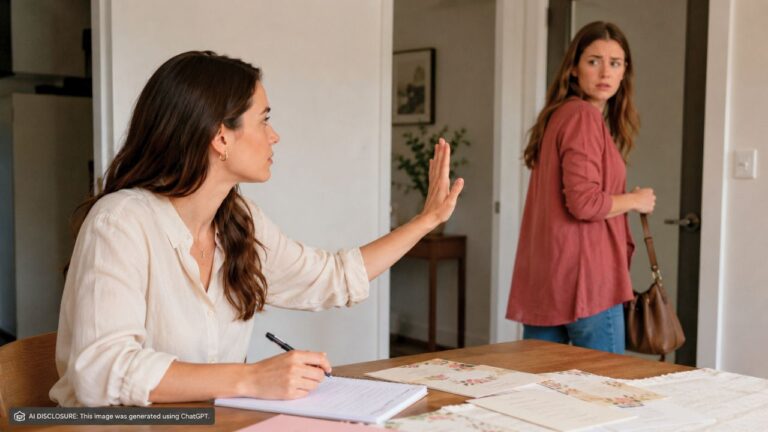
In the original post, a 28-year-old woman describes losing her grandfather and then watching the relationship with her step-grandmother—who had been close, even serving as her godmother—turn icy once inheritance details were finalized. The inheritance was legally structured so the grandchildren received a portion their grandfather couldn’t fully remove, and the step-grandmother received the rest. Then came a demand: hand back €6,000 each, or face the fallout.
The number isn’t enormous compared to the overall estate, but it isn’t pocket change either. For a single woman renting in a country where housing is brutal, €6,000 is not a rounding error. And the harder part isn’t the math—it’s the sudden shift from “family” to “strangers with lawyers.”
The whiplash of losing a person and gaining a negotiation
The woman paints a familiar picture: a grandfather who wasn’t warm, but provided. A step-grandmother who was, for years, a steady presence—holding her hand at her mother’s funeral, staying connected even as adult life scattered everyone. Then the grandfather dies, and what sounded like a quiet season of mourning becomes a financial process with spreadsheets, solicitors, and full disclosures.
This is where a lot of families fall apart. Inheritance forces everybody to say what they really think, and it often reveals expectations nobody talked about out loud. You can be “close” for decades and still have entirely different assumptions about who belongs to whom, who counts as “next of kin,” and who should sacrifice for the sake of peace.
The legal portion is not “taking”—it’s receiving
In her country, she explains, you can’t fully disinherit first-in-line heirs. Since her mother had died, she and her siblings became the heirs by law, though they were disinherited to the maximum extent allowed. The end result: roughly a quarter of the grandfather’s wealth was allocated to the grandchildren, split three ways, with the remainder going to the step-grandmother.
It matters to say this plainly: receiving what the law assigns you is not theft. It’s not “being in it for the money.” It may still feel awkward, especially if you never asked for it, but it isn’t immoral to accept what’s been designated—even if another relative wishes it were different.
If the grandfather wanted a different outcome, he could have planned within the boundaries of the law. He apparently did plan—he reduced their share as much as he could. That may sting emotionally, but it also means the step-grandmother isn’t being blindsided by an unknown rule. The structure existed before the grief set in.
When someone asks for €6,000, they’re rarely asking only for €6,000
The step-grandmother’s request was that each grandchild give up €6,000 “so she could be more comfortable.” Maybe she’s scared. Maybe she’s genuinely worried about long-term finances. Maybe she resents the numbers on paper because they feel like a judgment on her marriage, her place in the family, or her security as a widow.
Still, the request landed with a thud for a reason: it wasn’t framed as a need with transparency, it was framed as a cut. Then she refused a meeting. Then she went quiet. When people handle money like a test of loyalty—especially while avoiding conversation—they’re often trying to regain control, not solve a problem.
And the counteroffer from the grandchildren was reasonable: they were willing to wait to receive their portion so she wouldn’t be financially strained right now, even though that delay could cost them money. That’s not the posture of greedy people. That’s the posture of people trying to keep peace without getting played.
The sister’s “blood money” text is emotional blackmail
The ugliest part of the story might be the step-grandmother’s sister inserting herself with a nasty message. She invoked the dead mother’s character—“she was an angel and wouldn’t have been materialistic”—and dropped allegations that the grandfather emotionally and financially abused the mother. Then she ended with the kind of line that’s meant to stain the money forever: “Just know it’s blood-money.”
That’s a classic tactic: if I can’t persuade you with facts, I’ll shame you with someone’s memory. It’s also conveniently unprovable. Maybe there was abuse; maybe there wasn’t; the woman says she never heard that from the step-grandmother, and she remembers her grandfather as grumpy and mean, but not extreme. If there are serious claims, they deserve more than a guilt text lobbed like a grenade.
Using the dead to win an argument is a low move. It doesn’t honor the mother. It uses her.
Peace bought with cash is usually rented, not owned
The question hanging over everything is the one many decent people ask: “Should I just pay it to keep the relationship?” That temptation is understandable, especially since the step-grandmother was a real comfort during the hardest days of this woman’s childhood. Losing that relationship feels like losing family all over again.
But paying €6,000 each wouldn’t guarantee warmth returns. It might teach the step-grandmother and her sister that pressure works, that silence earns concessions, and that love can be invoiced. If they can extract €6,000 today, why not €6,000 more next year? Why not strings attached to every holiday, every visit, every milestone?
A relationship worth having can survive an honest “no.” A relationship that collapses because you won’t pay a fee to enter it was already in trouble. Money doesn’t create closeness; at best it temporarily covers the cracks.
If she’s truly struggling, there are better ways to handle it
To be fair, widows can find themselves scared and disoriented, even when the numbers look fine on paper. Maybe she doesn’t understand the finances. Maybe she expected something else. Maybe she’s thinking about long-term care, rising costs, or the fact that her “next of kin” isn’t who the grandchildren assumed.
If she needs help, the adult way is to talk plainly: “Here’s my monthly picture. Here’s my concern. Here’s what I’m asking, and here’s why.” Or even, “I’m overwhelmed and angry and I don’t like what this feels like, but I don’t want to lose you.” Instead, she used a solicitor to request a reduction, refused a sit-down, and then went silent. That’s not how you treat family you want to keep.
There’s also a difference between asking for help and demanding a surrender. A request that comes with relational punishment attached is not really a request.
What a steady response looks like
If you’re the grandchild in this situation, you don’t need to become cold or petty to stand your ground. You can keep your “no” simple and consistent: you’re not giving back €6,000, and you’re still willing to receive your inheritance later if that reduces immediate strain. Put it in writing, keep it respectful, and don’t argue with the sister. People looking for a fight don’t deserve a front-row seat to your emotions.
It also helps to separate grief from policy. You can miss your step-grandmother deeply and still refuse a demand that doesn’t sit right. Missing someone doesn’t mean you hand them your future. Stewardship matters, and for this woman—single, renting, starting over—this inheritance isn’t about luxury. It’s about stability.
If the step-grandmother chooses distance, let that be her choice. Pray for her, keep the door open to honest conversation, and don’t twist yourself into knots trying to prove you’re “good” by giving away what was left to you. Generosity is a virtue, but coerced generosity is just extortion with nicer stationery.
Families get weird around money because money exposes what we fear and what we worship. The cleanest path here is calm firmness: keep the inheritance you were legally given, refuse to negotiate against yourself, and stay open to reconciliation if she ever returns to the table like a grown adult who still cares about you.
Read more from Thrive Girly:
- Mother-in-Law Expected to Sleep Over After Every Visit — Then the Mom Said Overnight Stays Were No Longer an Option
- Relatives Showed Up to the Wedding Without Being Invited — Then the Couple Refused to Find Them Seats
- Grandma Buckled the Baby Into Her Car and Left Without Telling Anyone — Then the Mom Made Sure It Never Happened Again