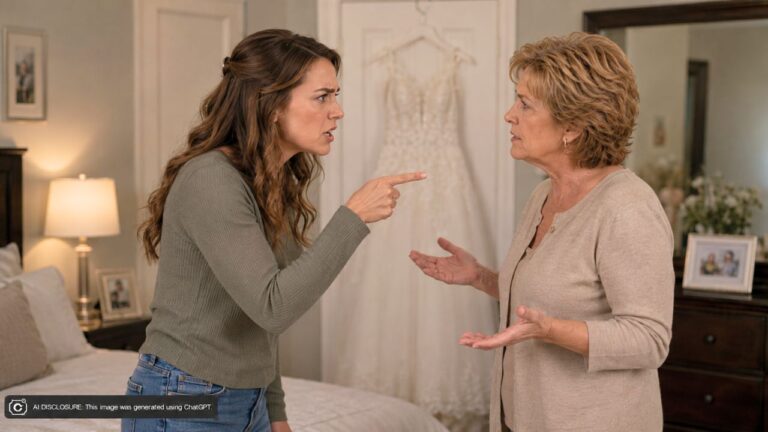
Her In-Laws Kept Overstepping Just a Month After the Wedding — Then She Blocked Them Completely

Photo credit: AI-generated image created using ChatGPT. Illustrative only.
A month after her wedding, a 21-year-old newlywed hit a point she didn’t think she’d reach: she blocked her husband’s entire family on social media and stopped engaging altogether. Not because of one awkward comment or a single bad day—but because the “little” things kept stacking up until they didn’t feel little anymore.
In the original post, she lays out a years-long buildup with her mother-in-law at the center, and a family system that seems to orbit around keeping that one person happy. Then came the wedding month, where three incidents landed back-to-back and turned her frustration into a hard stop.
The problem started long before the wedding photos
The couple has basically grown up together. She’s 21 now, her husband is 22, and they’ve been together since they were teenagers. They got engaged in 2024, were legally married the year before, and finally had their wedding a month ago.
But the relationship with his side of the family never felt easy. She says problems started when they were still in high school, especially with his mom. At 15, she was already dealing with comments comparing her to his ex (who cheated), plus a mother-in-law who stayed connected to that ex anyway.
Then there was the controlling behavior. After the couple got caught sneaking out as teens, the mother-in-law pushed them to break up. The poster says she was also made to do “sessions” with the mother-in-law—who is a pastor of her own church that the poster describes as more cult-like than mainstream.
She says she shares the Christian faith, just not the “warped version” she felt she was being pushed into. And that difference, in her telling, became a permanent mark against her.
When her husband left, the family picked a villain
Things didn’t smooth out as they got older. When her husband was almost 19, he moved out, and she says his family cut contact with him for six months. The reason, she explains, was that he’d been raised sheltered and controlled—and once he left his mom’s church, the family responded by shutting him out.
Eventually, they resumed contact “like nothing happened.” But by then, the poster says it was obvious who they blamed. She felt his mother had decided she was the cause of his “wrong doings,” and she describes herself and her parents as being treated like the enemy.
Meanwhile, she says her own parents stepped in to support him in practical ways. When his family kicked him off their phone plan and car insurance, her parents added him to theirs. She describes her parents as loving him like a son, and says the couple plans to move closer to them.
She also paints a picture of the wider family dynamic: a big family with more than five siblings, older sisters who keep things peaceful by appeasing their mom, and a dad she describes as spineless. In other words, even when something feels unfair, nobody wants to be the one to say it out loud.
The wedding month delivered three loud messages
After six years of “brushing off and letting go,” she says the wedding month was where everything finally got too obvious to ignore.
First: her mother-in-law wore white to the wedding. The poster says that three months earlier, her mother-in-law had asked about wearing a deep teal dress, so white wasn’t something the bride expected. She noticed right before walking down the aisle.
For a lot of brides, that’s not just a fashion choice—it reads like a statement. And the timing couldn’t have been sharper: she saw it at the exact moment she was about to walk into her own ceremony.
Second: the day after the wedding, one of her husband’s sisters (the mother of their nephew) called and berated him for not doing a mother-son dance. The couple isn’t close with her, and the husband simply didn’t want that moment included. But the sister told them they had excluded their mom and that he “owed her an apology.”
The third incident came the following week, and it wasn’t even about the wedding schedule. It was about a TikTok repost. The bride reshared a video about being treated badly as a daughter-in-law. She admits it “was not the wisest decision,” but it reflected where her head was at.
Then the sister messaged her husband again, saying their mom had seen it, and as a result the mother-in-law unfollowed the bride on social media. But the bride says that story doesn’t add up: the sister doesn’t even have TikTok (they’ve had to screen-record videos for her before), and she describes her mother-in-law as someone who doesn’t have TikTok either.
So in her mind, it wasn’t just anger—it was maneuvering. Someone saw it, someone talked, and the story got adjusted to make it look like the mother-in-law was the one who “found” it on her own.
She noticed a pattern: everything comes through someone else
One detail that stood out to her wasn’t just what was said, but who was saying it. She notes that her mother-in-law never messages her or her husband directly. The friction comes through other relatives—especially the sister—like a chain of communication designed to apply pressure without direct accountability.
That kind of setup can make every disagreement feel slippery. You can’t address it head-on if the person you’re really dealing with stays silent, while someone else does the confronting, scolding, and guilt-tripping.
By the time the TikTok message came through, she says she was done. Not with one family member, but with the whole system.
The block was immediate—and her husband didn’t fully follow
Her response was simple and final: she blocked all of them on everything and decided she would not be engaging anymore.
Her husband, she says, understood and respected her choice. But he didn’t want to cut all contact himself, which leaves them in that complicated newlywed space where one spouse goes fully no-contact while the other keeps a thread connected.
It also means future events—holidays, birthdays, family updates—could still find their way into their marriage, even if she’s no longer reachable online.
She ends by asking if she’s overreacting, or if it really is as insane as it feels—because when you’ve been dealing with something for years, it can be hard to tell what’s “normal family annoying” and what’s a pattern that will never change.
For now, the outcome is clear: a bride who wanted a fresh start after her wedding is choosing peace and distance instead. And a husband who loves his wife, but isn’t ready to fully detach from the people who keep putting her in the line of fire.
Read more from Thrive Girly:
- Mother-in-Law Expected to Sleep Over After Every Visit — Then the Mom Said Overnight Stays Were No Longer an Option
- Relatives Showed Up to the Wedding Without Being Invited — Then the Couple Refused to Find Them Seats
- Grandma Buckled the Baby Into Her Car and Left Without Telling Anyone — Then the Mom Made Sure It Never Happened Again