Her Husband’s Family Wouldn’t Budge on Staying Over the Holidays With a Newborn in a One-Bedroom — Then She Canceled Their Hotel Reservation Herself
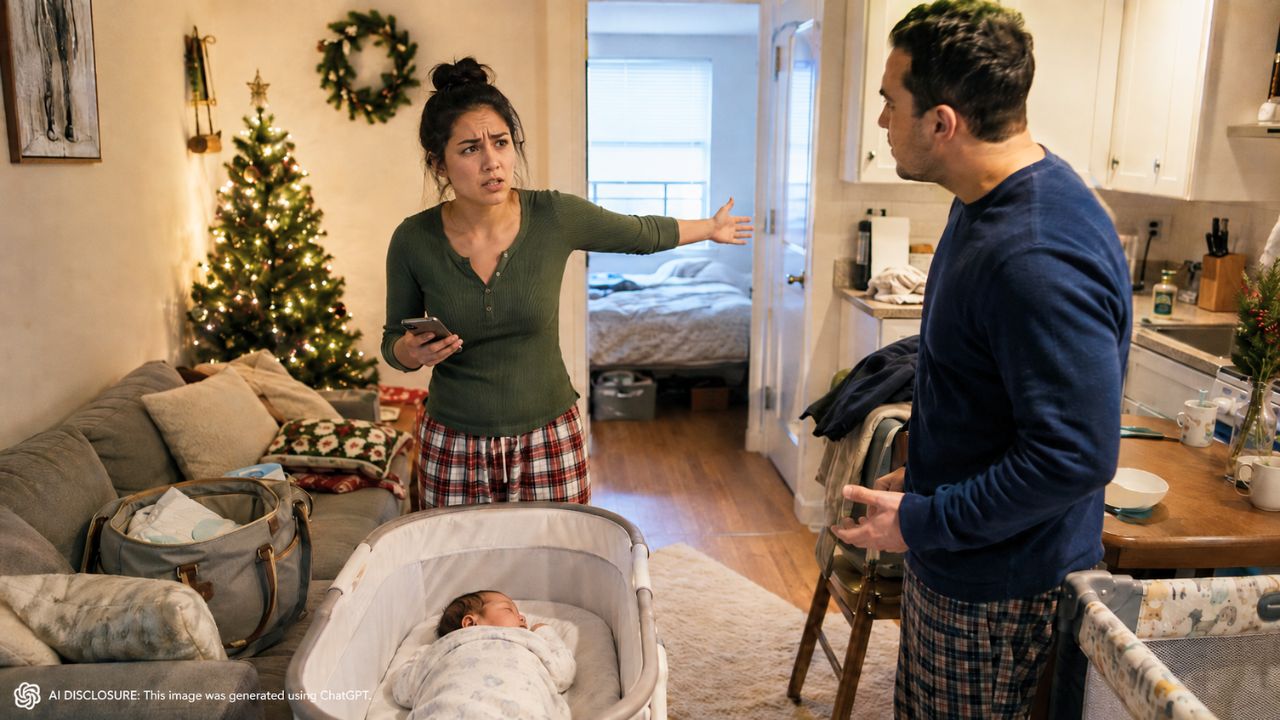
Photo credit: AI-generated image created using ChatGPT.
There’s a special kind of pressure that shows up around the holidays, the kind that makes grown adults start acting like middle schoolers with car keys. Add a newborn, a one-bedroom apartment, and extended family expecting to camp out for over a week, and you’ve got the recipe for a home that stops being a refuge and turns into a battleground.
In the source material, a new mom explains that her husband agreed to let his family stay in their one-bedroom for the holidays without working it out with her first. She tried to raise the concerns calmly—about the baby’s sleep, middle-of-the-night wakeups, and even the practical problem of fitting a playpen and baby-proofing in a small space—but her husband kept “analyzing it” without changing course.
So she made a practical move: she booked a hotel for 10 nights at a discounted rate as a backup plan. The point wasn’t luxury; it was leverage and safety—somewhere she and the baby could go if the house became unlivable. But as the story unfolded, the real issue wasn’t square footage. It was authority, respect, and a man who seemed more committed to pleasing his relatives than protecting his home.
A one-bedroom isn’t a guest suite, it’s a pressure cooker
People who haven’t lived it don’t understand how tight a one-bedroom can get with a baby. It’s not just “a little crowded.” It’s bottles, diapers, a place to safely set the child down, and a routine that keeps everybody sane—especially the mother who’s up at night and running on fumes.
When you bring houseguests into that, you’re not just adding bodies. You’re adding noise, schedules, opinions, extra dishes, and the subtle expectation that the host will accommodate everyone. For a newborn, “accommodate everyone” often translates to “sleep gets wrecked,” and once a baby’s sleep gets wrecked, so does mom’s ability to function.
The car-curtain argument wasn’t about curtains
The fight that set everything off started with a small practical decision. The baby was getting blasted by sun in the car, so the wife used magnetic curtains she’d bought and hung them in her husband’s vehicle during a long drive to a family gathering. He said it blocked his blind spots, so she tied them open. When it still bothered him, he told her she needed to ask before “just going and doing stuff.”
That’s the moment the bigger resentment boiled over, because she pointed out he hadn’t asked her before telling his sister the family could stay in their home. His response wasn’t, “You’re right, I should’ve talked to you.” It was, essentially, “I don’t need your permission—it’s my house.” That line tells you what kind of marriage he thinks he’s in, and it’s not a partnership.
“My house” is a dangerous phrase for a husband
A man can work hard, pay bills, and still fail at being a husband if he treats his wife like a tenant. Saying “my house” to the mother of your child isn’t leadership. It’s possession, and it’s often what a man reaches for when he doesn’t want to do the harder work of listening and compromising.
In the story, the husband escalated quickly—insults, crude name-calling, telling her to be quiet, telling her to “man up,” and trying to frame her concerns as selfishness. That isn’t normal marital conflict; that’s contempt. And contempt doesn’t fix itself with a polite conversation and a few days of cooling off.
There’s also something telling about the way he tried to justify the chaos: holiday stress is normal, he said, like in a movie where a big house is loud and crowded. But movies are scripted. Real life is a tired mother, a fragile sleep schedule, and a tiny home where there’s no place to breathe. A husband’s job isn’t to recreate holiday chaos. It’s to shepherd his family through a demanding season with as much peace as he can.
The three-day silence said more than the argument
After the blow-up, the husband stayed at work and barely came home except to sleep. The wife said he didn’t see his son for almost three days, and she had to reach out to push for an adult conversation. He answered with self-pity—saying nobody wants him around and he’s only good for food and money.
Work can be a real burden, and some men genuinely carry heavy loads. But hiding at work to avoid conflict at home isn’t provision; it’s avoidance. A father doesn’t get to disappear from his child because he’s angry at his wife, and a husband doesn’t get to turn a marriage problem into a solo pity party.
What’s worse is the implicit trade he’s offering: “I provide, so I decide.” That’s not a Christian picture of marriage, and it’s not even a stable worldly one. Provision is a responsibility, not a weapon.
Why the hotel became a symbol of sanity
She booked a hotel reservation she could cancel up to a day before check-in. She also said she got 10 nights for $518 total, and her husband dismissed it with an eye roll and claims it wouldn’t be that cheap. This wasn’t just about money; it was about him refusing to take her solution seriously because it didn’t come from him.
In a healthy marriage, a hotel in this scenario is a reasonable pressure valve. Not because you want to “run away,” but because sleep matters, safety matters, and a newborn doesn’t care about anybody’s holiday expectations. If guests can’t respect the baby’s schedule, the adults don’t get to pretend the baby should just deal with it.
The headline angle—her canceling the hotel reservation herself—fits the broader pattern here: she’s trying to create boundaries because her husband won’t. Whether she keeps the reservation, cancels it, or rebooks later, the deeper problem remains the same. When a wife has to privately engineer contingency plans to protect her peace, the marriage is already operating in emergency mode.
Respect is the real missing room in the apartment
One line in her update cuts through the noise: it’s not about control, it’s about respect. She wanted him to talk to her first, to weigh the reality of their home, their routines, and their child’s needs before making promises to his family. That’s basic husband work.
His family, interestingly, doesn’t come off as the loudest villain in this update. His sister even asked respectfully about borrowing the wife’s car during the visit, and the wife agreed with the understanding it would be returned if needed. That small detail shows the wife isn’t simply hostile to his relatives. She’s hostile to being steamrolled.
A husband is allowed to love his parents and siblings. He’s not allowed to use them as an excuse to dismiss his wife. If you can’t say “Let me talk with my wife first” to your family, you’re not leading; you’re still being led.
If a man wants peace, he has to earn it
She said people suggested divorce and that she sees why, but she wants to give him one more chance to start discussing decisions with her. That’s a sobering place to be, and it should sober any man reading. A marriage doesn’t usually collapse over one holiday visit; it collapses over a pattern of disrespect that finally becomes undeniable.
For the husbands out there: your wife is not your employee, and your home is not a little kingdom where you hand down decrees. If you want to host family, you do the adult thing—ask, plan, budget, set expectations, and protect your wife from being the default servant. And if the house can’t handle it, you pay for the hotel or you tell your family “not this year,” and you do it without blaming your wife like she’s the villain.
Holidays are supposed to be about warmth, gratitude, and worship, not power struggles in a cramped apartment. If a man won’t budge, won’t listen, and won’t speak with basic decency, the hotel reservation is the least of the concerns. The bigger question is whether he’s willing to act like a husband and father, or keep acting like the most important child in the room.
Read more from Thrive Girly:
- Mother-in-Law Expected to Sleep Over After Every Visit — Then the Mom Said Overnight Stays Were No Longer an Option
- Relatives Showed Up to the Wedding Without Being Invited — Then the Couple Refused to Find Them Seats
- Grandma Buckled the Baby Into Her Car and Left Without Telling Anyone — Then the Mom Made Sure It Never Happened Again