Her Husband’s Family Pressured Her Into Spending Every Holiday on Their Terms — Then She Refused to Spend Christmas With Them
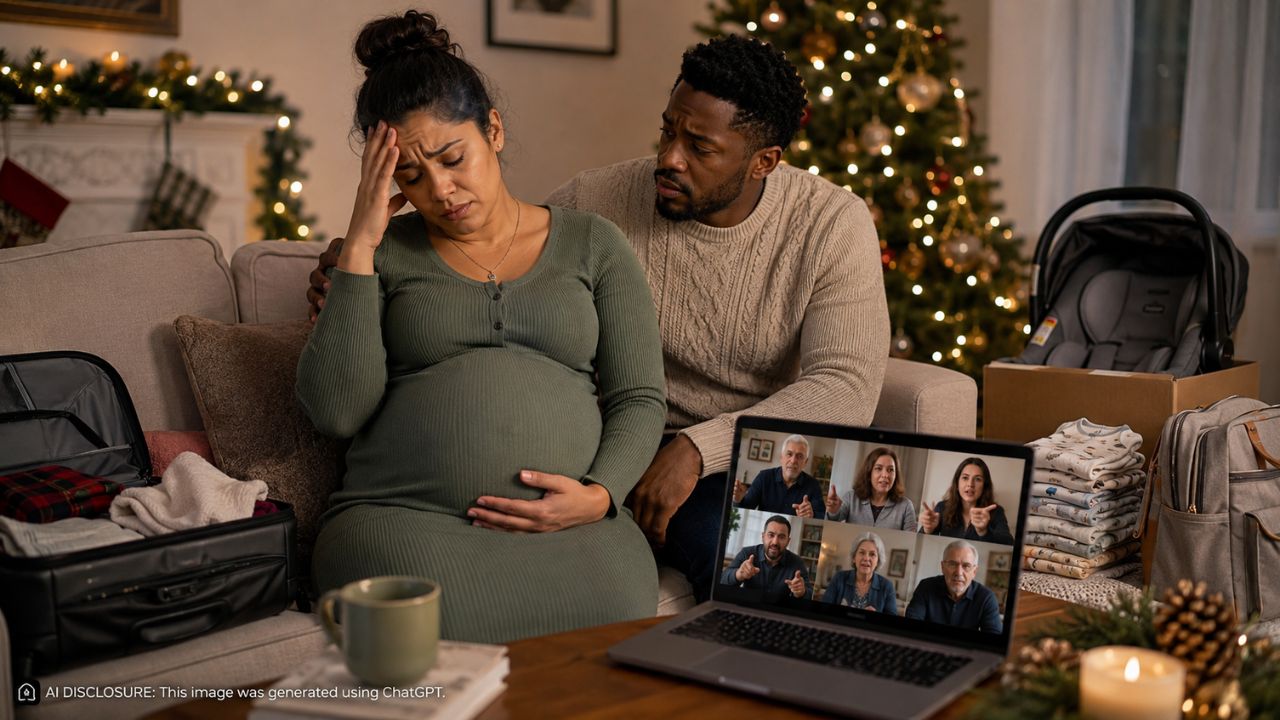
Photo credit: AI-generated image created using ChatGPT. Illustrative only.
At 25, she thought the most stressful part of December would be the usual last-minute baby prep: washing tiny onesies, double-checking the car seat, trying to sleep through the third-trimester insomnia. Instead, she found herself bracing for something else entirely—an invasion disguised as a holiday visit.
In the original post, the expecting mom explained that she and her husband are due with their first baby in December, and his close-knit family has a long-standing tradition of traveling in from different states to spend Christmas together. This year, their turn would’ve meant going to Ohio—until the reality hit that she’ll either be very pregnant or freshly postpartum.
A family tradition turned into a plan she never agreed to
Her husband’s family is the kind that does “big Christmas” every year, with relatives willing to hop flights, rotate locations, and pack a house with people who all genuinely want to be together. She, on the other hand, doesn’t come from that kind of background. She’s not close with her own family, and she didn’t grow up with large holiday gatherings.
So when travel became unrealistic, the family’s solution arrived quickly and confidently: if she can’t come to them, then everyone will come to her. In their minds, it was sweet. Efficient. A win-win. They’d still get their holiday, and they’d get to meet the baby, too.
But for her, it didn’t feel like a warm compromise. It felt like being cornered at the exact moment she’ll be most vulnerable.
She pictured Christmas postpartum… and felt sick to her stomach
She laid it out plainly: if she hasn’t delivered yet, she doesn’t want a full house while she’s waiting to go into labor. And if she has delivered, she doesn’t want 10 to 15 relatives flying in from all over the country to pass around a newborn during cold, flu, and RSV season.
It wasn’t framed as a punishment or a permanent ban. It was the very specific reality of December: her body, her baby, her recovery, and a season where viruses spread fast—especially when people are traveling.
So she told them she didn’t think they’d be doing Thanksgiving or Christmas this year. Not in the traditional way, and definitely not with a crowd.
That’s when the pressure campaign started.
They called her “dramatic,” then brought up the flights
Some relatives dismissed her concerns with the classic line: it’s “just family.” Instead of treating her hesitation like a normal, protective first-time mom instinct, they treated it like she was making a scene.
Then came the guilt. People had already spent money on flights because they were “really excited” to meet the baby. The message was clear even if it wasn’t said outright: if she says no now, she’s the reason Christmas is ruined.
Only she wasn’t trying to ruin anything. She was trying to avoid being freshly postpartum in her own home while acting like a host, a peacekeeper, and a baby-sharing station all at once.
And the truth is, this wasn’t the first time she’d felt steamrolled during the pregnancy. It was just the biggest example.
The holiday fight was sitting on top of a bigger pile of issues
Her post made it obvious that the Christmas debate didn’t come out of nowhere. There were already simmering disputes about what she and her husband would share, when they would share it, and who gets a say.
They learned the baby’s gender, but decided not to tell anyone yet. She wanted to share that information on their own timeline, but her mother-in-law didn’t take it as a simple preference. She took it personally, accusing her of “gatekeeping” because she wanted to start buying baby items.
Then there was social media. The mom-to-be described herself as very private and said she barely posts online. She also made it clear she doesn’t want pictures of her baby posted on the internet. That didn’t go over well either, which only deepened her feeling that her choices weren’t being respected.
And if all of that wasn’t enough, the delivery room issue was still hanging in the air.
The delivery room request pushed her from uneasy to done
Her view was simple: if you weren’t involved in making the baby, you don’t need to be present for the baby coming out. She wasn’t even planning to have her own mom in the delivery room. She wanted privacy, calm, and control in a moment that’s already intense.
But her mother-in-law and her mother-in-law’s sister kept insisting they should be there because it’s “their grandchild too.” She’d already said no, and they kept bringing it up anyway.
It’s the kind of repeated “just asking” that doesn’t feel like asking at all after the fifth time. It feels like wearing someone down until they finally give in—especially when the person being asked is pregnant, exhausted, and trying to keep the peace.
She also mentioned the comments and jokes that had started to feel less funny over time. Her mother-in-law liked to joke that when the baby is with Grandma, Grandma makes the rules. Maybe it was meant to be playful. But stacked on top of everything else—the gatekeeping accusation, the social media pushback, the delivery room pressure—it landed like a warning.
Her husband wanted to “deal with it later,” and she couldn’t
The hardest part wasn’t just his family’s expectations. It was the feeling that she was the only one taking the situation seriously right now.
Her husband kept telling her they would deal with it “when the time comes.” But for her, the time is already coming. She’s due in December, and plans are already being made around her as if she’s a venue, not a person who will be either heavily pregnant or recovering from birth.
She didn’t feel like people were thinking about her physical recovery, her stress level, or the fact that she might be bleeding, sore, overwhelmed, and learning how to take care of a brand-new human. She felt like all eyes were on the baby, and she was expected to just absorb the inconvenience.
So she asked the question that a lot of new moms quietly ask themselves when family excitement turns into entitlement: was she overreacting because it’s her first baby?
Where things were left: a December deadline with no easy answers
By the end of her post, nothing was neatly resolved. She was still staring down a holiday season where other people’s excitement had turned into assumptions, and assumptions had turned into plans that didn’t include her comfort.
She knew what she didn’t want: a huge family Christmas, people pushing past her “no,” and a postpartum period spent managing relatives instead of healing and bonding. What she didn’t have yet was a clear sign that everyone—especially her husband—was ready to back her up before the first visitor showed up at the door.
And that’s what made her refusal feel so big. It wasn’t only about Christmas. It was about whether “we’ll deal with it later” turns into a lifetime of her being expected to bend first—starting with the very first holiday her baby will ever have.
Read more from Thrive Girly:
- Mother-in-Law Expected to Sleep Over After Every Visit — Then the Mom Said Overnight Stays Were No Longer an Option
- Relatives Showed Up to the Wedding Without Being Invited — Then the Couple Refused to Find Them Seats
- Grandma Buckled the Baby Into Her Car and Left Without Telling Anyone — Then the Mom Made Sure It Never Happened Again