Her Best Friend Scheduled the Wedding Nine Days After Her Due Date — Then She Declined to Be Maid of Honor
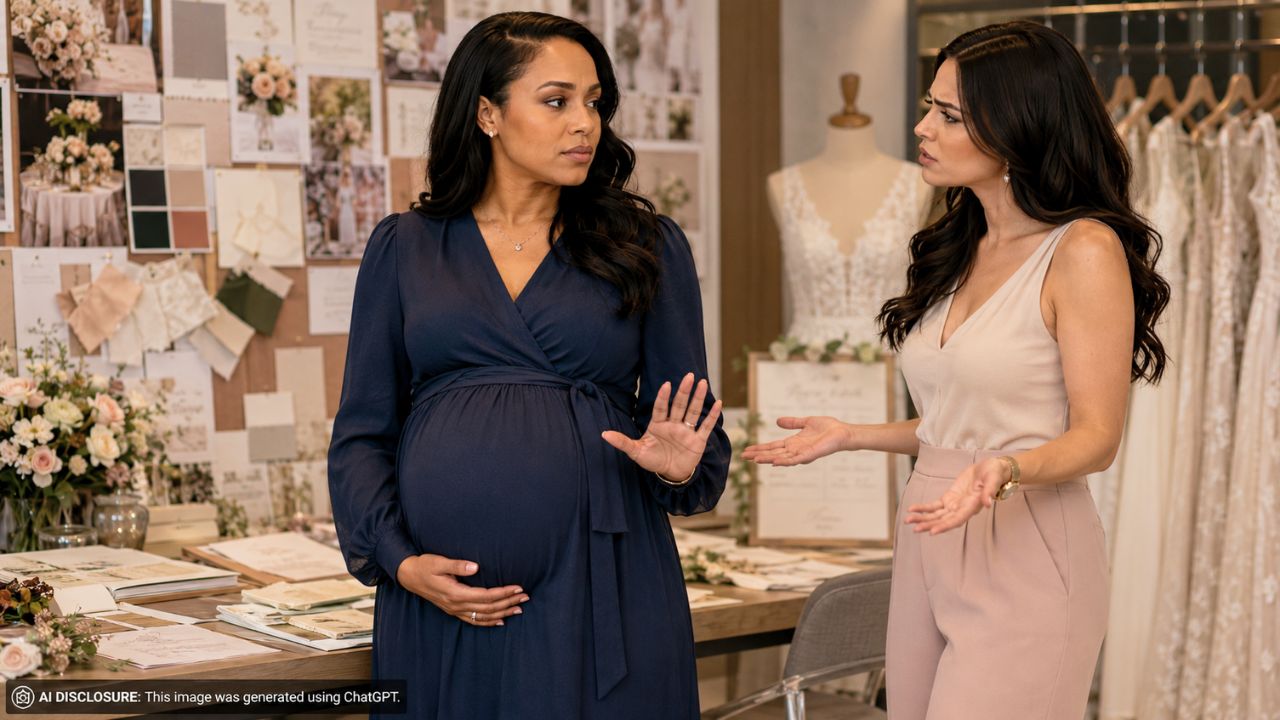
Photo credit: AI-generated image created using ChatGPT. Illustrative only.
There are some wedding requests that feel big but doable, and then there are the ones that make you blink at your phone and think, “Wait… are we in the same reality?” One woman says she found herself in exactly that spot when her best friend’s wedding date landed nine days after her due date—and her friend still expected her to show up in a major role.
In the original post, she explains that the situation didn’t explode all at once. It was more like a slow unraveling: a bridal party reshuffle, a baby on the way, and a bride who kept pushing for a “definite yes” even when the answer realistically couldn’t exist.
She said yes before she knew she’d be pregnant
When her friend—she calls her Jane—got engaged, Jane asked her to be maid of honor. At the time, it made total sense. She wasn’t pregnant yet, and she agreed.
But as wedding planning moved forward, life changed. By March 2023, she was starting to tell people she was expecting, due October 12. Jane’s wedding date: October 21.
That timing alone would make most people pause. Still, the first sign of trouble wasn’t the date—it was the first message Jane sent that sounded like she was already rethinking the maid of honor decision.
Then came the “maybe my sister-in-law should do it” text
Jane reached out saying her sister-in-law had been independently contacting people to plan the bachelorette and “other stuff,” and that she was extroverted and into that kind of planning. Jane suggested it might be “best” to make the poster a bridesmaid instead and have the sister-in-law step in as maid of honor, while also asking for her thoughts so it wouldn’t come off as hurtful.
That was the moment she chose to share her pregnancy news—partly because it explained why a change might make sense. If someone else wanted to handle the party-planning, fine. She admits she felt more irritated than devastated about potentially being replaced, but she could live with it.
What she couldn’t gloss over was the calendar. She told Jane her due date and said she probably wouldn’t be able to make the wedding at all, given it was only nine days later.
Jane responded that it was “super important” for her to attend, while acknowledging a baby can’t be scheduled. The conversation drifted for a bit after that, but it didn’t stay quiet for long.
Jane changed her mind again—and brought the title back
By late May, Jane came back with a new plan. She texted that the poster was going to be her maid of honor after all because she was her best friend, and the sister-in-law could be “matron of honor.” Jane said she’d looked it up and that having both was fairly common, framing it as a thank-you to her sister-in-law for being helpful with planning.
On paper, it might have sounded like an emotional, best-friends moment. In reality, the poster was staring down the final months of pregnancy, knowing the wedding would be right on the edge of postpartum survival mode.
She explained it again, more clearly: she didn’t think she could attend the wedding that soon after giving birth. If she was nursing, she wouldn’t be able to be away from the baby for long. She also wasn’t comfortable bringing a newborn to a wedding since the baby would be unvaccinated and extremely new to the world.
And then there were the practical details nobody wants to say out loud, but every postpartum person immediately understands. She didn’t know what size she would be for a dress. She didn’t feel comfortable standing in front of a crowd less than two weeks after delivery. And if she’d had stitches, they wouldn’t even be out yet.
Even so, she tried to meet Jane where she could. She told her she wanted to help with anything possible leading up to the wedding. She just couldn’t promise she’d be physically present as maid of honor nine days postpartum.
The bride’s follow-up wasn’t sympathy—it was pressure
At first, Jane said she understood. Then, only a few hours later, a longer message came through—and the tone had shifted.
Jane said she was “really really upset” and asked if she would at least show up for the vows. Jane framed it as a small ask: about a two-hour commitment including prep time. She even said the apparel requirement was basically just matching a color and that she could “show up in sweats” for all she cared.
Then came the part that landed like a thud: Jane suggested the poster’s husband, parents, or in-laws could watch the newborn for a couple hours. She said she needed to know a “definite” yes or no so she could “figure things out” on her end.
For the poster, that was the moment it stopped feeling like a friend being disappointed and started feeling like a friend refusing to absorb reality. She wasn’t talking about skipping a dinner reservation. She was talking about giving birth—then immediately turning around to attend a formal event an hour away.
She replied as gently as she could while still being honest. She told Jane she understood why she was upset and that she wished she could be there. But she didn’t know how she’d feel, didn’t know how nursing would go, and didn’t see childcare as an option. She also admitted she’d be exhausted and wouldn’t be able to truly celebrate.
It wasn’t a dramatic message. It was a realistic one.
After that, the silence said everything
Jane never responded.
The poster says she ended up not being invited to the wedding at all. Somewhere in the fallout, Jane “vaguely” invited her to go dress shopping with her, her mom, her sister-in-law, and her future mother-in-law—but never provided details. Instead of chasing down the info, the poster chose to step back, frustrated by what she saw as a total lack of understanding about pregnancy and postpartum recovery.
She also couldn’t stop thinking about how bad it would have been to agree and then cancel at the last second. Labor isn’t predictable. Recovery isn’t predictable either. Even driving an hour away that soon could have been off the table depending on what her delivery looked like.
And yet, the guilt lingered anyway—the kind that shows up when you know you did the sensible thing, but someone else has decided that sensible equals selfish.
Three years later, she still replays it
Even though this happened about three years ago, she says she still thinks about it more than she wants to. Not because she’s unsure of the logistics—those are clear—but because the friendship ended in such a sharp, quiet way.
From her perspective, she didn’t abandon Jane. She offered help leading up to the wedding. She communicated early. She didn’t overpromise. She simply couldn’t commit to a major wedding role—or even attendance—days after giving birth, with a newborn who would depend on her for nearly everything.
But Jane seemed to hear only one thing: “I won’t be there,” and she treated it like a personal rejection rather than a medical and logistical reality.
In the end, there wasn’t a screaming fight or a big public blowup. Just unanswered messages, no invitation, and a former best friend who apparently decided that if she couldn’t show up on command, she didn’t belong in the room at all.
Read more from Thrive Girly:
- Mother-in-Law Expected to Sleep Over After Every Visit — Then the Mom Said Overnight Stays Were No Longer an Option
- Relatives Showed Up to the Wedding Without Being Invited — Then the Couple Refused to Find Them Seats
- Grandma Buckled the Baby Into Her Car and Left Without Telling Anyone — Then the Mom Made Sure It Never Happened Again