Her Mum Handed Her Late Brother’s £2m Share to Her Other Son — Then a Cat Uncovered the Lost Will and She Won Half
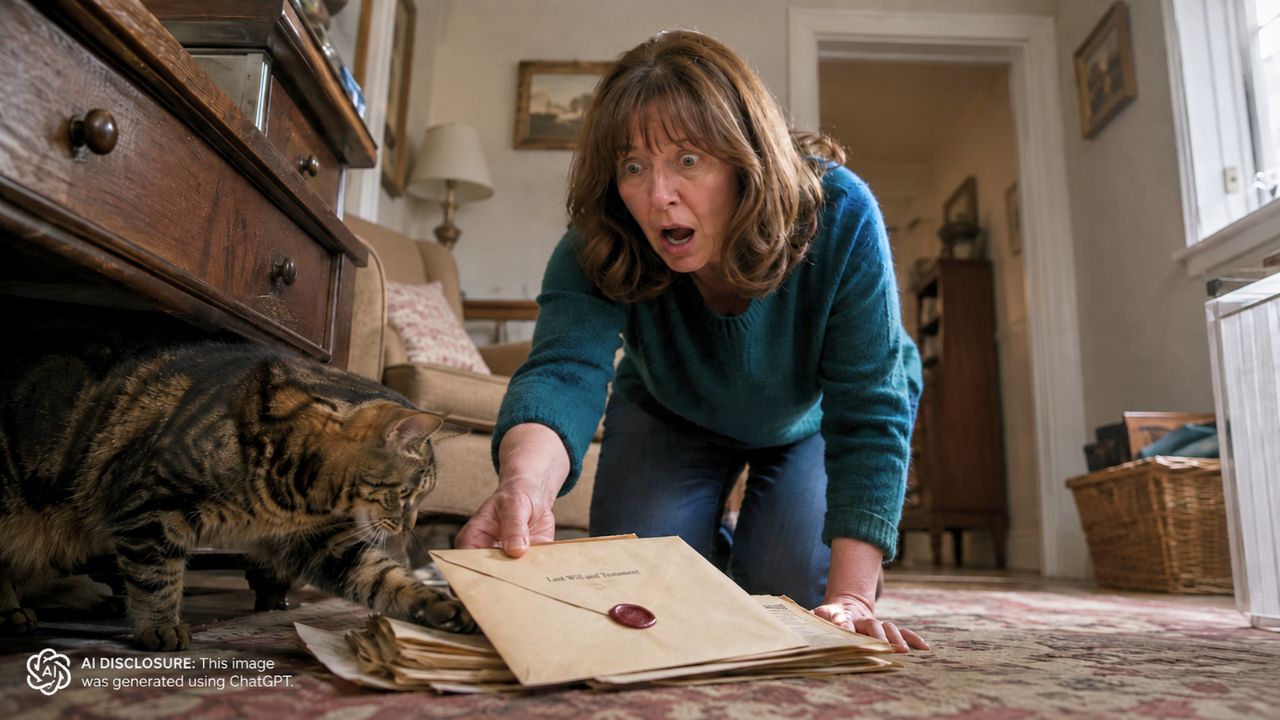
Photo credit: AI-generated image created using ChatGPT. Illustrative only.
Most family fights don’t start with a big villain twirling his moustache. They start with grief, paperwork, and people making decisions in the fog, then digging in when pride takes over. In one British inheritance battle, a missing will sat quietly in a pile of documents for years—until a cat knocked the right stack onto the floor and changed who walked away with millions.
The details come from the original post, which lays out how Venetia Murray ended up in a High Court fight over her late brother’s share of a Hertfordshire farm worth around £6 million. The case turned on whether her brother Dean Brunt had died without a will, or whether the will existed and had simply gone missing. What looked like settled family “business” reopened into a full-blown legal war.
On paper, it’s an inheritance story. In real life, it’s also about what happens when families avoid hard conversations, assume the law will sort it out, and let resentment become normal. And yes, it’s about a cat with impeccable timing.
A farm, three siblings, and a death that changed everything
The property at the center of the dispute was Ettridge Farm in Broxbourne, Hertfordshire. The court heard that the farm had been inherited by three siblings—Dean Brunt, Dale Brunt, and their sister Venetia—from their grandfather, Arthur Nicholls, who died in 1990. Arthur had bought the farm with earnings from prize fighting, and Dean was said to be especially close to him.
In 2007, Dean died in a railway accident at age 35, and a coroner returned an accidental death verdict. With Dean gone, the question became simple and brutal: who owned Dean’s roughly £2 million share of the farm? If he died without a valid will and had no spouse or children, the rules of intestacy would decide it.
How Dean’s share moved from mum to brother
Dean was believed to have died without leaving a will, and his mother, Marlene Brunt, obtained “letters of administration” on the basis that he died intestate. That meant she inherited his share of the farm. She then passed that share to her eldest child, Dale, which left Dale owning two-thirds of the land and business, with Venetia owning the rest.
Those kinds of transfers might look tidy from the outside, but they can plant a seed of bitterness that doesn’t stop growing. Venetia later told the court she had assumed she and Dale were joint owners after Dean’s death. She said she was shocked to learn—nearly a decade later—that her mother had inherited Dean’s share and then given it all to Dale.
The missing wills and a family feud that wouldn’t die
The fight escalated after Venetia discovered there were two wills Dean had made back in 1999. One will, lawyers said, was “crucial evidence” that Dean intended to leave his sister half his wealth, with the other half to his brother. In other words, Dean’s £2 million share would be split, not swallowed whole by one sibling.
Venetia and her uncle, Winston “Bob” Wrangle, took legal action against Dale and Marlene. The court also heard allegations from Venetia that Dale had bullied her out of running the business and treated their uncle badly, including trying to force him from his home on the farm. Those claims show how quickly money arguments turn into character arguments, and how hard it becomes to separate business decisions from family loyalty.
A solicitor’s cat and the will that almost got shredded
The case took a turn that sounds like a movie scene, but it was presented in court as plain fact. Dean’s former legal adviser, Howard Day, had kept documents connected to the family. After Mr Day died, papers from his office were sent to the London office of Mr Wrangle’s solicitor, Katy Sillett.
As the barrister for Mr Wrangle explained, Mrs Sillett was sorting through the documents and piling up unneeded duplicates to be shredded. Then her cat knocked over the papers set aside for destruction. When she picked them up, she realized what she assumed was a duplicate will was actually an original.
This second will mattered because it supported the authenticity of the first. It was in the same terms—splitting Dean’s share between Dale and Venetia—but had a steadier signature than the earlier-discovered copy. That steadier signature helped weaken the argument that the document had been created later as part of a fraud.
Forgery claims, signatures, and a judge who wasn’t buying it
Dale and Marlene argued the wills were forged and suggested they had been created after Dean’s death. The court heard that Mr Day had signed the wills on Dean’s behalf, and that the signature on the first document appeared unsteady, which opponents used to suggest it was signed years later when Mr Day’s hand was less firm. Experts indicated there was evidence the documents may have been written later, but the second, steadier signature complicated that narrative.
Judge Paul Teverson rejected the claim that the wills were forged. He pointed to “a substantial amount of evidence” that Dean had talked in the late 1990s about having made a will. The judge also rejected suggestions that Mr Day’s notes from the time were part of an “elaborate fraud.”
In the end, the ruling meant Venetia would receive half of Dean’s share of the farm. In practical terms, the decision moved a serious amount of money and property rights. In human terms, it exposed how far the family had drifted into secrecy and suspicion.
The part of the story nobody likes to talk about: concealment
One of the colder details in the judgment was the court’s view that Venetia and Mr Wrangle had been kept in the dark about Dean being treated as having died intestate and about the transfer of his share to Dale. The judge described Venetia as an “impressive witness” who was genuinely shocked by what she learned. He also said he did not believe she would associate herself with a fraudulent claim.
By contrast, the judge called Marlene a “most unimpressive witness,” noting that her evidence shifted during questioning. He expressed sympathy for her grief, but said it did not justify concealing the way Dean’s estate had been administered. He suggested the most likely explanation was that Marlene knew there was a will but did not reveal it because she believed it was not Dean’s will, but one created by Mr Day.
That’s the kind of mess grief can create: people start telling themselves a story that makes their choices feel necessary. Then the story hardens into a stance, and the stance becomes a family identity—until a court forces it into the open.
What a case like this says about stewardship and responsibility
Money has a way of revealing what’s already there. If there’s jealousy, it’ll find the microphone. If there’s favoritism, it’ll get legs and start walking around the family table. And if someone thinks, “I’ll just handle this quietly,” that quietness often becomes the very thing that poisons relationships for years.
There’s also a plain stewardship lesson here that doesn’t require a sermon: important documents shouldn’t live in mystery piles, and a family shouldn’t be left guessing about intentions after someone dies. Adults owe each other clarity, even when clarity is uncomfortable. A will doesn’t fix every problem, but a missing will can multiply them fast.
The oddest part is that this fight may have turned on a moment no one could plan: a cat knocking over papers that were headed for the shredder. It’s funny in the way life can be funny, but it’s also a little sobering. Some people spend years scheming, or avoiding, or stonewalling—only for a small, accidental act to bring the truth back into the room.
Read more from Thrive Girly:
- Mother-in-Law Expected to Sleep Over After Every Visit — Then the Mom Said Overnight Stays Were No Longer an Option
- Relatives Showed Up to the Wedding Without Being Invited — Then the Couple Refused to Find Them Seats
- Grandma Buckled the Baby Into Her Car and Left Without Telling Anyone — Then the Mom Made Sure It Never Happened Again