Neighbor Drilled Holes Into Her New Fence to Hang Her Own Lights Without Asking — Then She Made Her Pay for the Damage
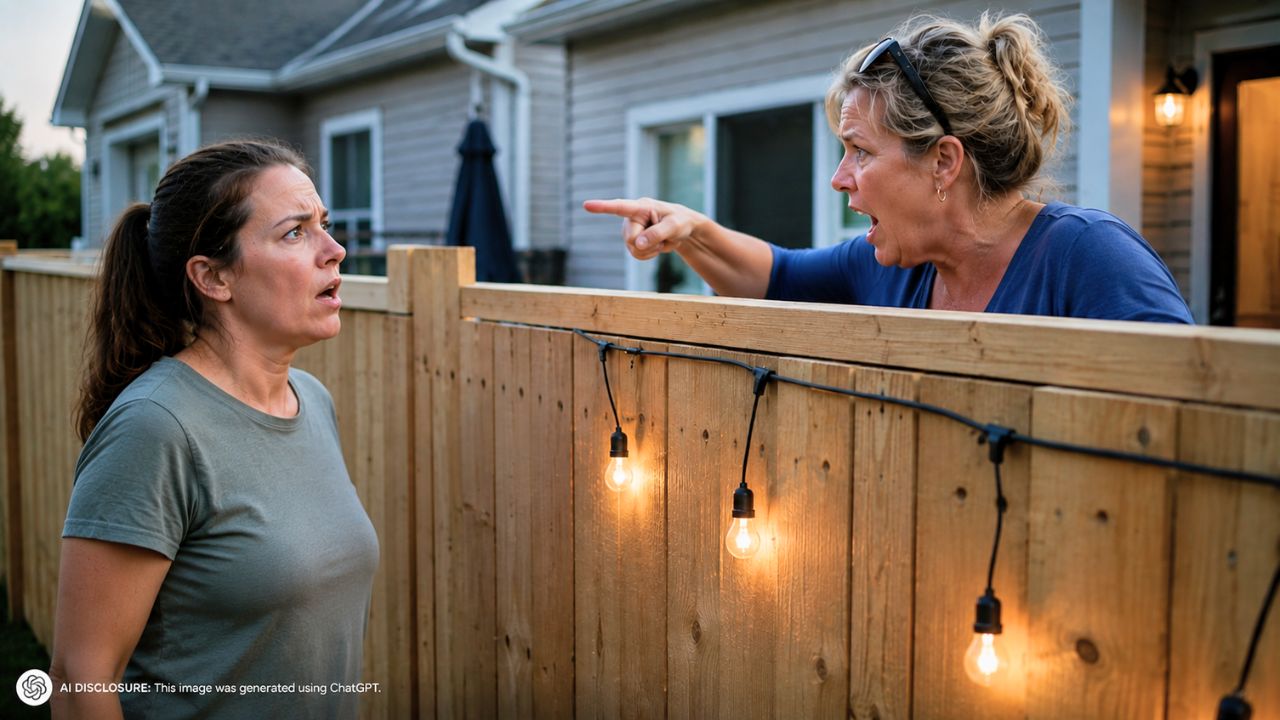
Photo credit: AI-generated image created using ChatGPT.
A good fence is supposed to do two things: mark what’s yours and buy you a little peace. You spend the money, you put it on your property, you paint it, and you go back to living your life. Most of us aren’t looking for a feud with the people next door, especially after decades of keeping things polite and predictable.
That’s why this story, shared in the original post, lands in that annoying middle ground where it’s “just some holes” and also not just some holes at all. A homeowner paid for a new wood privacy fence set on their own property, not on the boundary line. Then they discovered their long-time neighbors had screwed seven lights into it, drilling into freshly painted boards, without asking first.
When the homeowner confronted them, the neighbor’s initial posture was cooperative: they were willing to pay for removal and a basic patch job. But when the homeowner quoted $250 to remove and repair, the neighbor balked. The homeowner’s spouse—non-American and unfamiliar with local property norms—preferred to let it go, and for a moment, that’s where things stood.
The part that stings isn’t the lights
Let’s be honest: seven little lights don’t sound like the end of the world. If they’re on the far side of the fence, you won’t even see them, and you might wonder why it’s worth the oxygen. Plenty of men would rather swallow irritation than risk turning a neighborly relationship into a cold war over something that seems small.
But what people call “small” is often where disrespect hides. Drilling into someone else’s brand-new fence without asking is a decision that says, “Your property is available for my convenience.” It’s not the wattage that’s offensive; it’s the assumption.
Property lines and personal boundaries are related
The homeowner made a point that matters: the fence wasn’t on the boundary line. It was on their property, paid for by them, installed to keep a long, arms-length relationship exactly that—calm, civil, and not too close. In other words, the fence wasn’t only about privacy; it was about clarity.
A lot of neighbor trouble starts when clarity gets replaced by familiarity. Twenty-five years next door can create a false sense of shared space, shared tools, shared permission. Healthy neighborhoods run on simple courtesies: ask first, don’t assume, and if you mess something up, you make it right without a performance.
The $250 argument: what are you really paying for?
When the neighbor balked at the $250 repair cost, you can feel the shift. Suddenly it’s not “We’re sorry, we’ll fix it,” but “That seems like a lot for a few holes.” And yes, patching wood sounds cheap until you remember the full scope: removing fixtures cleanly, patching properly, matching paint, and restoring boards so they don’t look like they’ve been chewed on.
There’s also the cost nobody wants to pay: the cost of being corrected. Some people would rather argue over a number than admit they were out of line. If you’ve lived long enough, you’ve seen this pattern everywhere—someone makes a mess, then acts like you’re the problem for wanting it cleaned up well.
Still, it’s worth saying plainly: a homeowner doesn’t owe a discount on damages to protect someone else’s pride. If you put holes in another man’s fence, you don’t get to negotiate him down like he’s selling you a used lawnmower.
Marriage adds another layer, and it’s not always simple
The update is where the story turns human. The spouse, not familiar with property law and likely not accustomed to the same expectations around boundaries, urged the homeowner to let it go. If you’re married, you recognize that moment: you’re not just managing the neighbor; you’re managing unity in your own house.
It’s easy to frame it as “one person is right and one is wrong,” but it can be more complicated. One spouse might be protecting peace and dreading escalation, while the other is protecting stewardship and basic respect. Those aren’t bad motives, but they can pull in opposite directions if you don’t slow down and talk it through.
Sometimes the best move is to choose the long game: protect the relationship at home first, then deal with the conflict outside with a cooler head. Other times, letting things slide teaches the wrong people the wrong lesson. Either way, a couple has to decide together what kind of household they’re running—one that avoids discomfort at all costs, or one that can address problems without turning them into wars.
Flowers, a check, and a Bible: apology or pressure?
After the homeowner “let it go,” the neighbor surprised them with flowers, a $200 check, a Bible, and a note quoting Mark 12:31—“Love your neighbor as yourself”—offered as “full resolution.” On one hand, that’s an apology in motion: a gift, money, and an acknowledgment that something wasn’t handled well.
On the other hand, mixing cash, Scripture, and a declared “full resolution” can feel like a tidy way to close the file without actually addressing the underlying issue. A real apology doesn’t just soothe feelings; it respects the person you wronged enough to let them decide what makes it right. Declaring the matter settled can come off less like repentance and more like a transaction with religious packaging.
It’s also fair to notice the mismatch: earlier, $250 felt too high. Then $200 appears with extras. That may be goodwill, or it may be an attempt to regain moral footing. Either way, a Bible isn’t a repair tool, and a verse isn’t a permission slip.
How a man can handle this without becoming the neighborhood villain
If you’re the homeowner in this situation, the goal isn’t to “win.” The goal is to reestablish clear lines so you don’t keep paying for someone else’s assumptions. There’s a way to do that without swagger, threats, or endless passive-aggressive yardwork.
Start with calm clarity: you can accept the apology and still insist the lights come off and the fence be restored to the condition it was in before. If you’re willing to settle for the $200, say so explicitly, and confirm what “settled” means—removal, patching, repainting, or whatever you can live with. If $250 is the real cost and you want it done right, you’re not sinning by stating the number again and holding to it.
And if you decide, for the sake of peace at home, to accept the $200 and do the rest yourself, at least lock in the boundary going forward: no attachments to the fence, no drilling, no “temporary” hooks, no surprises. Peace isn’t pretending things are fine; it’s making sure the same thing doesn’t happen again.
“Love your neighbor” doesn’t mean “let your neighbor take liberties”
Mark 12:31 is not a command to become a doormat. Loving your neighbor as yourself includes the kind of honesty you’d want if you were the one in the wrong. If you damaged someone’s property, you’d want them to tell you plainly, not stew for months and then explode later.
Love also includes respect for what belongs to another person. Good fences can make good neighbors, but only if both sides honor the fence. Using Scripture to rush forgiveness while skipping responsibility is a common trick of the immature, not a mark of the faithful.
If the neighbor’s apology is sincere, they’ll understand a firm boundary. If they only wanted the discomfort to go away, they’ll resent the boundary. Either way, the homeowner learns something useful.
This is one of those disputes that seems trivial until you see what it represents. A fence is boards and posts, sure, but it’s also stewardship, respect, and the quiet agreement that we don’t take what isn’t ours. If the relationship is going to stay “arms length” for another 25 years, the healthiest thing may be simple: accept the apology, restore what was damaged, and keep the lines clear—politely, firmly, and without theatrics.
Read more from Thrive Girly:
- Mother-in-Law Expected to Sleep Over After Every Visit — Then the Mom Said Overnight Stays Were No Longer an Option
- Relatives Showed Up to the Wedding Without Being Invited — Then the Couple Refused to Find Them Seats
- Grandma Buckled the Baby Into Her Car and Left Without Telling Anyone — Then the Mom Made Sure It Never Happened Again