Her Parents Kept Sending New Guest Names Past Every Deadline — Then She Told Them the Invites Had Already Gone to Print
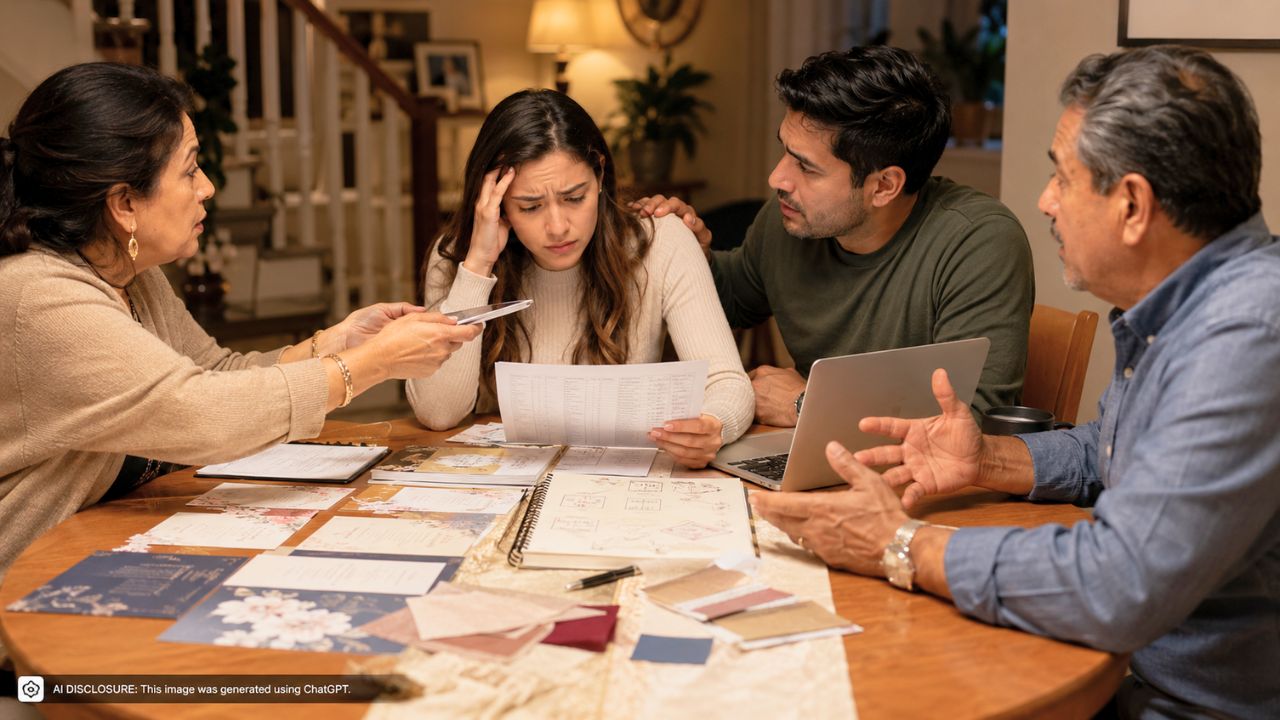
Photo credit: AI-generated image created using ChatGPT. Illustrative only.
Wedding planning has a way of turning “small favors” into big, emotional power struggles. For one 25-year-old bride, it wasn’t the flowers or the dress that pushed things to the edge—it was the guest list, the venue capacity, and a parent who wouldn’t stop pushing for “just a few more people.”
She and her fiancé are getting married later this year, and they’ve already made the hard calls that come with a smaller space. The kind where you stare at the list and realize every extra name means someone else doesn’t make the cut.
But once her mom started asking for additional invitations for extended relatives she barely speaks to, it stopped feeling like a suggestion and started feeling like a demand. And when the bride tried to shut it down, the conversation flipped into something else entirely: who gets to decide what her wedding looks like.
The wedding was already built around a smaller room
From the start, this wasn’t a 200-person blowout. The couple chose a smaller venue, and they were already forced to trim their guest list down to close friends and immediate family. It wasn’t easy, and it wasn’t casual.
They weren’t cutting because they didn’t care. They were cutting because reality was doing what it always does in wedding planning—showing up with a budget, a room size, and a hard limit.
Financially, the couple is carrying most of the load. The bride shared that they’re paying about 80% of the wedding themselves. Her parents offered a contribution, which she appreciated, but the money came with an assumption that would become the center of the blowup.
Then her mom asked for more invites—specifically for relatives she doesn’t even like
Her mom didn’t ask for one extra seat. She asked for four additional invitations for relatives the bride barely talks to. Not “people who raised her,” not “the aunt who feels like a second mom,” but family members who, in her words, aren’t actively in her life.
One name on the request list felt especially pointed. The bride said one of the relatives was a cousin who had openly mocked her at a previous family gathering and tends to make passive-aggressive comments.
That detail matters, because it changes the vibe from “including family” to “forcing a guest you don’t feel safe around.” Some people can tolerate an awkward distant relative for a holiday meal. A wedding is different. It’s expensive, emotional, and full of moments you can’t redo.
So she told her mom no. There wasn’t space, and they’d already prioritized the people who are actually present in their lives.
The conversation turned into a money-and-control standoff
That’s when her mom shifted the argument. Instead of acknowledging the space limit, she framed it as a fairness issue: since the parents are contributing financially, they should get some say in who attends.
It’s one of those lines that sounds reasonable for about two seconds—until you think through the consequence. If money equals decision-making power, then the wedding stops being the couple’s event and starts becoming a shared project where the loudest opinion wins.
The bride didn’t scream. She didn’t threaten. She offered something that, on paper, should have solved it: she said she’d return her parents’ contribution if it meant they could keep the guest list exactly as it was.
Instead of taking that off-ramp, her mom got angrier. The bride said her mom accused her of being disrespectful.
Now they were no longer arguing about four chairs. They were arguing about authority, gratitude, and whether a financial gift is still a gift once it’s used as leverage.
She tried to keep the peace, but she didn’t want “strangers” at her wedding
There’s a specific kind of exhaustion that comes from being told to invite people “for appearances.” The bride described these relatives as basically “strangers,” not because they’re literal strangers, but because the relationship isn’t real in any meaningful day-to-day way.
And she didn’t pretend the emotional side wasn’t there. She said she doesn’t want any family tension, but she also doesn’t want people at her wedding just to satisfy someone else’s idea of what the guest list should look like.
Her reasoning was simple: it’s their day, not her parents’ day.
What makes this kind of situation spiral is that it puts a bride in an impossible position. If she caves, she’s uncomfortable at her own wedding, paying for the privilege of being uncomfortable. If she doesn’t cave, she becomes the villain in a story where “family” is treated like a trump card that overrides everything else.
The “invites are already handled” line became her final stop
In scenarios like this, the push rarely happens once. It happens in waves: another phone call, another “I was thinking,” another relative name floated like it’s harmless. The headline version of this moment is the kind of firm, no-more-negotiations message brides end up using when soft answers aren’t respected—when you have to make it clear the decision is done and the train has left the station.
That’s the energy behind the idea of saying the invitations are already finalized and sent to print. It isn’t about being dramatic. It’s about ending the loop where every boundary becomes a debate, and every “no” turns into a new angle.
Because once someone believes they can keep adding names past every cutoff, deadlines stop mattering. And if deadlines don’t matter, the couple never gets to actually plan—only react.
The bride’s real-life version of that final stop was offering to return the money and keep the list unchanged, which is another way of saying: “If you want control, I won’t take the funds.”
The question she couldn’t shake: is she wrong for holding the line?
In the original post, she boiled it down to what a lot of couples quietly worry about: is she being rude, or is she protecting her wedding from becoming an obligation-filled family performance?
Her parents did contribute, and she doesn’t deny that. She appreciates it. But she also didn’t want that contribution to become a tool used to override the couple’s decisions—especially when the “requested guests” include someone who has already treated her poorly.
She’s left trying to balance two things that don’t naturally go together: keeping the peace with her parents and keeping the wedding day comfortable for herself.
And for now, the situation is still unresolved in the most stressful way possible: not with a clear agreement, but with hurt feelings, accusations of disrespect, and a bride wondering if holding firm makes her the problem—or if giving in would set the tone for every future milestone, too.