Mother-in-Law Demanded a Set Weekly Schedule With the Baby — Then the Mom Said Grandparents Don’t Get Custody Arrangements

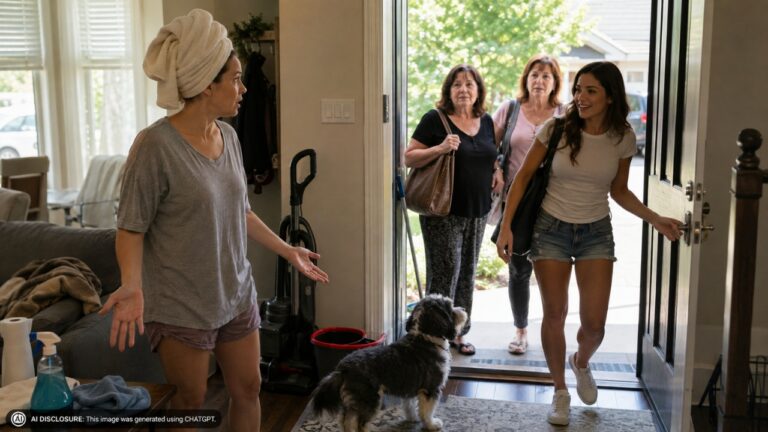
Photo credit: AI-generated image created using CHATGPT. Illustrative only.
At 37 weeks pregnant, she expected the usual end-of-pregnancy nerves: the hospital bag, the baby kicks at 2 a.m., the “is that a contraction?” spiral. What she didn’t expect was to be negotiating a standing visitation schedule with her mother-in-law for a baby who hadn’t even arrived yet.
But that’s exactly where she found herself after a dinner conversation went sideways. Her husband’s mom wasn’t just excited for her first grandchild—she was acting like she’d already been assigned a weekly time slot. And when she declared Fridays as “her day,” the mom-to-be snapped with a line that made the table go quiet: “Are you going to file for joint custody too? You don’t get to choose.”
The pressure was already intense before the baby even arrived
In the original post, the expecting mom explained that her mother-in-law has reasons for feeling extra attached to this pregnancy—reasons that are sad, complicated, and also not the pregnant woman’s responsibility to manage.
Her husband is now an only child after the death of his brother when they were young adults. The loss still hits his mom hard, and the “family name” pressure has hovered over the couple for a long time. Adding another emotional layer, the baby girl is due on the late brother’s birthday, which the mom-to-be said makes the situation feel even heavier.
So yes, this grandmother-to-be is thrilled. But the excitement has come with a lot of steamrolling, and the pregnant woman said it’s been making her feel like her own pregnancy is being treated as someone else’s life event.
The first red flags were small… until they weren’t
The couple had one simple request early on: don’t tell people yet. They wanted to share the news on their own timeline.
That boundary lasted seconds. The mother-in-law immediately started texting family, and because she’s a hairdresser, she also told “every single one” of her clients that she was going to be a grandma. The mom-to-be described it like the news wasn’t hers to share anymore—it had become community information, broadcast through a salon chair.
Then came the preparation, except it wasn’t the helpful kind where someone asks what you need. The mother-in-law thrifted “literally one of everything” for her own house without checking what the parents wanted, needed, or were comfortable with.
And as if that wasn’t enough, she reportedly had a “grandma shower” thrown with older clients from a convalescent home where she does hair. She didn’t ask—she told the mom-to-be that she planned to bring the baby there and have the residents “take turns holding” the child while she worked.
To the pregnant mom, it wasn’t just overexcited. It felt like planning ownership.
Dinner turned into a custody-style negotiation
The breaking point came at dinner when the couple tried to “manage her expectations” before the birth. The mom-to-be said the conversation didn’t go well, largely because her mother-in-law didn’t treat it like a discussion.
Instead, she announced a plan: she would be taking the baby every Friday. Not occasionally. Not when asked. Every Friday, because it’s her day off.
Her husband tried to slow it down with what sounded like a compromise: maybe once both parents were back at work. That’s when his mom doubled down. No, she said—right away. And if not taking the baby, then sleeping over at their house. It wasn’t framed like help offered; it was framed like a schedule being implemented.
When the husband asked the obvious question—what if they want a Friday with their own daughter?—his mom’s response was blunt: “No. Fridays are my day with my granddaughter.”
That’s when the pregnant woman blurted out the custody comment, comparing the demand to a co-parenting arrangement. She felt rude afterward, but also couldn’t get past what she saw as a wild level of entitlement.
It wasn’t just the schedule—it was the way she saw herself in the parenting role
The mom-to-be didn’t pretend this was only about one Friday statement. To her, it was part of a bigger pattern: the mother-in-law talking like she had decision-making power, and treating her own past parenting choices as the gold standard.
She said her mother-in-law regularly references how she did things as “the standard,” and that some of those practices are “incredibly antiquated.” When the pregnant mom disagrees, she feels talked down to, like she’s a kid being corrected instead of an adult about to become a parent.
Underneath all of it, she admitted she had a thought she’s been trying hard not to say out loud: that her mother-in-law might be trying to fill the emotional void of losing her son by attaching herself too tightly to the baby. The mom-to-be even acknowledged that this might be “unfair psychoanalysis” fueled by rage, but it still felt hard to ignore.
And then there was another looming issue: the mother-in-law “fully expects” to be in the delivery room. The mom-to-be made it clear that wasn’t happening, and she wasn’t even sure she wanted hospital visitors at all.
After she walked away, her husband stepped in
One detail that softened the situation—at least a little—was what happened after the dinner moment exploded. The mom-to-be said she got up and left the table, and her husband stayed behind and handled his mom directly.
According to her update, he was “very straightforward” that his mother needed to erase any sense of expectation and entitlement, because they weren’t committing to plans or building their newborn’s life around someone else’s schedule. His mom pushed back at first, but then ultimately agreed and behaved better for the rest of dinner.
It wasn’t a magical fix, and the mom-to-be didn’t act like it was. But it mattered that her husband didn’t shrug it off or leave her to be the bad guy. He spoke up, drew the line, and made it clear that parenting decisions belong to the parents.
The question now is how she’ll react once the baby is actually here
The mom-to-be admitted she knows she may welcome help and advice once she’s postpartum, and she doesn’t want to shut out support just because she’s feeling protective as a first-time mom. But she also doesn’t want “help” that comes with ownership, surprise plans, and weekly demands.
Because the hard part isn’t saying no once at a dinner table. The hard part is what happens later—when there’s a newborn, when everyone’s tired, when someone tries to show up on a Friday like it’s a standing appointment.
For now, the couple says they’ll keep repeating the message and, if there’s another overstep, they’ll take “more dramatic measures.” And for a mom about to give birth, that’s probably the most realistic ending there is: not a clean wrap-up, but a line in the sand before the real-life pressure test begins.