MIL Said She’d Earned the Right to See Her Grandson Alone — Then the Mom Said That Wasn’t How Trust Works
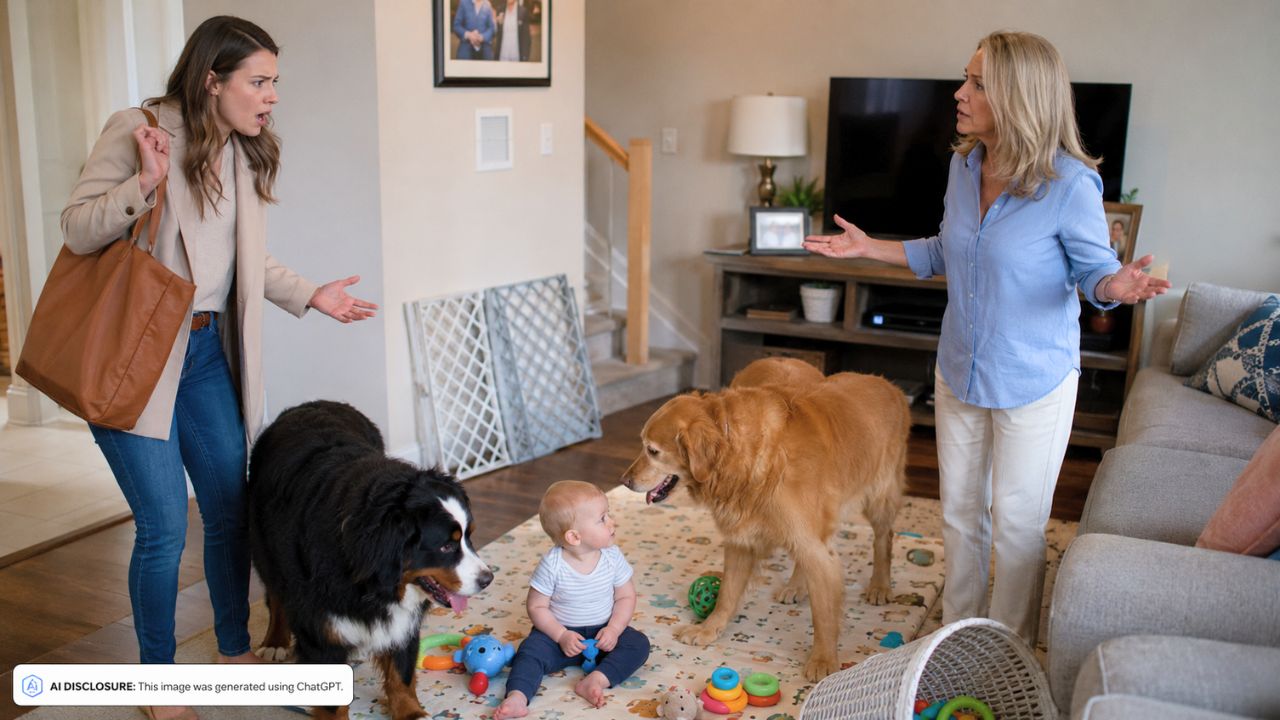
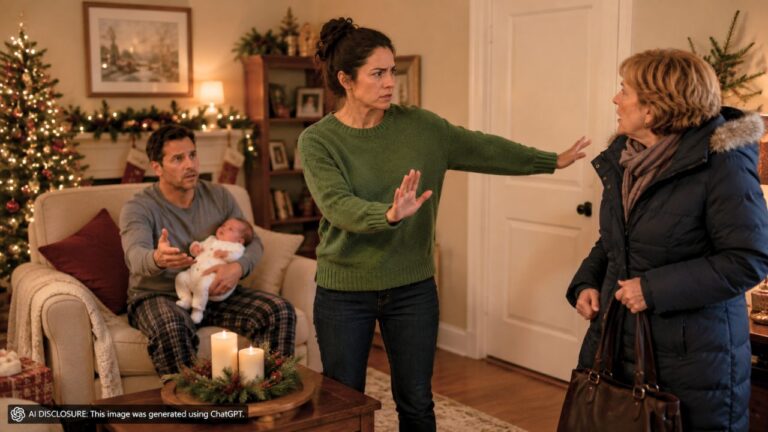
Photo credit: AI-generated image created using ChatGPT. Illustrative only.
It started like so many grandparent babysitting arrangements do: a little compromise here, a swallowed complaint there, and a mom telling herself she could “pick her battles.” But one thing wasn’t negotiable—her one-year-old son being around two large, untrained dogs.
She’d told her mother-in-law from the beginning that she didn’t want the dogs having free access to the baby’s play space. At minimum, she wanted a baby gate up. In her mind, it wasn’t about being picky. It was about keeping a toddler safe in a house where the animals weren’t trained, weren’t socialized well, and had already shown behavior that made her uneasy.
And then one weekend, she walked in early and found the exact situation she’d been trying to prevent.
The problem started before the big blowup
In the original post, the mom explained that her MIL had a habit of ignoring requests while watching her one-year-old son, “C.” Most of the time, she let small stuff go. But the dogs were the line she couldn’t cross.
MIL had two big dogs that, in the mom’s words, were “untrained & poorly socialized.” Even without that, she believed dogs and little kids shouldn’t be left alone together. On top of that, she admitted she had past trauma that made her especially uncomfortable with dogs having easy access to the baby, even when an adult was around.
Her request wasn’t complicated: keep the gate up to block the dogs from the play area when C is there. She wasn’t demanding the dogs be locked away all day, just separated during visits so her child could play without two large animals wandering in and out.
MIL didn’t like the rule, but agreed anyway
When they first talked about it, MIL pushed back fast. She basically framed the request as disrespectful to the dogs’ routine, saying, “this is their home & they aren’t used to being gated out of rooms.”
The mom tried to meet her halfway. If the gate was a problem, she suggested MIL could babysit at the parents’ house instead. That way, the dogs wouldn’t be part of the equation at all.
But that idea hit another nerve. MIL got upset and complained that babysitting at the parents’ house would “take away her overnight visits.” In the end, she reluctantly agreed to keep the dogs gated away from C during visits, and the mom thought they had a working arrangement—even if it felt like pulling teeth to get there.
At least on paper, the deal was set.
Then they walked in early—and saw everything
The situation blew up the weekend the parents went to pick up C after he’d spent the night with MIL. They arrived earlier than planned, and the father-in-law let them in.
MIL didn’t hear them come in. And that’s when the mom got the kind of gut-punch moment parents don’t forget.
She walked toward the playroom and saw there was no gate. MIL wasn’t in sight. And the dogs were alone with the baby.
She grabbed her son and went looking for MIL, finding her “on the other side of the house.” The mom asked why C had been left alone with the dogs after she’d explicitly asked that not happen.
MIL’s response wasn’t apologetic or even embarrassed. She shot back, “well he wasn’t bit, was he?”
The mom tried to explain that the point wasn’t whether something had already happened—it was the fact that something could have happened. A one-year-old doesn’t know how to treat animals gently, and two large, untrained dogs don’t need much of a trigger to react in a way that can’t be taken back.
But MIL doubled down and accused her of being dramatic. Then she said something that stopped the mom cold: she’d “been letting C pull their tails & fur & the most they do is growl and snap at him, but they haven’t actually got him.”
So it wasn’t just that the gate was down. It was that the baby had been allowed to harass the dogs until they growled and snapped—signals that many adults would consider warnings—yet MIL still treated it like proof everything was fine.
The mom said she couldn’t even keep arguing because she was so shocked and upset. Instead, she laid down a consequence: “From now on if you’d like time with your grandson it will be supervised.” Then she walked away.
The husband stayed “out of it,” and that didn’t help
After telling her husband what she’d seen, the couple left. On the drive home, MIL called her son crying.
Instead of stepping in, the husband told both his mom and his wife that he “wasn’t getting involved” and that they should “sort it out ourselves.” That might sound neutral, but in families like this, neutrality often lands like abandonment—especially when one person is making safety decisions and the other is trying not to upset anybody.
Later, the mom got a text from MIL saying she had “no right” to put limits on her time with C. MIL didn’t frame it as a misunderstanding or a mistake. She framed it as a power struggle—one she didn’t intend to lose.
And then she escalated it even further.
“Grandparent rights” and the culture argument
In her text, MIL threatened to seek court-ordered visits, claiming “grandparent rights” if overnight visits and babysitting were taken away.
The mom said she didn’t believe MIL would actually be able to get court-ordered visitation. But the threat itself landed hard, because it wasn’t about smoothing things over. It was about forcing access.
As if that wasn’t heavy enough, other family members piled on with a cultural argument. They told the mom she was in the wrong and that, in their Hispanic culture, “Abuela has more say than mom.” According to them, by marrying into a Hispanic family and having a baby, she had “agreed” to that dynamic.
That left the mom stuck in a nightmare triangle: a MIL who ignored her rules, relatives who claimed she didn’t get to make them, and a husband who said he’d “go with whatever” she decided but also called her decision “excessive & mean.”
So the consequence—supervised visits only—turned into a referendum on who gets to call the shots.
Where things were left: supervised, or nothing
The mom didn’t describe any reconciliation. What she described was a clear decision: if MIL wanted time with C after leaving him alone with untrained dogs—and after admitting she let him pull their tails until they growled and snapped—it wouldn’t happen without supervision.
And even though her husband said he’d follow her lead, he also made it clear he didn’t fully support it emotionally, which is the kind of detail that can quietly poison the next family gathering, the next babysitting request, and the next “I’m just trying to help” speech.
For now, the message was simple: trust isn’t something you “earn” by being a grandparent. It’s something you keep by doing the one thing you were asked to do—especially when a child’s safety is on the line.