In-Laws Demanded to See the Newborn on Their Schedule — Then She Decided Not to Answer the Door
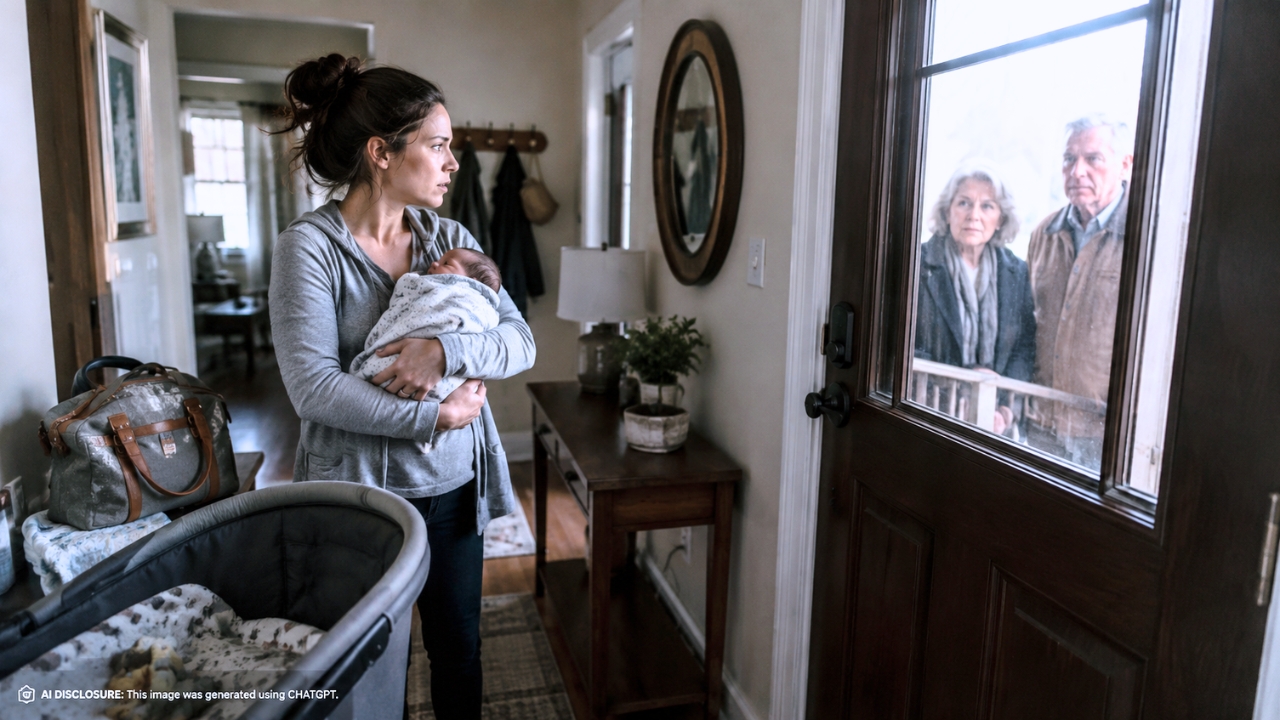
Photo credit: AI-generated image created using CHATGPT. Illustrative only.
She’s not due until December, and she’s already doing the mental math every expecting mom knows too well: who’s going to want access to the baby, when, and on what terms. Except in her case, there’s an added twist—she and her husband won’t even be bringing their newborn to their own place.
Instead, the 27-year-old mom-to-be and her 26-year-old husband are moving into her parents’ house in September for financial reasons while he finishes school. It’s practical. It’s temporary. And it also makes her original postpartum plan feel impossible to enforce.
She had a plan for the first month, until life changed it
Before the moving plans came up, her idea was simple: no visitors for the baby’s first month. The goal wasn’t to be dramatic or controlling—it was about illness prevention and giving herself time to recover without a parade of people passing the newborn around.
But once the couple decided they’d be living with her parents for the next year or two, that “no one for a month” rule started to crumble. It’s hard to keep someone from seeing the baby when they live in the same house, and she admitted that excluding her parents would also mean losing out on the kind of help new parents often desperately need.
So she started thinking about a compromise: allow her parents to be around the baby since they’re sharing a home, but keep the one-month “no visits” rule for her in-laws.
The hospital question brought the awkwardness to the surface
It wasn’t just about popping by the house after the birth. Both sets of parents had already expressed they wanted to be at the hospital when the baby arrives.
That’s when the pressure started to feel real. Her mother-in-law had asked about the hospital plans, and the mom-to-be didn’t know what to say. She didn’t want to upset anyone, but she also didn’t want to agree to something she’d regret when she’s exhausted, healing, and trying to figure out breastfeeding and sleep deprivation in real time.
There’s also an emotional layer she didn’t gloss over: she believes her in-laws already dislike her, partly because of a language barrier and partly because her personality reads as “skittish/aloof,” something she connects to past trauma. Basically, she’s not walking into this conversation with the confidence that everyone will assume good intentions.
Letting her parents help felt fair… until it didn’t
On paper, the idea made sense. If she and the baby are living under her parents’ roof, those grandparents are going to see the baby. They’ll be in the kitchen, the hallway, the living room—real life. And she openly acknowledged that their help would be “great,” which is the understatement of the century for anyone who has seen the postpartum stage up close.
She even considered setting smaller rules instead of a full ban, like asking her mom not to get close to the baby’s face while still helping out around the house.
But once she said it out loud, another question popped up: is it unfair to give her parents access while shutting out the in-laws for a month?
That’s the part that stuck in her head. Not because she suddenly wanted a house full of visitors, but because she could already picture how it might be framed: her family gets special treatment, his family gets kept at arm’s length. And if the relationship is already strained, that kind of decision doesn’t land softly.
Her real fear wasn’t just germs—it was control
Even though the concern began with illness prevention, the heart of the situation was about who gets to decide what postpartum looks like.
When extended family members want to “be at the hospital,” it can come with expectations—like being in the waiting room, being first to hold the baby, dropping in when it’s convenient for them, and treating the birth like a group event rather than a medical experience happening to one person.
And because she’s living with her parents, there’s already a built-in imbalance. Her parents will inevitably have more access than his. The question is whether she should try to equalize that by pulling back from her own parents too, even if that makes her life harder.
In her mind, it seemed like there were only two options: accept help from her parents and risk drama with the in-laws, or enforce the same rule on everyone—even if that means less support during the toughest weeks.
In the the original post, she asked for advice before she accidentally set off a family fight she couldn’t walk back.
She reconsidered after feedback and admitted one influence
After hearing people out, she posted an edit that shifted the tone. She said she agreed she was “probably watching too much Tiktok,” and that while a full one-month break from visitors sounded nice, it wasn’t very realistic—especially without having her own place.
Instead of trying to enforce an uneven rule between the two families, she decided to focus on precautions: asking everyone to wash their hands and be careful while still allowing them to see the baby.
It wasn’t a dramatic mic-drop ending. There was no big confrontation. Just a mom-to-be realizing that her day-to-day reality—living with her parents, needing support, and not wanting to ignite resentment—required a plan she could actually maintain.
And honestly, that’s where a lot of these situations end up: not with the perfect boundary, but with the boundary you can enforce at 2 a.m. when you’re tired and the baby is crying.
The decision didn’t erase the underlying tension
Even with a more flexible approach, the uncomfortable part is still sitting there. Her in-laws want to be involved. Her parents will have built-in proximity. And she’s already feeling the sting of being misunderstood by her husband’s family.
Her edit suggests she’s leaning toward a middle ground—letting family meet the baby with basic hygiene precautions, rather than a strict isolation period. That may reduce the “you’re keeping us out” narrative, but it doesn’t solve everything about hospital access, timing, or expectations.
Because the truth is, the first real test won’t be what she writes in a message months in advance. It will be the moment she’s postpartum and someone asks, “So when can we come by?” and they mean now. Or when someone decides the schedule should revolve around them instead of the baby’s needs.
For now, she’s trying to set a plan before emotions are running high—and before anyone is standing on the doorstep expecting to be let in. In families where hurt feelings travel fast, thinking ahead can be the difference between a quiet newborn phase and a months-long grudge.