Her Mother-in-Law Had Been Planning Her Delivery Room Entrance for Months — Then the Mom Told the Hospital Staff That Plan Was Never Happening

Photo credit: AI-generated image created using ChatGPT. Illustrative only.
It started with a dinner meant to celebrate a long-awaited first pregnancy. By the time dessert should have been on the table, the expectant mom felt like she was negotiating access to her own medical event—and her own home.
A 27-year-old woman said she and her 27-year-old husband recently got married in May and then found out they were expecting their first child. They were excited, but she quickly realized his side of the family had a very different idea of what “being involved” was going to look like. And his mother, she said, wasn’t treating involvement like a request.
The boundaries were already a problem before the pregnancy
The mom-to-be explained that her husband comes from a large, tight-knit family where everyone is in everyone’s business. She comes from a smaller setup—three sisters—and she’s used to more deliberate boundaries, especially around children.
She gave one specific example: when she posts her nieces and nephews online, she keeps it respectful, sharing only things like hands or the backs of heads because she’s honoring her sisters’ preferences. On her husband’s side, she said, relatives don’t operate that way and “will post whatever.” It wasn’t just a difference in style—it was a preview of how they might behave once a new baby arrived.
Then came another moment that stuck with her. A friend of theirs was due to give birth soon, and her mother-in-law openly talked about how she “couldn’t wait” to meet that baby before leaving on a New Year’s trip that had been planned long ago. The expectant mom questioned why her mother-in-law assumed visiting would be allowed, especially during a time of year when illnesses spread easily. She said her mother-in-law just stared back and didn’t answer.
The pregnancy news spread fast—and she hadn’t even told her own family
When the couple found out she was pregnant, her husband was thrilled and immediately told his parents and sister. The next thing she knew, congratulations messages started pouring in from extended relatives.
That didn’t feel like a warm welcome to her—it felt like a warning. She said she didn’t even know how far along she was yet, and she was anxious about being “out of the woods” regarding miscarriage risk. On top of that, she hadn’t had the chance to tell her own parents or sisters first.
She confronted her husband about it. At first, she said, he got defensive. But once she told him how hurt she was, he apologized. Still, the damage was done: private medical news had already become family news, without her consent.
At dinner, her mother-in-law spoke like she’d already been assigned a role
The couple went to his parents’ house for dinner to celebrate the pregnancy, but also to set expectations for privacy going forward. The mom-to-be said the conversation didn’t stay calm for long.
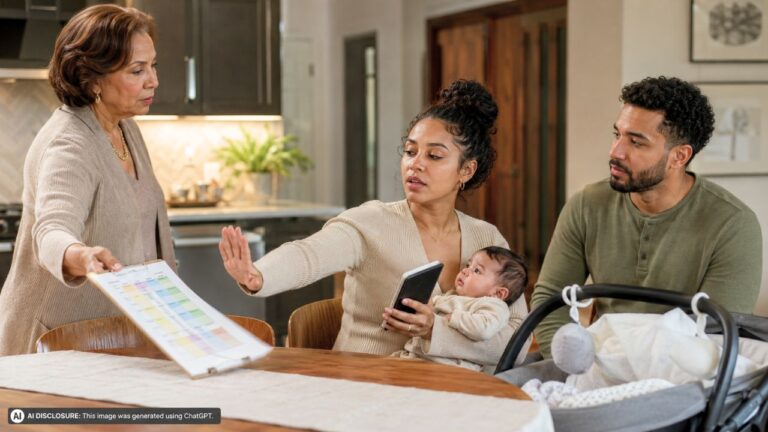
Her mother-in-law started asking about birth plans: when she might be due, what hospital they’d chosen, and how she’d need to ask for time off. Then, according to the post, the mother-in-law said she “couldn’t wait to be in the room.” She also mentioned having a room ready at the couple’s house so she could stay and help with the baby.
The expectant mom described feeling steamrolled—like the plan was being announced at her rather than discussed with her. She said her mother-in-law kept talking, not letting her get a word in, until she finally cut in with a clear “no.”
Only she and her husband would be in the delivery room, she said. After they came home, they wanted a week to themselves with the baby. And while she thanked her mother-in-law for the offer to help, she made it explicit that she wouldn’t be living with them.
Her husband backed her up, but the pushback didn’t stop
Her mother-in-law didn’t take the boundary as final. She looked offended, the expectant mom said, and insisted that her son would want her there.
That’s when the husband stepped in directly. He told his mother he agreed with his wife: no one else would be in the room besides the two of them. The father-in-law tried to cool things down by telling his wife it was okay and that “times are different,” which seemed to take some heat out of the moment, at least temporarily.
But the mother-in-law moved straight to the next milestone—gender. She asked if, once they found out, she could do a gender reveal. The expectant mom said they didn’t want to know the gender at all and planned to keep it a surprise.
Instead of letting that stand, the mother-in-law replied, “that’s okay bring me the ultrasound photos and I’ll know.” The expectant mom said she wanted to respond, but she was emotionally drained and stayed quiet for the rest of the night. Afterward, she said, she felt distant from her husband despite him supporting her in the moment.
A relative labeled her the villain, and the stakes got real
The next day, she received a text from one of her husband’s relatives saying she was wrong for telling her mother-in-law she couldn’t be in the delivery room—and that she was “robbing her from that experience.”
It was a familiar escalation for anyone who has dealt with boundary-heavy families: once a private disagreement becomes a group discussion, the pressure multiplies. Suddenly it’s not just an awkward dinner conversation. It’s extended family weighing in, taking sides, and framing a medical boundary as a personal attack.
That matters here because childbirth isn’t a spectator event. It’s a medical procedure with pain, vulnerability, and serious health considerations. The delivery room also comes with practical issues the expectant mom was already worried about: exposure to illness, unwanted photos, and information spreading faster than she can manage.
In her mind, it wasn’t only about the birth. It was about what happens next—who shows up, who posts what, who believes they’re entitled to access, and how hard it might be to put the genie back in the bottle once the baby is here.
What people focused on: locking down the hospital plan and the information flow
In the original post, the expectant mom asked whether she was wrong for telling her mother-in-law “no.” The strongest thread running through reactions was that the person giving birth gets to decide who is present, and that hospitals are used to enforcing that choice.
Even without a play-by-play of every response, the practical angle is clear: the couple will likely need to be proactive, not just verbally firm. When a family member is already talking like they’ll be in the room and staying in the house—and then recruiting relatives to apply pressure—simply hoping they’ll accept “no” can be risky.
That means tightening the circle on who gets details like the due date, which hospital they’re using, and when labor starts. It also means making sure hospital staff are aware of the plan long before delivery day so the burden doesn’t fall on the mother while she’s in labor.
For this couple, the unresolved tension isn’t whether the mother-in-law will feel left out. It’s whether she’ll respect the decisions being made by the parents—before the birth, during it, and in that first week at home when the new family wants privacy. The husband backed his wife at dinner. The next test is whether that unity holds when the phone keeps buzzing and the pressure ramps up.