Extended Family Assumed Their Wedding Invites Were Automatic — Then the Couple Told Them the List Had Already Been Finalized
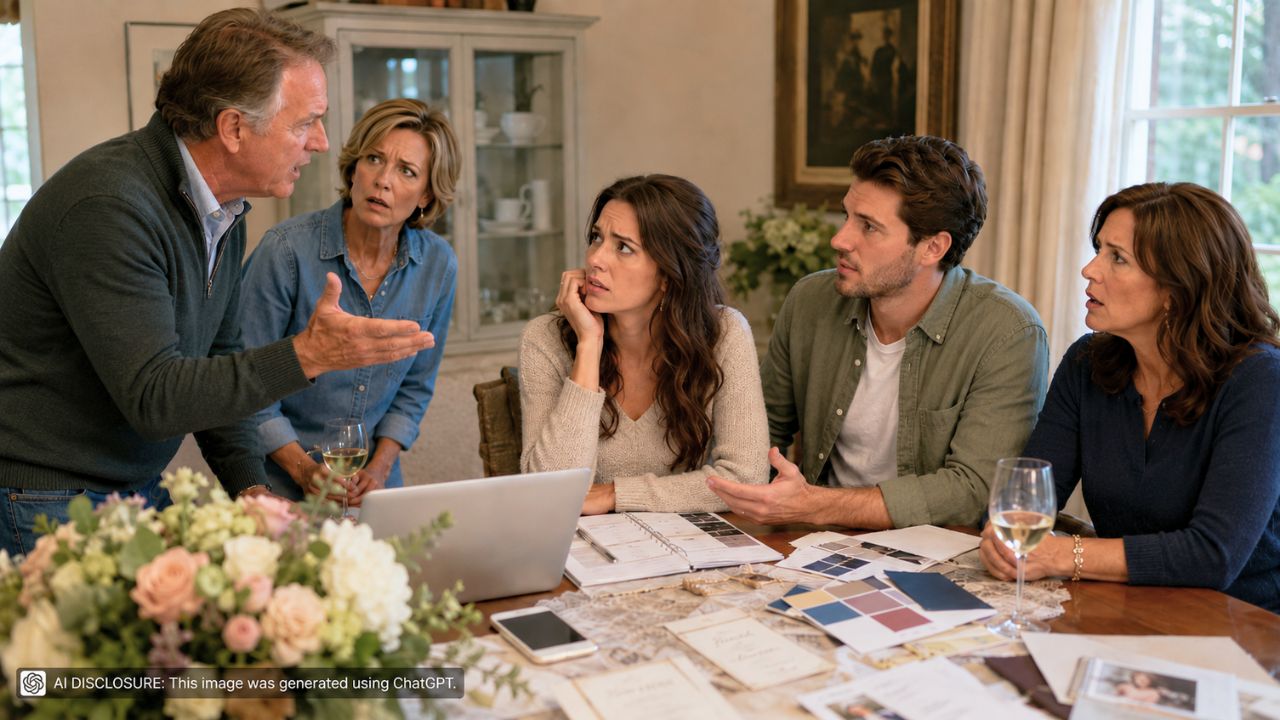
Photo credit: AI-generated image created using ChatGPT. Illustrative only.
Wedding planning can make even the calmest families act like the guest list is a group project. And for one 25-year-old bride, the moment she and her fiancé tried to keep things small turned into a full-blown argument with her dad—because his definition of “family” comes with a lot of extra people attached.
She didn’t want a huge event. She wanted the people she actually feels close to, the ones who’ve shown up in her real life, not just on paper. But her dad heard “wedding” and seemed to assume that meant an automatic invite for anyone he considers part of his household orbit.
A small wedding meets a very complicated family tree
The bride’s parents are divorced, and both remarried. On her mom’s side, the story is simple: her mom has been with her stepdad since she was 8, and the relationships feel stable and familiar.
Her dad’s side, though, is the kind of situation where you need a flowchart and a deep breath. Her dad shares the bride and her two brothers with her mom, but that’s only the starting point. He has children with multiple partners—Emma with Lauren, Daniel with Mia, Jessie and Cole with Amanda, Luna with Kate—and he’s currently married to Janet, with two kids of their own. On top of that, Janet has five kids from different relationships.
And it doesn’t stop there. The bride explained that her dad is also involved in the life of Mia’s other son, and that he “took on” Amanda’s daughter even though she isn’t biologically his. In her world, that means her dad’s side is always expanding, always complicated, and somehow everyone is expected to organize their lives around it.
They finalized the guest list based on closeness, not obligations
When she and her fiancé started planning, they agreed on a smaller wedding—one focused on the people closest to them. And that’s where the math started to matter.
She admitted she isn’t close to her half-siblings or step-siblings, but she still made an exception and included them anyway. In other words, she already stretched her comfort zone for the sake of keeping the peace.
But two specific kids felt like a step too far: Amanda’s daughter and Mia’s other son. Her dad may consider them his own, but she doesn’t view them as her siblings, and she didn’t want to “factor them into” the wedding numbers.
There was also a practical problem: inviting those kids would likely mean inviting Amanda, too. The bride pointed out that Amanda had said she wouldn’t want her youngest traveling out of state without her, which would turn two extra invites into three—and that’s before you even get into whether other adults would expect the same treatment.
The line they drew was clear—and her dad hated it
So the couple made what they thought was a straightforward decision: invite her dad, his wife Janet, and her half- and step-siblings. That’s it. No ex-partners. And no additional kids her dad feels responsible for.
In her mind, it wasn’t meant as a personal insult. It was a boundary based on relationship and size. But her dad didn’t hear it that way.
He was “pissed off,” she said, and argued that more of his side should be invited. The frustration wasn’t subtle. From his perspective, the wedding was a time to include the entire extended, tangled family unit he’s built over the years—and he seemed to feel entitled to a bigger say in the guest list.
For the bride, this wasn’t just about two extra names. It was about the pattern: the constant expectation that everyone else should bend to accommodate the chaos on his side, even when it’s exhausting and requires “a lot of effort to try and get everyone together.”
Then the numbers made the unfairness feel even louder
When she laid out the guest count, the imbalance became obvious. Her fiancé had invited a tiny group: his parents, two siblings, and four grandparents. Her mom’s side was similarly small—just her mom, stepdad, and grandparents.
Her brothers were included, bringing their spouses. The couple also invited five friends total between them. It was intimate, not a ballroom blowout.
Meanwhile, her dad’s side already accounted for 14 people, and with her grandmother included, it hit 15. That’s before adding the two kids her dad wanted included—and before adding Amanda, if that became necessary. For a small wedding, that’s a huge percentage of the room taken up by one parent’s complicated situation.
And the detail that made her frustration sharper: she and her fiancé were paying for the entire wedding themselves. Not her dad. Not anyone else. Just the two of them.
Which meant the demand wasn’t coming with a check attached—only pressure.
Why this didn’t feel like “just inviting a couple more people”
From the outside, some families would say, “It’s only two more kids.” But in a small wedding, two more people isn’t nothing. It changes seating. It changes catering. It changes the vibe. And it can open the door to even more expectations.
Because if she invites the kids her dad “took on,” what happens next? Does Mia expect to be invited, too, since her son is? Does Amanda insist she needs to come along? Does Janet feel like her five kids should get plus-ones? In blended families, one exception can quickly turn into a whole new branch of the guest list.
The bride seemed to understand that part instinctively. She wasn’t just deciding against two extra invites—she was trying to stop the guest list from turning into a symbol of her dad’s entire romantic history and current household structure.
And she was trying to avoid making her wedding day feel like a reunion she didn’t plan.
The question she couldn’t shake after the argument
After her dad got angry, she was left wondering if she’d crossed a line by not including everyone he considers family. She wasn’t questioning whether she loves her dad. She was questioning whether her wedding was required to validate every relationship he’s collected over the years—and every child he’s chosen to play a parental role for.
It’s also clear she wasn’t trying to punish anyone. She already invited half- and step-siblings she isn’t close to, purely to be inclusive. She just didn’t want to keep expanding the circle until the wedding became unrecognizable.
The situation, as she shared it in the original post, ended with her dad still upset and her still holding the line: the guest list was set, the wedding was meant to be small, and she wasn’t willing to add people she doesn’t see as her siblings—especially when it would likely mean adding even more adults to manage.
And honestly, that’s what makes this kind of wedding drama so brutal. It’s never just about the chairs. It’s about who gets to define “family,” who gets to make demands without paying the bill, and whether a couple is allowed to plan one day that doesn’t revolve around someone else’s mess.