Neighbor Sued Over 14.6 Square Feet and Demanded They Tear Down Their Retaining Wall — Then Alaska’s Supreme Court Sided With Them
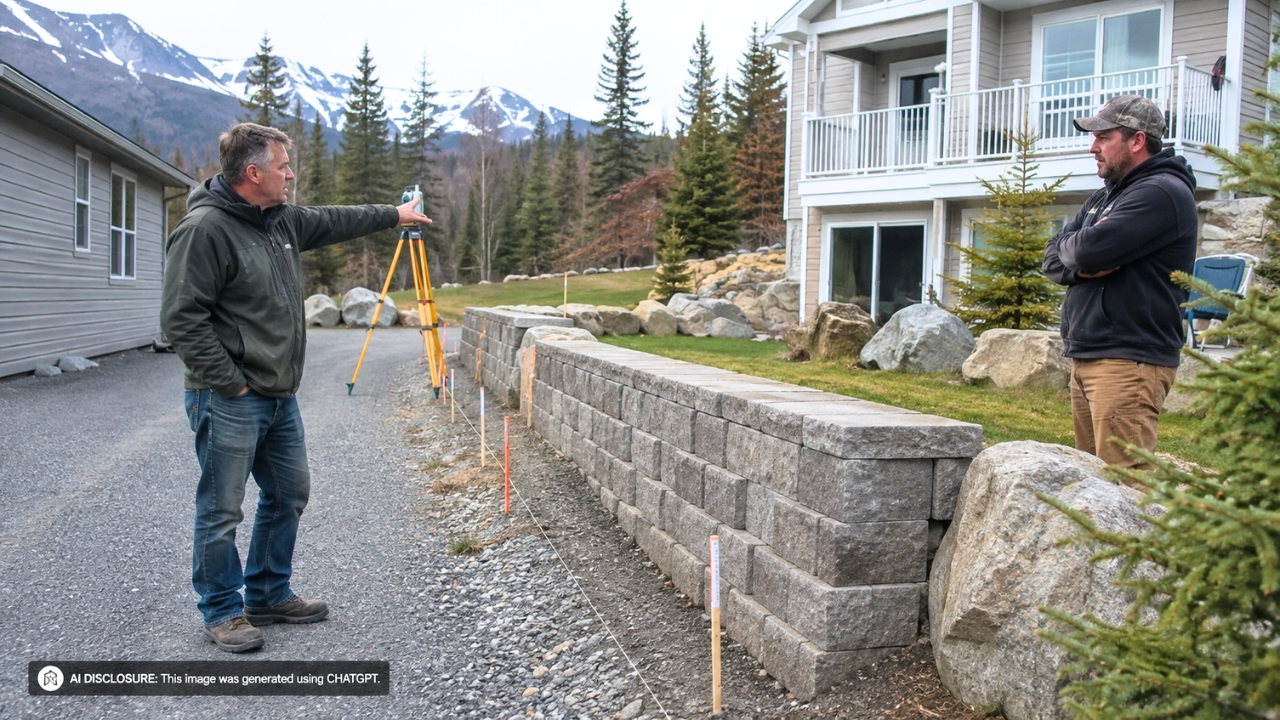
Photo credit: AI-generated image created using ChatGPT. Illustrative only.
Property line fights have a way of making normal people act like they’ve lost their minds. It starts with a fence, a wall, or a shed that “feels” a little too close, and before long you’re measuring inches like they’re miles and talking about “principles” like you’re defending the Alamo.
In Alaska, one neighbor claimed a retaining wall crossed the line by 14.6 square feet and demanded it come down. The case climbed all the way to the state’s highest court, and the outcome is a pretty sharp warning about what happens when a civil dispute turns into a personal crusade. The details come from the source material in Humphrey v. Reges, decided June 5, 2026.
The Alaska Supreme Court affirmed the lower court’s ruling for the neighbors who built the wall. It also upheld the trial judge’s decision to remove the suing homeowner from the trial after repeated disruptions, and it left in place an attorney’s fee award that would make most people sit down and reassess their life choices.
A wall, a survey, and a claim of 14.6 square feet
The dispute was between two adjacent lot owners. Robert and Mala Reges owned Lot 38, which Robert Reges bought in 2006, and Dion Kirk Humphrey owned Lot 39, purchased in 2008. The dividing line between the lots wasn’t a simple straight shot; it had angles and points that came up repeatedly, referred to in the litigation as corners #1, #2, and #3.
In 2006, the Regeses hired a surveyor (Fred Walatka of Walatka & Associates) to survey their property. At some point between 2006 and 2023, they built a retaining wall along the boundary area. Then in May 2023, Humphrey hired Elizabeth Walatka—of the same firm—to do a new survey. A month later, Humphrey emailed Reges claiming the wall extended onto Humphrey’s property by “14.6 square feet” and demanded removal plus compensation.
Reges denied there was an encroachment. He offered to excavate near one corner to find an underground monument that the 2006 survey used as a boundary marker, but Humphrey responded that he’d be “taking court action.” And he did.
The lawsuit and the neighbors’ counterpunch
Humphrey, representing himself, sued in June 2023 for “encroachment on property fence/retaining wall.” The Regeses answered that, as they understood it, Humphrey was trying to recover real property under Alaska law, and they said the wall was entirely on Lot 38. They also argued that even if there was a slight intrusion, they had gained title to the land under the wall by adverse possession.
They didn’t stop at defending. They filed counterclaims and asked for a recordable order confirming that the land under the wall belonged to Lot 38. Humphrey didn’t file an answer to those counterclaims, and the case moved forward with a lot of motion practice—much of it driven by Humphrey.
This part matters because boundary disputes aren’t only about where the line is. They’re also about whether someone has treated a strip of land as their own long enough, openly enough, and continuously enough to acquire rights to it. That’s a hard reality for a lot of homeowners to swallow, especially when the land in question feels like it’s “yours” because it’s on your deed.
Procedural problems: late jury request and repeated motions
Before trial, Humphrey made several requests the superior court denied. He tried to get exhibits admitted through motion practice, which the court said wasn’t the proper way to do it. He also sought to recuse the judge and pushed for a jury trial, but the court denied the jury request as untimely under Civil Rule 38(b), which required a request within 10 days after service of the last pleading.
The court even had to correct a pretrial order that mistakenly suggested a jury trial had been requested. Humphrey kept pressing the point anyway, to the extent that the court eventually sanctioned him $25. It’s not a huge sanction, but it’s the kind of signal a judge sends when someone won’t take “no” for an answer.
Discovery got messy too. The Regeses asked to enter Humphrey’s property to excavate at corner #2 to look for the monument. Humphrey didn’t allow it. The court granted a motion to compel and ordered Humphrey to comply with discovery and to permit access for that excavation. The monument, according to later filings, wasn’t found during the 2023 excavation.
The trial: hearsay fights and a courtroom that couldn’t stay calm
Trial began in September 2024. Humphrey didn’t submit a trial brief or a preliminary witness list, and he didn’t call any witnesses besides himself. A big piece of what he wanted to use was an email from a Walatka & Associates employee stating there was an encroachment. The court ruled it was hearsay and wouldn’t admit it.
During testimony and cross-examination, the record describes Humphrey repeatedly interrupting, arguing with the judge, and disregarding instructions. The court admonished him and explained procedures, telling him to wait his turn and raise his hand if he wanted to speak. Humphrey also made allegations of discrimination and called Reges “crooked,” which is the kind of language that rarely helps in a courtroom.
The judge tried escalating steps rather than dropping the hammer immediately. She warned that if the disruptions continued, she’d bring in officers or move the proceedings to videoconference. Humphrey kept interrupting, and the court moved the trial to videoconference. Later, after a continuance, the problem didn’t improve, and the court again moved him to videoconference while allowing the Regeses to remain in the courtroom.
Even then, Humphrey continued to unmute himself and interrupt. After repeated warnings, the court removed him from the trial entirely, telling him he could submit a written closing argument and obtain a recording of the rest of the proceedings. The Regeses finished presenting their case without interruption.
The “two-inch” overage and what the evidence supported
There was a moment where the case could’ve stayed focused on measurements. Humphrey attempted—after failing to properly identify the witness by the court’s deadline—to call the email’s author from Walatka & Associates. The court didn’t allow him to call the person as a witness, but did permit an offer of proof, and the Regeses agreed.
That employee said he wasn’t a registered surveyor but assisted with the 2023 survey. He testified that his measurements showed about a two-inch overage along a distance of 33 feet following the fence line. He also described the request to calculate an overage as “highly unusual,” noting that fences often straddle lot lines.
In the end, the superior court found the retaining wall was entirely within Lot 38. But it also went further: even if the 2023 survey suggested a small overage onto Lot 39 near corner #2, the court concluded the Regeses had obtained the right to occupy that area through adverse possession. The court granted them a prescriptive easement appurtenant to the portion of Lot 39 under the retaining wall and fence.
Why the Alaska Supreme Court sided with the wall-builders
Humphrey appealed, still representing himself. The Alaska Supreme Court addressed something it said it hadn’t considered before: whether a trial court abuses its discretion by removing a disruptive civil litigant from trial. The court held the trial judge did not abuse her discretion.
The Supreme Court acknowledged that a civil litigant has due process rights, including notice and an opportunity to be heard, and that the right to be present at trial is rooted in due process. But it also emphasized that the right isn’t absolute, and it leaned on reasoning used in criminal cases (where rights are even stronger) and federal civil cases recognizing removal can be appropriate when someone’s conduct makes proceedings impossible.
What carried the day was the judge’s patience and the step-by-step approach. The trial court explained procedures, warned Humphrey, tried lesser measures like videoconference, and only removed him after continued disruptions. The Supreme Court also noted Humphrey wasn’t completely silenced; he still submitted proposed findings of fact and conclusions of law after trial.
The court also said Humphrey waived most of his other appellate arguments because he didn’t adequately brief them or support them with authority. Being self-represented gets you some leniency, but it doesn’t let you bypass the basic obligations of making coherent legal arguments on appeal.
The expensive part: attorney’s fees after a boundary fight
The superior court awarded the Regeses attorney’s fees of $37,566.70 under Alaska Civil Rule 82 because they were the prevailing party after trial. Humphrey challenged that too, but the Supreme Court held there was no abuse of discretion.
This is where the “principle of the thing” can turn into a financial bruise that lingers for years. A small strip of disputed land can become a very large bill, especially if the case is fought hard, tried, appealed, and made more complicated by courtroom behavior that drags everything out.
People forget that courts aren’t just measuring land; they’re measuring conduct. If a judge has to spend time managing constant interruptions, repeated improper motions, and procedural chaos, the meter is running the whole time—on both sides.
There’s a sober takeaway here without turning it into a lecture. If you think a neighbor crossed the line, start with calm conversations, clear documentation, and competent advice, and keep your pride on a short leash. The wall may or may not be in the wrong place, but if you lose your composure in the one place that demands discipline, you can lose far more than 14.6 square feet.
Read more from Thrive Girly:
- Mother-in-Law Expected to Sleep Over After Every Visit — Then the Mom Said Overnight Stays Were No Longer an Option
- Relatives Showed Up to the Wedding Without Being Invited — Then the Couple Refused to Find Them Seats
- Grandma Buckled the Baby Into Her Car and Left Without Telling Anyone — Then the Mom Made Sure It Never Happened Again