His Sister Got Their Father’s 2020 Will Probated From a Copy With No Explanation for the Missing Original — Then an Appeals Court Reversed It
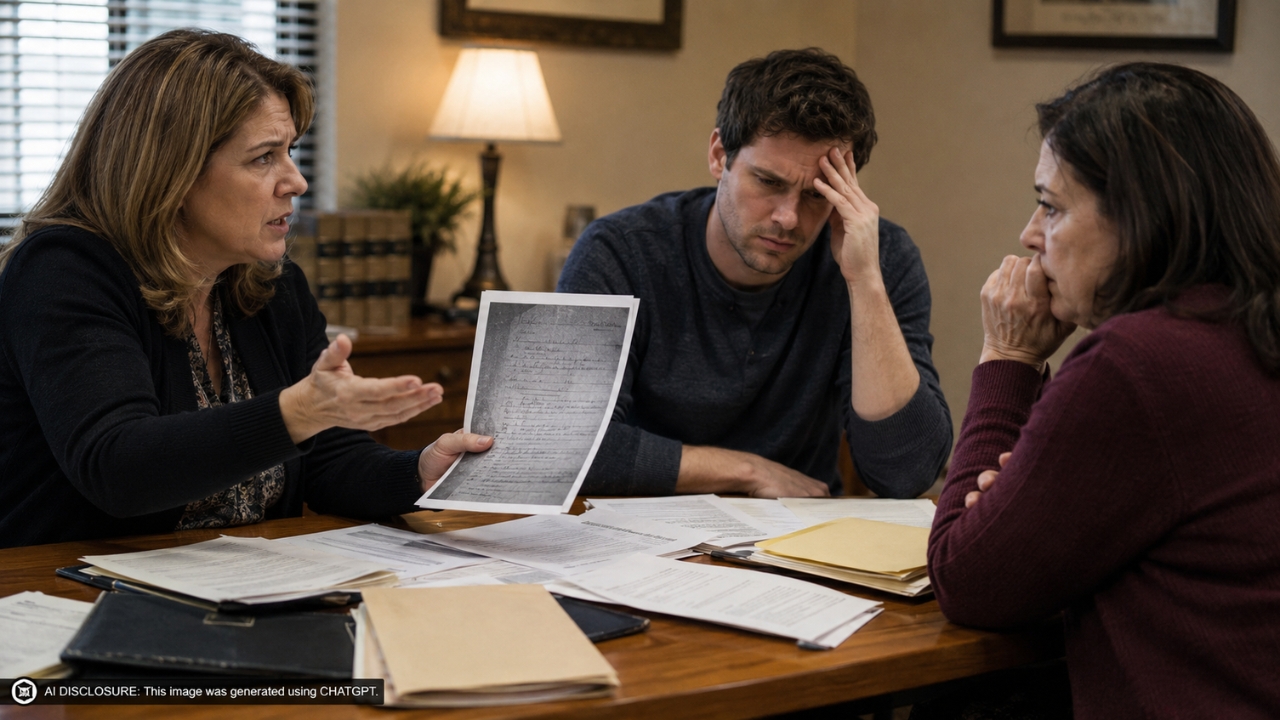
Photo credit: AI-generated image created using ChatGPT. Illustrative only.
Impact-Site-Verification: 723d1d82-0b11-4618-8c30-47fade58708c
Families can survive a lot. They can survive money problems, distance, old grudges, even years of awkward holidays. What they don’t survive very well is confusion and suspicion around a parent’s last wishes, especially when the paperwork is messy and the emotions are already raw.
A recent Texas appeals court decision laid that problem out in plain terms: one side asked the court to probate a later will from a copy, without producing the original, and without laying out a clear, diligent search for it. The trial court accepted it anyway. The appeals court reversed and sent it back. The decision is laid out in the source material, and it reads like a caution sign posted in the middle of a family driveway.
Here’s what happened, what the court focused on, and why the missing original mattered more than people might assume.
A grandfather dies, and two “last wills” show up
Max Harlan Covington died on November 16, 2024. After his death, two relatives came forward with competing probate applications, each claiming they had the document that reflected Max’s true final instructions.
Gina Covington Jones, Max’s daughter, applied on February 10, 2025, to probate a 2020 will. Robert Nathan Covington, Max’s grandson, opposed that and applied on February 24, 2025, to probate a 2017 will. The contrast was stark: Gina’s 2020 will left Max’s entire estate to her, while Robert’s 2017 will left the estate to Robert and his wife in equal shares.
These situations turn family members into legal opponents fast. The court isn’t there to referee who “deserves” what. It’s there to decide which document can legally be treated as the will, and whether the legal requirements were met.
The 2020 will was a copy, not the original
The first big wrinkle is simple: Gina did not file the original 2020 will. She filed a copy and told the court the original could not “by any reasonable diligence be produced.” The copy was self-proved, which generally helps establish execution formalities, but it doesn’t erase the problem of a missing original.
Robert raised multiple challenges to the 2020 will, including claims that Max lacked testamentary capacity and that Gina exerted undue influence. He also argued that if Gina wanted the court to accept a copy, she had to do more than shrug about where the original went. The trial court held a hearing and ultimately admitted the 2020 will to probate.
The trial court’s order specifically found that the cause of nonproduction had been “sufficiently proved” and that the 2020 will had not been revoked. Robert appealed, and Gina did not file an appellee’s brief.
Texas law doesn’t let you probate a copy on vibes
The appeals court framed the legal issue without drama: Texas law imposes specific requirements for probating a will, and extra requirements apply when the original will isn’t produced in court. The court leaned on the Texas Supreme Court’s recent guidance in Estate of Brown and the applicable sections of the Texas Estates Code.
Two separate hurdles matter when you’re offering only a copy. First, the applicant must prove the cause of nonproduction—evidence sufficient to satisfy the court that the original cannot, by reasonable diligence, be produced. Second, if the will was last seen in the testator’s possession or somewhere he could readily access, the applicant may also need to overcome a rebuttable presumption that the testator revoked it.
Those requirements are independent. If you fail the first one—explaining why the original isn’t available after a reasonably diligent search—you can lose without the court ever reaching the revocation question. That’s exactly where this case turned.
Gina’s explanation shifted, and she described no search at all
At the hearing, Gina testified that the copy of the 2020 will came from the attorney who drafted it. She also agreed it was possible the original was misplaced when Max and his belongings were moved to a state veterans nursing home. Then, under cross-examination, her explanation changed shape.
She testified that her aunt, Sue Blevins, moved Max into the nursing home and that Gina assumed Sue stole the will. Gina also said she had possessed the original at one time and that it was located in Max’s underwear drawer at his house, where Gina was living on the property. When pressed about the shift between “lost during the move” and “stolen,” Gina said, “It’s lost. I don’t know where it’s at,” and later, “I don’t know what happened to the [2020] Will.”
The key detail for the appeals court wasn’t that her story was imperfect or that she didn’t know the exact moment the original disappeared. The court made clear that applicants don’t have to prove exactly how the will was lost. The problem was more basic: Gina gave no testimony whatsoever about any search for the original after Max’s death.
What “reasonable diligence” looks like in real life
The law’s phrase “reasonable diligence” can sound like paperwork talk, but it’s really about common sense backed by effort. If you’re asking a court to accept a copy of someone’s will, you’re asking the court to treat that copy as the controlling document for distributing a person’s property. That’s not a small thing.
A reasonably diligent search is not one magical step. Courts have recognized searches broad enough to include places a will would likely be found—safe-deposit boxes and other likely storage spots—as examples of diligence. In everyday terms, it means you can explain, in detail, what you checked, where you looked, who you contacted, and what you learned.
In this case, the appeals court didn’t say a search had to be perfect. It said there needed to be evidence of a search. Without that, the legal requirement wasn’t met, and the trial court’s finding couldn’t stand.
The trial court probated the 2020 will anyway, and the appeals court stepped in
The trial court, announcing its ruling, noted that will contests can be emotionally charged and emphasized it had a legal question to decide. It ruled that it had not heard sufficient testimony to “set aside” the application to probate the 2020 will, so it admitted the 2020 will to probate and appointed Gina as independent executrix, as the 2020 will provided.
On appeal, the Sixth Court of Appeals in Texarkana reviewed the ruling under an abuse-of-discretion standard. That standard gives trial courts room to make judgment calls, but it doesn’t let them ignore the legal requirements. A court has no discretion about what the law is.
The appeals court sustained Robert’s first issue: Gina did not demonstrate the will could not be found after a reasonably diligent search. Because that requirement wasn’t met, the court reversed the order probating the 2020 will and remanded the case for further proceedings. The appeals court did not reach Robert’s second issue about revocation, since the case already failed on nonproduction.
The hard lesson: paperwork and trust don’t age well without stewardship
This kind of fight doesn’t usually start in a courthouse. It starts years earlier, when someone signs a will, sticks it in a drawer, tells one person about it, tells another person something different, and assumes the family will “figure it out.” Then illness comes, a move happens, belongings get boxed up, and the one document that could settle the matter cleanly goes missing.
If you’re a man with any responsibility—kids, property, a business, even just a bank account—this is the part that should sober you up. Order is a form of love. Clear instructions, stored properly, communicated wisely, and revisited occasionally can keep the people you care about from tearing each other apart later.
The court’s job here wasn’t to decide which relative seemed nicer or which version of events felt more believable. It was to enforce the rules that protect estates from guesswork and manipulation. And on this record, with no evidence of a diligent search for the original, the appeals court said the 2020 copy should not have been probated on that showing.
Families don’t need perfection, but they do need clarity. When the original will disappears and nobody can clearly explain what was done to find it, the law doesn’t just raise an eyebrow—it hits the brakes.
Read more from Thrive Girly:
- Mother-in-Law Expected to Sleep Over After Every Visit — Then the Mom Said Overnight Stays Were No Longer an Option
- Relatives Showed Up to the Wedding Without Being Invited — Then the Couple Refused to Find Them Seats
- Grandma Buckled the Baby Into Her Car and Left Without Telling Anyone — Then the Mom Made Sure It Never Happened Again