Her Boss Fired the New Server the Day After Learning She Was Pregnant — Then She Filed a Charge and the Restaurant Settled
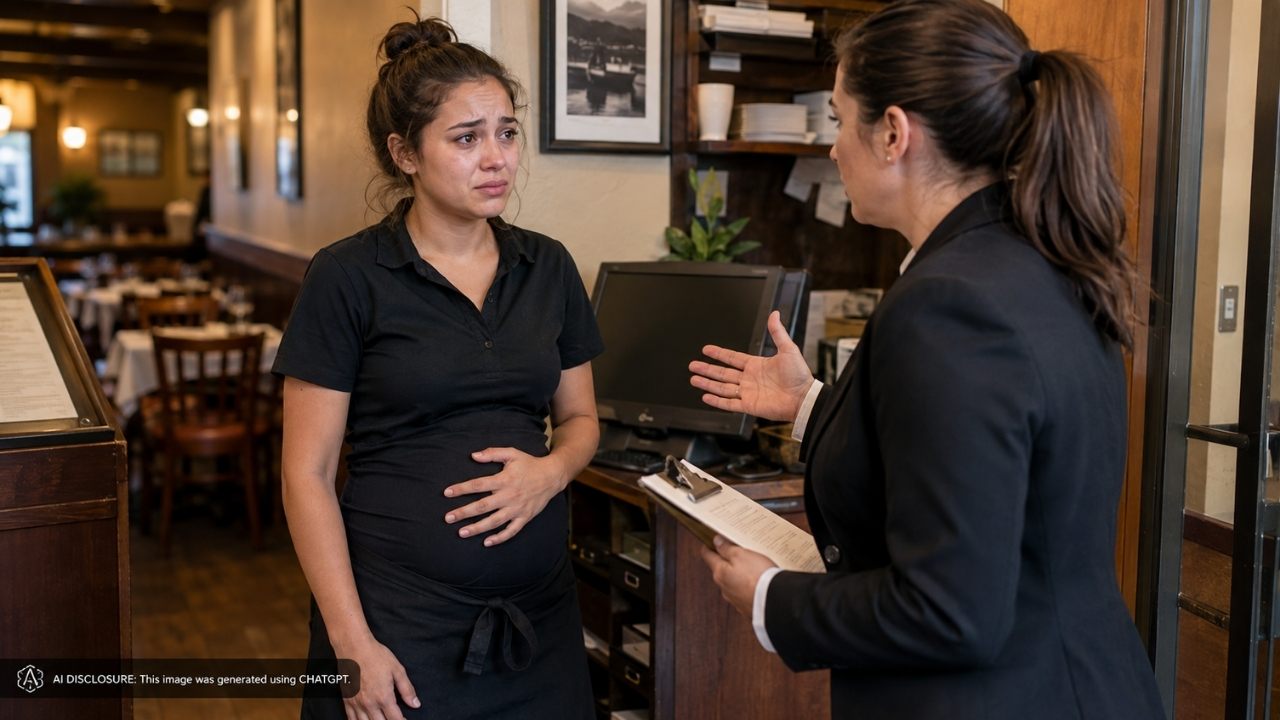
Photo credit: AI-generated image created using ChatGPT. Illustrative only.
Most bosses like to talk about being “family-friendly” right up until real life shows up at the host stand. A pregnancy announcement shouldn’t be treated like a scheduling problem or an inconvenience to manage. It’s a normal part of life, and for a lot of women, it’s happening right in the middle of trying to hold down a job and pay the bills.
A federal lawsuit filed by the U.S. Equal Employment Opportunity Commission (EEOC) says a restaurant in Bay St. Louis, Mississippi, fired a new server the day after learning she was pregnant. The case ended in a settlement that included monetary damages and other relief, as detailed in the original post from the EEOC.
The details are straightforward, which is part of what makes it hard to read. A woman starts a job, she’s there less than a week, her employer learns she’s pregnant, and she’s out the next day. If that’s what happened, it’s not “bad timing” or “a misunderstanding.” It’s discrimination, plain and simple.
What the EEOC says happened at Cosmos Restaurant
The EEOC’s lawsuit targeted Smoke BBQ, LLC, and Thorny Oyster, LLC, identified as the operators of Cosmos Restaurant in Bay St. Louis. The agency alleges the restaurant fired a female server in November 2023 the day after it learned of her pregnancy. The worker, the EEOC said, had held the position for less than a week before being terminated.
That timeline matters because it takes away the usual cover stories employers hide behind. It’s hard to argue “performance issues” or “it just wasn’t a fit” when someone barely had time to learn the menu. A quick firing right after a pregnancy disclosure looks like what it is: a reaction to the pregnancy.
Why pregnancy-based firing is illegal under Title VII
The EEOC says the alleged conduct violates Title VII of the Civil Rights Act of 1964, as amended, which prohibits discrimination on the basis of pregnancy. This isn’t a fuzzy rule that depends on a manager’s mood. Federal law treats pregnancy discrimination as a form of sex discrimination.
Marsha Rucker, the EEOC’s regional attorney for the Birmingham District, put it plainly in the release: employers cannot dismiss pregnant workers because of their pregnancy. That sentence shouldn’t be controversial, but it still needs saying because some workplaces quietly behave like pregnancy is a liability they can delete with a termination letter.
How the case got to federal court
The EEOC didn’t walk into court on day one. The press release says the agency filed suit—EEOC v. Smoke BBQ LLC and Thorny Oyster LLC, Case No. 1:25-cv-00278—in the U.S. District Court for the Southern District of Mississippi after first attempting to reach a pre-litigation settlement through its administrative conciliation process.
That’s an important detail because it shows there was an earlier chance to deal with the problem without the courtroom spotlight. Conciliation is essentially the government’s attempt to resolve claims before litigation. When it doesn’t work, that’s when you see a federal lawsuit with the EEOC’s name on it, and that’s a situation most employers would rather avoid.
What the settlement includes: money and “injunctive relief”
The restaurant operators agreed to pay “significant monetary damages” and provide other relief to settle the lawsuit, according to the EEOC. The release doesn’t list a dollar figure, and it doesn’t need to for the main point to land. Settlements like this are expensive in more ways than one, because they cost money, time, and reputation.
There’s also the non-money side, and sometimes that’s what changes the day-to-day reality for future employees. EEOC Birmingham District Director Bradley Anderson said the “injunctive relief” in the decree includes mandatory training requirements, policy changes, and reporting obligations. In plain language, the settlement wasn’t just a check—it also required the business to tighten up how it operates and prove it’s complying.
The hard truth about how pregnancy gets treated at work
In restaurants especially, bosses live and die by staffing. A manager might see pregnancy and immediately picture missed shifts, doctor appointments, and a future leave they’ll have to cover. But being a leader means you don’t punish someone because their life is moving forward, especially for something as normal as having a child.
If a workplace can’t handle pregnancy without reaching for the exit sign, that’s not an employee problem—it’s a character and management problem. Adults build schedules. Adults make accommodations when required. Adults don’t fire a woman because she’s pregnant and then act shocked when the federal government comes knocking.
What employees can learn from a case like this
The EEOC’s release points people to its pregnancy discrimination resources, and that’s worth paying attention to. A lot of workers don’t know what protections they have until they’re already in the middle of a mess. And when you’re newly pregnant, you may not have the energy for a fight—you’re trying to keep your health steady and your income coming in.
This case also shows that enforcement can include both compensation and corrective action. It’s not just about “getting back” at an employer; it’s about stopping the same decision from being repeated on the next hire. Even then, none of this is easy for the person who lost the job in the first place, because money doesn’t erase stress or the scramble to find new work.
What employers should take from it (especially the ones who mean well)
Some bosses aren’t trying to be cruel; they’re just stressed, reactive, and used to doing whatever keeps the floor covered. But good intentions don’t excuse illegal decisions. If you run a business, the responsibility is on you to know the law, train your managers, and keep your personal opinions out of employment calls that affect someone’s livelihood.
Pregnancy isn’t a moral failing, and it isn’t an operational crisis. It’s a season of life that deserves basic respect and fair treatment. The settlement’s training and policy requirements are a clue that the EEOC wants more than a payout—it wants workplaces to grow up and operate with consistency.
There’s a particular kind of ugliness in firing someone who’s pregnant, especially when she’s brand new and likely still trying to prove herself. If the EEOC’s allegations are accurate, this wasn’t complicated. The settlement is a reminder that the law takes pregnancy discrimination seriously, and it should. A decent workplace doesn’t treat a baby on the way like grounds for termination, and a decent boss doesn’t need a lawsuit to figure that out.
Read more from Thrive Girly:
- Mother-in-Law Expected to Sleep Over After Every Visit — Then the Mom Said Overnight Stays Were No Longer an Option
- Relatives Showed Up to the Wedding Without Being Invited — Then the Couple Refused to Find Them Seats
- Grandma Buckled the Baby Into Her Car and Left Without Telling Anyone — Then the Mom Made Sure It Never Happened Again