Her Sister Got the £600,000 House and She Got £250 in a Hospital-Bed Will — Then the High Court Threw It Out as ‘Highly Suspicious’
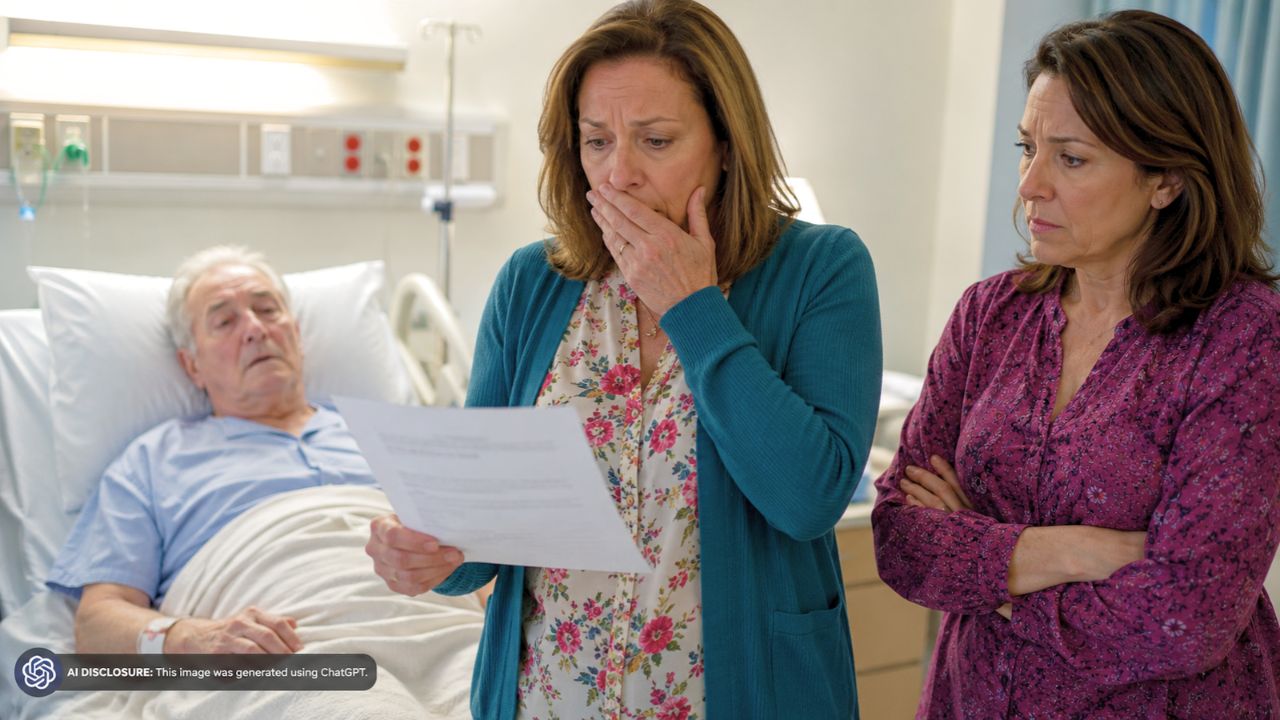
Photo credit: AI-generated image created using ChatGPT. Illustrative only.
Some families fight over money in the open. Others do it in polite silence for years, then it all explodes at the funeral. This one ended up in the High Court after a father’s final will left his £600,000 home to one daughter and handed the other two siblings just £250 each.
In a case reported in the source material, the court was asked to decide whether a “hospital-bed will” made shortly before the father’s death should stand. The judge didn’t just raise an eyebrow at how it was done—he called the circumstances “highly suspicious” and ultimately upheld an earlier will that split things far more evenly.
It’s the kind of story that makes your stomach tighten, because it’s not really about paperwork. It’s about family dynamics, end-of-life vulnerability, and how quickly a lifetime of relationships can get translated into a few pages of ink.
A father’s last will left a lopsided inheritance
Laxmikant Patel died aged 85 in October 2021. His main asset was a house in Harrow, valued at about £600,000, and his August 2021 will left that home entirely to his eldest daughter, Anju Patel.
His younger daughter, Bhavenetta Stewart-Brown, and his son, Piyush Patel, were left just £250 each. The will reportedly described Bhavenetta as “bad tempered” and suggested both younger siblings had “failed in [their] sense of duty,” though the father also reportedly said he hadn’t “forgotten them” as their father.
Anju’s position was that their dad’s decision came from a growing mistrust of Bhavenetta and Piyush. She claimed he believed they were “only after his property,” while she was, in the words attributed to the will writer, “the only light in his life.”
The earlier will told a very different story
What made the dispute sharper is that the 2021 will didn’t just tweak a few numbers—it overturned a long-running pattern. A 2019 will had left Anju £50,000, with the rest split so each child received 33% and 1% went to a charitable trust administered by Anju.
That’s not a minor change; that’s a total reversal of the family’s financial future. Bhavenetta’s legal team argued it didn’t make sense alongside what the father had done in his 2018 and 2019 wills, which leaned toward an equal division.
When you see that kind of late-stage swing, it doesn’t automatically mean wrongdoing. People do change their minds, especially when relationships deteriorate. But big changes made during sickness, isolation, or dependence are exactly where courts start looking harder.
A hospital setting and Covid restrictions raised the stakes
The disputed will was made in August 2021, around two months before Patel died. By then he was terminally ill, frail, and in hospital under Covid restrictions, with limited access and increased reliance on the people around him.
Bhavenetta claimed there was a “cloud of suspicion” over how the will was drawn up and executed. Her barrister argued there was a pattern of “isolation and control” by Anju and her husband, particularly while Patel was in hospital at the end of his life.
Anju disputed that framing. She told the court she had a close and loving relationship with her parents and said she wasn’t estranged from her family, but that her sister chose to disconnect from her.
How the will was prepared became a central issue
Anju’s case was that her father gave instructions for the will to be prepared by Vijaykant Patel, someone she knew through the Hare Krishna temple and who said he was also a friend of her dad. Vijaykant Patel reportedly visited Laxmikant Patel in his bed at Northwick Park Hospital and took notes during that meeting.
Those notes, as described in court, painted a picture of harsh feelings toward the younger siblings, including “revulsion” and an insistence that “everything goes to Anju.” The implication was that this wasn’t confusion or coercion—it was a deliberate decision driven by disappointment and mistrust.
Bhavenetta’s team, however, argued the situation didn’t pass the smell test. They contended that Patel struggled with English and did not “know and approve” the contents of the will, and that the shift away from the older wills was “most odd” given his prior, consistent intentions.
The judge said the circumstances were “highly suspicious”
Deputy Master Jason Raeburn ruled in favour of Bhavenetta, upholding the 2019 will. In doing so, he described the circumstances of the 2021 hospital will as “highly suspicious,” and he didn’t treat that as a throwaway comment.
A key practical issue was “lack of due execution.” The judge said there was no evidence the witnesses signed at the same time using the same pen, and he wasn’t satisfied the deceased signed in the presence of all witnesses at the same time.
He also noted the broader context: the deceased was seriously ill, had recently been diagnosed with terminal cancer, and was soon to be discharged but didn’t wait until he was home to make the will. In plain terms, the court wasn’t prepared to accept a document that changed everything, made under pressure, without clear proof it was properly and safely executed.
A family backstory marked by faith, duty, and tension
The court heard Patel was a gentle, hard-working man who migrated from Uganda in the early 1970s and built a life in London. He worked shifts at the Ford plant in Dagenham while his wife Shardaben ran a newsagent’s, and he was described as devoutly religious, attending the Swaminarayan temple in Neasden daily.
He and his wife donated around £180,000 to that temple over their lives, which speaks to a sense of commitment and stewardship. Against that background, Bhavenetta’s barrister also alleged Anju, a Hare Krishna follower, had tried to distance her father from his customary Swaminarayan faith—another detail that fed the court’s concern about influence and isolation, even if those claims were contested.
None of this is the tidy picture people like to imagine: faithful parents, obedient children, and clean endings. It’s closer to real life, where duty and affection can get tangled, and where family members sometimes keep score instead of keeping peace.
What this case shows about late-life decisions
If you’ve lived long enough, you’ve seen how quickly a family can get turned upside down by a crisis. A hospital stay can scramble routines, change who has access, and put an older person in a position where they’re relying on others for basic things—food, transport, conversation, even paperwork.
That’s why the “how” matters as much as the “what.” If a will is made in a vulnerable moment, the process needs to be careful, transparent, and properly witnessed. Not because families deserve a perfect ending, but because courts are rightly hesitant to let a sloppy or questionable process decide who gets the house and who gets a token amount.
On a human level, it’s also a warning about relationships. If a parent has complaints—about “bad temper,” control, neglect, or money—the time to address that is years before a hospital bed, not in the final weeks of life through a document that invites suspicion and bitterness.
The High Court’s decision means the earlier 2019 will stands, rather than the late 2021 version. For this family, that doesn’t erase the damage, but it does show that “last minute” doesn’t automatically mean “last word,” especially when the circumstances don’t look clean.
Read more from Thrive Girly:
- Mother-in-Law Expected to Sleep Over After Every Visit — Then the Mom Said Overnight Stays Were No Longer an Option
- Relatives Showed Up to the Wedding Without Being Invited — Then the Couple Refused to Find Them Seats
- Grandma Buckled the Baby Into Her Car and Left Without Telling Anyone — Then the Mom Made Sure It Never Happened Again