Future Sister-in-Law Picked a Wedding Dress Nearly Identical to Hers — Then the Bride Told Her She Couldn’t Wear It
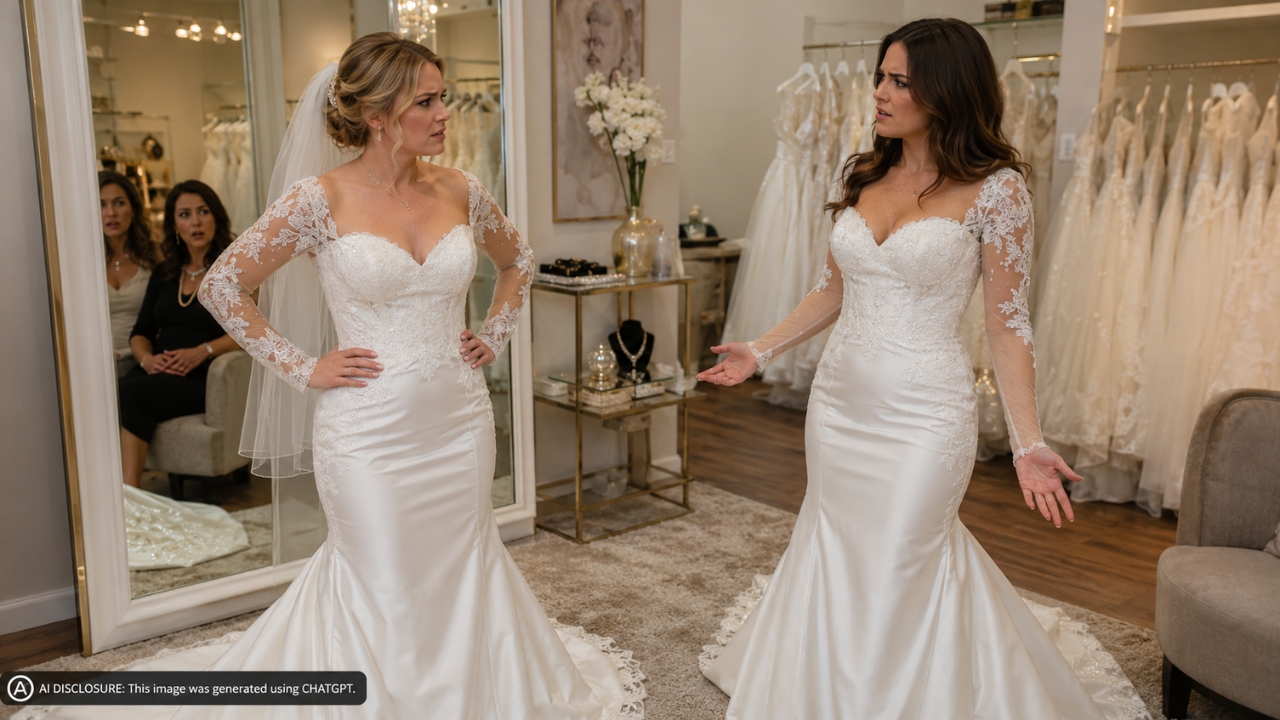
Photo credit: AI-generated image created using ChatGPT.
There are a few kinds of wedding drama you can see coming a mile away. Seating charts. Plus-ones. A groomsman who treats “formal” like it’s a suggestion. But the one that gets surprisingly personal, surprisingly fast, is the dress—because it isn’t just fabric. It’s identity, memory, photos that live longer than most friendships, and a moment a bride has probably pictured since she was a kid.
In the original post, a 28-year-old bride-to-be (Ella) says she’s getting married in October after nearly two years of planning. She found a very specific gown last winter—satin, sweetheart neckline, dramatic lace sleeves—and describes it as unique and deeply “her.” Then her older brother’s fiancée, Sophie, announced she’d picked her own dress for next year, and it looked nearly identical in every major detail.
Ella’s not claiming Sophie stole the exact dress off the rack. She’s saying the style, fabric, neckline, sleeves, and train were so close that even her fiancé blurted out that it was basically Ella’s dress. Sophie reportedly laughed it off with an “imitation is flattery” line, and Ella—calmly, by her own telling—said she did mind and asked her not to copy it so closely before Ella even gets to wear hers.
A dress can be “just a dress” and still be a problem
There’s a line men like to use in situations like this: “It’s just a dress.” It sounds mature, like we’re rising above pettiness. Sometimes it’s even true. But it can also be a lazy way to avoid dealing with the actual issue, which usually isn’t the dress—it’s respect.
Ella’s not trying to copyright sleeves. She’s reacting to a pattern she says she’s seen before, where Sophie competes quietly: a bag here, a hairstyle there, always a step behind but somehow right on top of her. A near-clone of the wedding dress, especially after being at the bridal fitting, doesn’t feel accidental. It feels like somebody stepping into your lane on the one day that’s supposed to be unmistakably yours.
If you’ve ever had a sibling or in-law who can’t let you have something without reaching for the same thing, you know how exhausting it is. Individually, each moment looks small. Add them up and it starts to feel like someone is trying to erase the boundaries between “me” and “you.” That’s not a dress problem. That’s a character and relationship problem.
The timing makes it worse
There’s also the simple fact that Ella hasn’t even walked down the aisle yet. If Sophie had unknowingly fallen in love with a similar style years later, you might chalk it up to trends. But this is happening in the same family, in the same season, with both weddings close enough that everyone will remember the first dress when the second appears.
Photos don’t care about good intentions. Family members will compare. Guests will comment. Someone will joke about “twins.” Even if nobody says it out loud, the bride will feel it in the room. Weddings are already a lot—emotionally, financially, logistically—and this kind of avoidable friction is the sort of thing that turns a happy year into a grind.
Sophie’s response—“People won’t remember in a year”—doesn’t exactly help her case. That’s the kind of dismissive line people use when they want you to drop it, not when they’re trying to honor you. If you’re joining a family, you don’t start by telling the bride her once-in-a-lifetime moment is basically forgettable.
Competitive people love plausible deniability
What makes these situations hard is that the offender rarely looks like a movie villain. They smile. They joke. They frame it as admiration. “I just love your taste!” And if you push back, you’re the “controlling” one who “can’t take a compliment.”
That’s why the “imitation is flattery” line lands like a dodge. Flattery is voluntary; copying is a choice. And copying something as signature as a wedding dress—down to fabric, neckline, sleeves, and train—doesn’t read like inspiration. It reads like an attempt to share the spotlight without doing the work of finding your own look.
If Sophie truly didn’t realize how close it was, her reaction would’ve been different. A normal, peace-seeking response sounds more like, “Oh man, I didn’t think of that. Let me keep looking,” or at least, “I see why that bothers you.” Rolling eyes and minimizing is not what people do when they care about family harmony.
Where the brother and parents step in—and where they fail
Family reactions in the post are pretty predictable. Mom sides with the bride. Dad wants the drama to disappear. Brother says his fiancée’s feelings are hurt and calls it “just a dress,” then stops speaking to his sister.
Here’s the hard truth: a man about to get married needs to practice being a peacemaker, not a pressure valve. Telling your sister she “hurt her feelings” without addressing what your fiancée did is how you train your future marriage to handle conflict—deny, deflect, and punish with silence. That doesn’t get better after the wedding. It gets worse.
And dads, for all our strengths, can be guilty of the same thing: “Not worth the drama.” Sometimes that’s wisdom. Other times it’s just emotional outsourcing—hoping the women will smooth it over so nobody has to have a direct conversation. But the “drama” doesn’t vanish. It relocates and grows teeth.
Is the bride wrong for drawing a line?
Ella told Sophie she’s free to wear whatever she wants, but that she felt it was disrespectful to copy her dress so closely before she’s even worn it. That’s not a meltdown. That’s a boundary. The fact that she tried to stay calm matters, because tone is often the only thing people will remember when they want to paint you as unreasonable.
Could she have handled it privately instead of at a family dinner? Maybe. A direct but quiet conversation tends to land better than a moment in front of an audience. But Sophie also chose a public reveal, and according to the post she was present at the bridal fitting, which makes the “oops, coincidence” argument harder to swallow.
In a healthy family, you can say, “That’s too close, and it stings,” without being labeled controlling. Control is “you must wear X.” A boundary is “I’m asking you not to do this because it harms our relationship.” Those aren’t the same, even if the person on the receiving end wants to pretend they are.
A practical way forward that doesn’t poison the wedding year
If this situation is going to cool off, somebody has to stop treating it like a courtroom. Ella doesn’t need to win; she needs peace and clarity. Sophie doesn’t need to be humiliated; she needs to decide whether she wants to join this family with humility or with rivalry.
The cleanest solution is also the simplest: Sophie chooses a different dress, or makes substantial alterations so it’s clearly its own gown—different neckline, different sleeves, different fabric, different silhouette. Not “slightly different beading.” Different enough that nobody confuses them, and Ella doesn’t feel like she’s being shadowed at her own wedding.
The brother should be the one to lead that conversation with his fiancée. Not with threats, not with lecturing, but with sober honesty: “My sister picked that dress first, and it matters to her. I need you to respect that.” If he can’t say that now, he’s not ready for the thousand other moments in marriage where doing the right thing costs you a little comfort.
And Ella, for her part, should be careful not to keep litigating every past slight in the same conversation. Stick to the current issue. Name it plainly. Ask for a specific change. Then let people show you who they are by what they do next.
Weddings have a way of revealing what was already there. This isn’t really about satin and lace; it’s about whether two women can stand in the same family without one trying to outshine or overwrite the other, and whether the men around them will be steady enough to tell the truth. If Sophie adjusts the dress and the brother grows a spine, this becomes a footnote. If everyone keeps minimizing, it becomes the opening chapter of a long, tiring rivalry nobody asked for.
Read more from Thrive Girly:
- Mother-in-Law Expected to Sleep Over After Every Visit — Then the Mom Said Overnight Stays Were No Longer an Option
- Relatives Showed Up to the Wedding Without Being Invited — Then the Couple Refused to Find Them Seats
- Grandma Buckled the Baby Into Her Car and Left Without Telling Anyone — Then the Mom Made Sure It Never Happened Again