Her Biological Father Abandoned the Family for an Affair When She Was 13 — Then She Left Him Off the Family Tree at Her Own Wedding
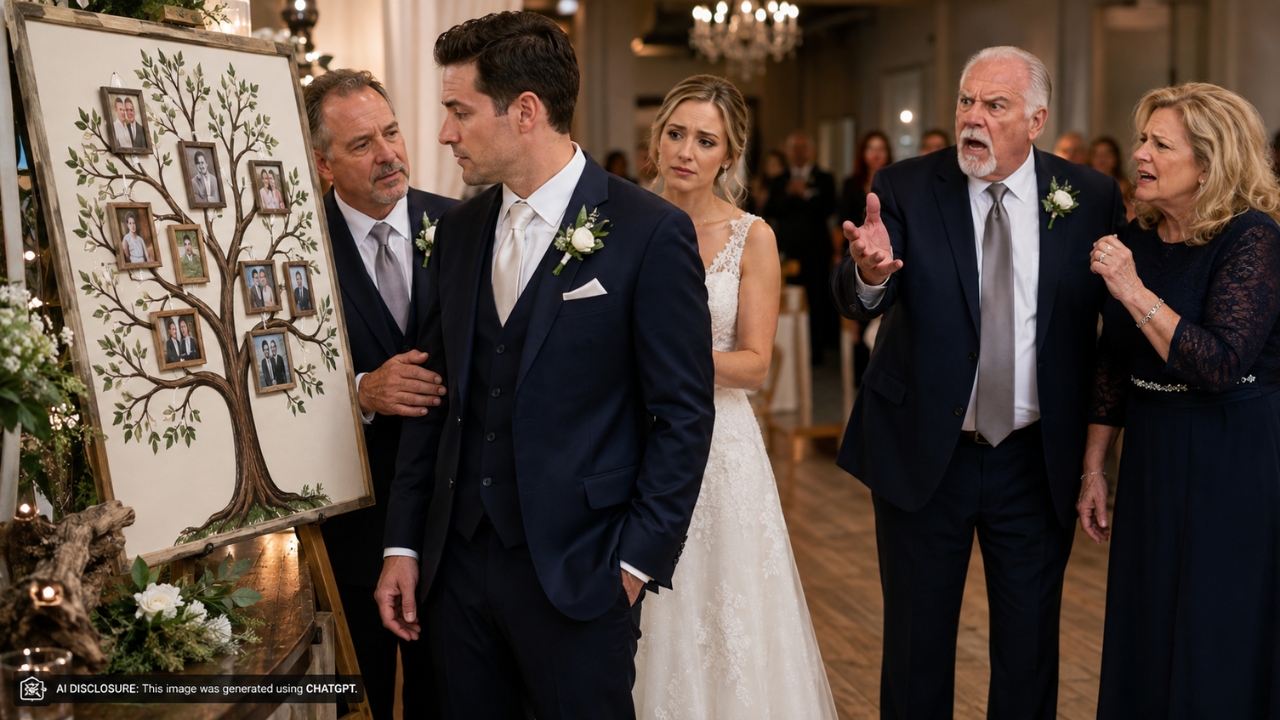
Photo credit: AI-generated image created using ChatGPT.
A wedding is supposed to be a clean line in the sand: a public “this is my family now,” a day where you honor what brought you here and commit to what you’re building next. It’s also one of the few days where unresolved family business shows up in a suit and expects a seat at the table.
In the original post, a 34-year-old groom describes a father who left when he was 13 after an affair that produced a new child. The father moved on, the son and his sister were left behind, and the relationship eventually went cold enough that the son went no contact at 17. Years later, at his wedding, the son left his biological father off the family tree and put his stepfather in that place instead.
The blowback was immediate. His father was furious, his stepmother accused him of “breaking his heart,” and extended family started hounding not only him and his wife, but also his mother and stepdad. It’s a familiar pattern: the person who did the leaving demands the comfort of belonging, and the people who stayed are told to keep the peace.
A father can leave the house and still expect the title
One of the hardest truths for grown men to accept is that “father” is not just biology. Biology starts a story, but character sustains it, and presence gives it weight. If you disappear from your kid’s life, you can’t be shocked when the kid grows up and files you under “stranger.”
This man’s father didn’t just have an affair. He abandoned his children, tolerated a new wife “rubbing it in,” skipped birthdays and Christmases, and prioritized the second family for years. Then he shows up later with apologies and tears, expecting the past to be overwritten by emotion.
The wedding tree wasn’t decoration; it was a statement
A family tree at a wedding sounds like a sweet detail until you remember what it represents: legacy, belonging, and the people who carried you. Swapping in a stepfather wasn’t a petty jab. It was an honest declaration of who actually did the job.
The son describes his stepfather as a good man who treated him and his sister like his own. That matters. Plenty of men marry a woman with kids and keep a polite distance, but the ones who step in with consistency—rides, rules, groceries, hard talks, quiet support—earn a place that blood alone can’t demand.
If you’re the biological father reading this and feeling defensive, sit with that for a minute. If your son’s “family tree” doesn’t include you, the issue isn’t the paper. It’s the years that came before the paper.
Apologies don’t erase absence, and tears don’t pay back time
It’s good that the father apologized. A man should own his sins plainly and without qualification. But apologies aren’t a magic ritual that forces reconciliation on a schedule that favors the offender.
The son notes that his father “kept apologising thinking that what he did was okay,” which suggests there may have been minimizing or self-justifying mixed into the apology. That’s common. A man wants forgiveness without fully accepting what he destroyed: birthdays missed, trust broken, childhood stability traded for excitement.
Repentance has a cost. It usually looks like consistency over time, not one emotional phone call. If the father wanted to rebuild, he’d have to accept boundaries, accept that he doesn’t get access to the grandkids on demand, and accept that his adult son may never feel close to him again.
Family pressure often protects the wrong people
Notice who got “hounded” in this situation: not the father for leaving, but the son for refusing to pretend it didn’t matter. The extended family went after the son and his wife, and they also took shots at the mother and stepdad. That tells you a lot about how families sometimes operate.
Some relatives treat peace as the highest virtue. They’d rather the wronged person swallow it than the wrongdoer face consequences. They call it maturity, but it’s often just avoidance dressed up as moral superiority.
A man building a household has to learn this skill: you can’t let outside voices run your home. If your family of origin is demanding that you give access, honor, and a platform to someone who didn’t act honorably, you’re allowed to say no. You don’t have to be cruel, but you do have to be clear.
The half-brother isn’t the enemy, but he got hit in the crossfire
The son also mentions a half-brother who is furious and was told off. In the heat of it, the son said the half-brother was “nothing more than a mistake,” and he admits that was too far. He’s right to admit it, because that line doesn’t land on the father; it lands on the kid who didn’t ask to be born into the mess.
You can reject a man’s betrayal without dehumanizing the people who came after it. That half-brother may represent the affair, but he isn’t the affair. If the son wants to keep his conscience clean, that’s one place to tighten up his speech, even if he never wants a relationship.
The same goes for trading harsh names with the stepmother. She may have been cruel and provocative, but a man doesn’t need to match that energy to prove he’s serious. There’s a difference between firm boundaries and losing control of your tongue.
Protecting your kids is a different responsibility than honoring your dad
As a husband and father, this man isn’t just guarding his own heart anymore. He’s deciding who gets access to his children, who gets to influence them, and what kind of family culture he’s building. His biological father has met the children once, and only because the sister facilitated it. That’s not a relationship; that’s a cameo.
Then the father calls and wants to talk to him and the children, and the son shuts it down. Some people will call that cold, but it can also be sober. If you’ve watched a man consistently choose himself over his kids, it’s not irrational to assume he may bring instability, guilt trips, and disappointment into the next generation too.
Christian faith doesn’t require you to hand your children over to someone unsafe or unreliable. Forgiveness is a heart posture; access is a stewardship decision. A man can release bitterness without granting closeness.
If reconciliation ever happens, it has to be built like a house
Reconciliation is possible in some families, but it can’t be demanded, and it can’t be rushed. If the father is sincere, he needs to accept the long road: showing up consistently, respecting boundaries, speaking well of the mother and stepdad, and taking full ownership without blaming anyone else for his choices.
On the son’s side, the path—if he wants one—probably starts smaller than a father-son reunion. It might look like a brief conversation without the stepmother, no pressure on the kids, and an agreement that “no” is a complete sentence. Trust isn’t rebuilt by speeches; it’s rebuilt by predictable integrity over time.
And if the son decides reconciliation isn’t on the table, that’s a decision he’ll have to live with. He should make it from conviction, not from a desire to wound, and he should keep his own behavior clean so the cycle doesn’t continue in his home.
A man doesn’t get to rewrite history just because he finally feels sad about it. The father walked out, and the son grew up, built a life, married his partner, and chose to honor the man who actually acted like a dad. The healthiest thing in the whole story might be the simplest: a grown man telling the truth about who showed up, and then protecting the family he’s responsible for now.
Read more from Thrive Girly:
- Mother-in-Law Expected to Sleep Over After Every Visit — Then the Mom Said Overnight Stays Were No Longer an Option
- Relatives Showed Up to the Wedding Without Being Invited — Then the Couple Refused to Find Them Seats
- Grandma Buckled the Baby Into Her Car and Left Without Telling Anyone — Then the Mom Made Sure It Never Happened Again