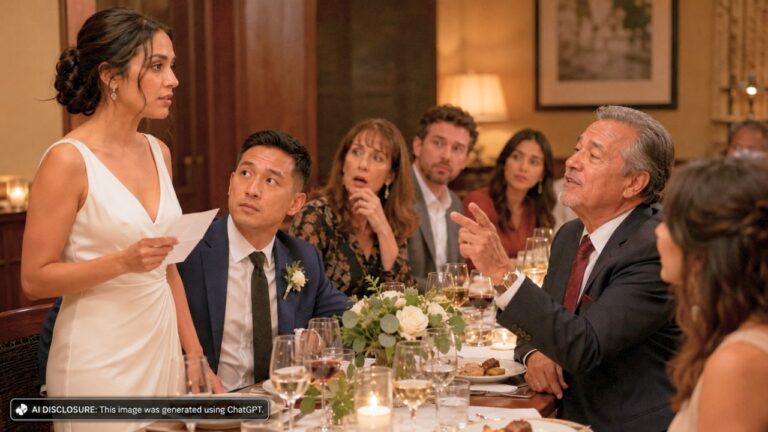
Her Dad’s Wedding Speech Called His Wife ‘Mom’ Without Ever Asking — Then the Groom Pulled the Speech Entirely
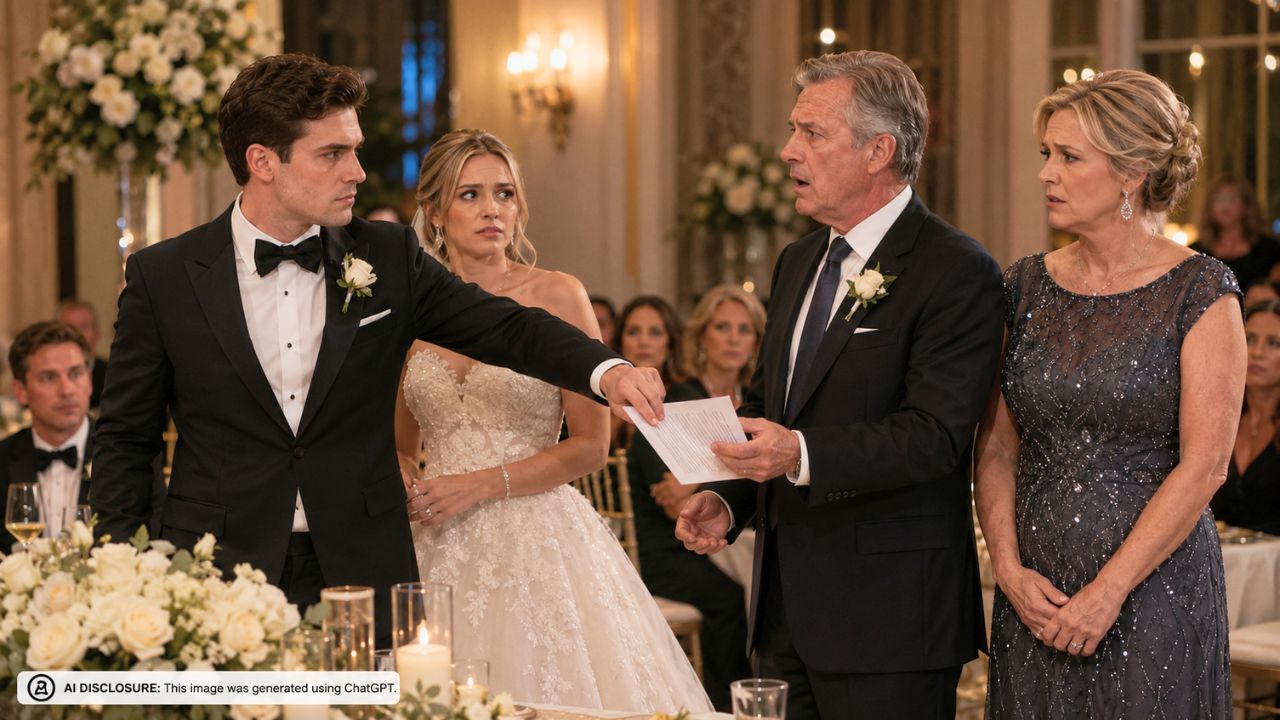
Photo credit: AI-generated image created using ChatGPT. Illustrative only.
Wedding speeches are supposed to be simple: a little honor, a little humor, a sincere blessing, and then you let the couple get on with their night. But every man who’s been to enough receptions knows speeches can turn into a battleground fast, especially in blended families where old grief and new loyalties sit at the same table.
In the original post, a 24-year-old groom says his dad asked to give a toast at the reception. The groom agreed, even though speeches weren’t really part of the plan. Then an aunt sent him the speech ahead of time, and what he read made his stomach drop.
His father repeatedly referred to the father’s wife—his stepmother since he was eight—as “Mom,” even though the groom says he has never called her that and never agreed to. The speech, as described, wasn’t just a warm nod to a step-parent; it sounded like a public attempt to rewrite the relationship and force a title the groom hasn’t given. So the groom pulled the plug and told his dad he could no longer speak at all.
A toast became a referendum on a mother’s place
The groom’s biological mother died when he was a child, about a year before his stepmother entered his life. That detail matters because grief doesn’t vanish just because life moves on, and kids don’t “transfer” the word “mom” on command. He says he respects his stepmother, cares about her as his dad’s wife, and sees her as a good person, but he never placed her in the “mom” spot in his heart.
According to his description, the speech used “mom” more than once or twice—he counted 21 times. It also centered on how “they” dreamed about his wedding and how “they” were lucky to be his parents, with special emphasis on how lucky he is to have a mom like her. When you’ve got that many references, it stops sounding like a slip and starts sounding like a mission.
The hidden problem: it wasn’t just sentimental, it was strategic
A lot of dads don’t think in terms of emotional tactics. They think in terms of outcomes: “If I say it strongly enough, maybe it’ll become true.” But a wedding microphone isn’t a counseling session, and it’s not a stage for pressure. It’s a public moment that seals memories for the couple and the guests.
The groom also mentioned a specific sore spot: he chose to do a special dance with his maternal grandmother instead of his stepmother. That’s his call, and it’s not hard to see why a man would want to honor the woman connected to his late mother. If the speech was written to counteract that choice—by spotlighting the stepmother as “Mom” in front of everyone—then it’s not a toast. It’s a correction, delivered in public.
Most men can recognize the play: if you can get the room to clap for a claim, the person on the receiving end feels boxed in. It’s hard to pull someone aside after and say, “I don’t agree with what you said,” when half the guests already accepted it as the official story.
Dad’s angle: “She deserves recognition”
The father’s argument, as described, wasn’t subtle. He told his son he needed to “shine a spotlight” on his wife because she deserved to be honored as a parent of the groom, and the groom wasn’t giving her that recognition. He also insisted it wasn’t the groom’s decision to stop him from giving the speech.
That’s where a lot of fathers get sideways: they confuse their feelings about their wife with their child’s relationship to her. A husband can be deeply grateful to a woman who helped raise his child. He can believe she sacrificed, served, and stood in the gap. None of that automatically grants her a title the child doesn’t use.
It’s also telling that the dad framed it as “acknowledge how our family actually is instead of living in the past.” In plain terms, he wants the wedding to validate a narrative: that the stepmother is mom “in everything but blood,” and that formal adoption paperwork doesn’t matter. He may mean well, but forcing a label is still forcing.
The groom’s boundary: “Not that speech, and not that word”
The groom didn’t say his dad couldn’t praise his wife. He said he didn’t want that specific speech read at the wedding, with that repeated “mom” framing. When his father refused to change course, the groom escalated to the cleanest boundary he had: no speech at all.
Some people will hear that and think “controlling,” because weddings can bring out the worst kind of micromanagement. But there’s a difference between controlling centerpieces and protecting a once-in-a-lifetime moment from a public guilt campaign. If a man knows a speech is designed to poke at a painful family issue, he’s not obligated to hand over the microphone out of politeness.
A good rule is simple: if you wouldn’t allow a best man to roast your bride, you don’t allow your father to roast your relationship history. The audience might laugh, but the marriage will remember.
Blended families and the temptation to rewrite history
There’s a particular temptation in second marriages: to make the new family feel “whole” by smoothing over anything that reminds people of loss. A deceased mother is not a stain to be cleaned up. She’s part of the story, and a child’s loyalty to her memory isn’t an insult to the stepmother.
Titles like “mom” and “dad” are earned over years, but they’re also granted by the child, freely. If a grown man still doesn’t use a title, that’s information. It may hurt, and it may feel unfair to the step-parent who worked hard, but you can’t manipulate a heart into agreement by declaring it publicly.
The father seems to believe the wedding is the one day he can finally say, “See? This is your mother,” and get applause for it. That’s not leadership. That’s using a milestone as leverage.
What a wise father would do instead
A wise father who loves his wife and his son can do something far simpler: honor his wife without stealing language that doesn’t belong to him. He can thank her for her faithfulness, speak about the kind of home she helped build, and recognize the many unseen ways she served. None of that requires calling her “Mom” if the groom doesn’t.
He can also keep the focus where it belongs—on the couple. A father’s speech is meant to bless a new household, not settle an old argument. If there’s unresolved pain over titles and roles, it should be handled privately, with patience, and with the humility to accept that not every longing gets fulfilled the way we want.
And if the dad genuinely wants peace, he can ask his son, directly and calmly, what kind of acknowledgment would feel respectful without feeling forced. A stepmother can be honored as a valued parent figure or cherished family member without being crowned with a title that the groom has never used.
So was the groom wrong to pull the speech?
Based on the details given, the groom’s decision reads less like spite and more like protection. He wasn’t trying to punish his dad’s wife; he was trying to prevent a public performance that would frame her as “Mom” in a way he never agreed to. If his dad had been willing to revise the speech, the situation likely would’ve stayed in the manageable zone.
But once the father said it wasn’t the groom’s decision and insisted on reading the same message, he forced his son into a simple choice: allow a predictable wound on his wedding day, or remove the microphone. A man doesn’t have to volunteer his own wedding reception as the place where someone else fights for recognition.
A wedding day can’t fix a family. It can only reveal it. If this father wants a real relationship between his wife and his son, it won’t be achieved through a toast that bulldozes the son’s boundaries; it’ll be built through years of respect, restraint, and honest conversations that don’t need an audience.
Read more from Thrive Girly:
- Mother-in-Law Expected to Sleep Over After Every Visit — Then the Mom Said Overnight Stays Were No Longer an Option
- Relatives Showed Up to the Wedding Without Being Invited — Then the Couple Refused to Find Them Seats
- Grandma Buckled the Baby Into Her Car and Left Without Telling Anyone — Then the Mom Made Sure It Never Happened Again