Bride’s Sister Demanded a Plus-One — Then the Bride Learned Who She Planned To Bring
Photo credit: Thrivegirly
The guest list was supposed to be the easy part. The venue contract was signed, the catering numbers were tight but manageable, and the bride had already cut coworkers and distant cousins to keep things under budget. Then her sister started texting about needing a plus-one like it was a non-negotiable requirement.
At first, it sounded like ordinary family friction. The bride had set a clear rule: couples who lived together or were married got two seats, everyone else got one. Her sister, who’d been dating on and off for months, didn’t make the cutoff. But instead of accepting it, she kept pushing, saying she’d feel “singled out” at a wedding where she’d be sitting near extended family.
The bride finally agreed to revisit it—until she learned who her sister actually planned to bring. That’s when the issue stopped being about feelings and started looking like a security problem.
The plus-one request didn’t match the sister’s usual behavior
The bride wasn’t surprised her sister wanted a date. What surprised her was how intense she got about it. She called their mom multiple times, asked the maid of honor to “put in a good word,” and even floated the idea that she wouldn’t participate in the ceremony if she didn’t get a plus-one.
It hit a nerve because the bride had already asked her sister to be a bridesmaid and help with pre-wedding tasks. Their relationship had been shaky lately, but the bride thought this would be a chance to reset. Instead, the plus-one turned into a power struggle, and their mom started gently suggesting the bride “just give her the extra seat.”
The bride said she could consider it if she knew the person and if the sister could confirm the name for the seating chart. That’s when the sister got cagey, saying it would “ruin the surprise.” The bride didn’t love that, but she chalked it up to her sister being dramatic.
A casual question revealed a name the bride didn’t expect
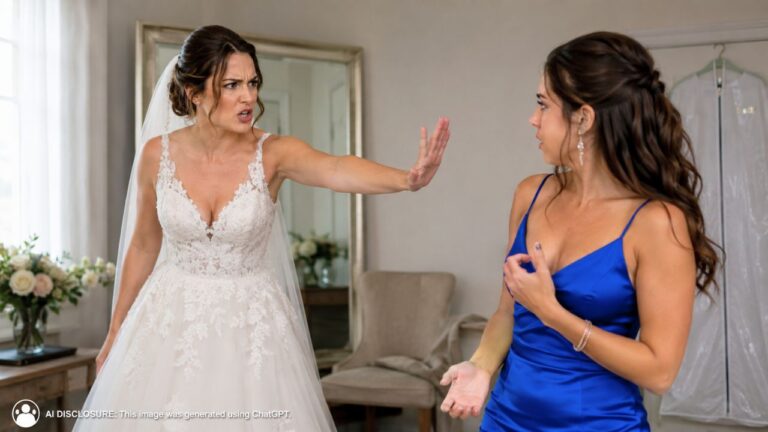
The turning point came during a final dress fitting when the bride mentioned the plus-one situation to her fiancé. He went quiet, then asked which “surprise guest” the sister meant. The bride shrugged and said she didn’t know.
Later that night, the fiancé told her something he hadn’t wanted to bring up during the busy planning phase. The sister had been seen around his apartment complex a few weeks earlier, talking to a man the bride recognized immediately when the fiancé described him: her ex.
Not just any ex, either. This was the one the bride hadn’t invited to group hangouts, hadn’t wanted to hear updates about, and had worked hard to keep at a distance. The relationship ended badly, with arguments that spilled into public spaces, angry late-night calls, and the kind of break that left the bride changing her routines for a while.
The bride texted her sister directly and asked for the name. After dodging for an hour, the sister finally confirmed it. She was planning to bring the bride’s ex to the wedding.
The bride realized it wasn’t just awkward, it could spiral fast
In a vacuum, bringing an ex as a wedding date sounds like a messy stunt. In this case, it also raised safety and disruption concerns. The bride remembered how her ex handled conflict: sudden shows of up-at-the-door behavior, long confrontational conversations that wouldn’t end, and a tendency to pull other people into the drama.
The wedding venue was small, with a strict headcount and a tight schedule. The bride and groom were paying for private security for the entrance mainly to keep things smooth, not because they expected trouble. Suddenly, they were imagining the ex walking in, drinking, and deciding that this was the time to clear the air.
The bride called her coordinator and asked what options she had if someone showed up uninvited. The coordinator told her the venue could remove someone if the couple authorized it, but it would be easier if names were on an approved list and the couple gave security a heads-up. The bride also checked the contract and saw that disruptions could lead to extra fees if staff had to get involved.
So the bride made a decision: the sister could still attend, but there would be no plus-one for her, and the ex would not be allowed in. She sent it in writing, clearly, without negotiation.
The sister escalated, and the family pressure followed
The sister didn’t take it quietly. She claimed the bride was “punishing” her and said she was entitled to a guest because she was in the wedding party. She also implied the bride was being controlling and that the ex had “changed,” framing it like the bride was being dramatic about an old breakup.
Then the sister tried a different angle: she told relatives that the bride was refusing to let her bring “someone important,” without mentioning who. The bride started getting calls from an aunt and a cousin asking if she was really making her sister come alone. When the bride explained the actual identity of the plus-one, a few relatives backed off immediately, but others still pushed the idea that it would “prove everyone is mature.”
The groom’s side wasn’t thrilled either, because the bride’s sister had been positioned in photos and seating as part of the core group. Changing that would be noticeable. But the groom stayed firm, pointing out that it was their wedding day, and they weren’t hosting a social experiment.
The bride eventually removed her sister from the bridal party, keeping her invitation as a regular guest only. That’s when the sister threatened to show up with the ex anyway.
The couple treated it like a planning issue and a security issue
Once the sister made the threat, the bride and groom stopped handling it as family drama and started treating it like logistics. They gave security a list with the ex’s name and a photo from old social media, along with instructions that he was not to be allowed in. They also asked the venue to keep an extra staff member near the entrance during the ceremony start, when things are most chaotic.
The bride also documented everything. She saved the texts where her sister confirmed the name and where she threatened to bring him anyway. She emailed her coordinator to summarize the situation, so there was a timestamped record in case anything went wrong and the venue needed to justify a removal.
To reduce the chance of a scene, the bride asked her mom to stop acting as the messenger. She also told a couple of trusted friends to keep an eye out during cocktail hour and to alert security if the sister tried to sneak someone in through a side door or service entrance.
It wasn’t the kind of wedding prep she wanted, but it was calmer than arguing in circles.
People zeroed in on proof, boundaries, and not negotiating in person
When the situation spilled into the wider family group chat, reactions split into two camps. Some people treated the sister’s plan as a cruel provocation, especially given the history. Others focused on the practical risk: even if nothing “dangerous” happened, the ex’s presence could hijack the day and leave the bride feeling tense from the first song to the last.
The most levelheaded advice the bride got was consistent. Keep the boundary in writing. Don’t meet the sister to “talk it out” alone. Make sure vendors and venue staff know the plan. And avoid giving the sister more details than necessary, like entry times or where the couple would be before the ceremony.
One family friend suggested a simple test: if the sister’s goal was genuinely to have support, she could bring a close friend the bride knew and trusted. The sister rejected that immediately, which only reinforced that this was about the ex, not about needing company.
By the week of the wedding, the sister was still invited but barely communicating. The bride’s mom was trying to keep the peace, the groom wanted the plan locked down, and the bride felt torn between grief that her sister was doing this and relief that she’d drawn a line before it became a surprise at the door. The only thing left was to see whether the sister would show up alone—or test the boundary when it mattered most.