Grandparents Wanted Sleepovers With the Baby — Then the Parents Shut It Down Immediately

By the time the baby was eight weeks old, the new parents had their routines down to a science: feeds on a timer, a short evening walk, then a careful handoff into the bassinet. Sleep was fragile, hard-won, and tied to a strict safe-sleep setup they’d built around exhaustion and anxiety. That’s why the request from the grandparents didn’t land as a sweet offer of help.
They wanted overnights. Not a one-off, “If you ever need a break.” It was framed as a plan—regular sleepovers at their house, starting soon, with the baby in the nursery they’d set up years earlier “just in case.” The parents said no right away, thinking that would be the end of it.
It started as an offer, then turned into a schedule
The grandparents lived about 25 minutes away and had been enthusiastic since the pregnancy announcement. They dropped off hand-me-downs, asked about the registry, and talked constantly about “grandparent time.” After the birth, they began visiting more often—usually in the late afternoon when the baby was fussy and the parents were trying to get dinner on the table.
At first, the overnight idea was pitched as a kindness: the parents could sleep, catch up on laundry, maybe even go out for coffee. But it didn’t stay in the realm of “if you want.” The grandparents started suggesting dates and implying the parents were being stubborn for not taking help.
When the parents repeated no, the grandparents pivoted to persistence. They brought a portable crib over to the parents’ home to “show how easy it would be,” and they talked about how they’d already bought bottles and a formula sampler. The baby was breastfed, and the mother hadn’t even introduced a bottle yet.
The parents’ boundaries were met with pressure and guilt
The couple tried to keep it calm. They explained that the baby was too young, that they weren’t comfortable being separated overnight, and that they were following their pediatrician’s guidance about safe sleep and routines. The grandparents didn’t argue the facts so much as the tone, acting like the parents were accusing them of being unsafe.
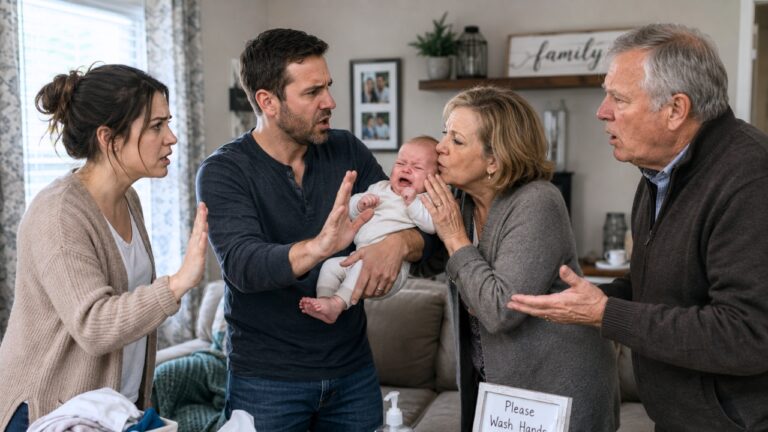
Then came the guilt. The grandparents brought up how they’d raised kids “without all these rules,” how they deserved bonding time, and how the new parents were “keeping the baby from family.” The conversations kept happening in front of other relatives, where it became harder to shut down without causing a scene.
The parents noticed other little boundary pushes, too. The grandparents tried to take the baby into another room during visits, saying the parents should “relax,” and they kept offering blankets in the bassinet even after being told no. Once, when the mother stepped into the kitchen, she came back to find the baby dozing on a couch cushion with a thick throw pulled up to the baby’s chest.
That was the moment the parents stopped treating the sleepover request as a harmless difference of opinion.
The breaking point came during a “quick” errand
A week later, the grandparents offered to watch the baby while the parents ran to the pharmacy. It was supposed to be 20 minutes, and the parents agreed because they were running on fumes and thought it might ease some tension. Before leaving, they went over the basics again: baby stays in the living room, on the firm portable crib mattress, no blankets, no couch sleeping, no leaving the room.
When they returned, the living room was quiet. The baby wasn’t in the portable crib. The grandparents were in a back bedroom with the door mostly closed, and the baby was asleep in a different setup—pillows nearby, a blanket tucked around the legs, and a soft stuffed toy by the face. The grandparents brushed it off as “perfectly fine for a nap,” and they were irritated at being corrected in their own home.
The parents didn’t argue in that moment. They picked up the baby, grabbed the diaper bag, and left. On the drive back, the father called and said there would be no more unsupervised visits for now, and there would be no overnights. The message wasn’t framed as punishment; it was framed as safety.
The response was immediate: calls, texts, and then a long message about disrespect, gratitude, and how the parents were “overreacting.” It didn’t stop there.
Escalation moved from family drama to practical safety steps
In the days after the cutoff, the grandparents showed up unannounced twice. The first time, they rang the doorbell repeatedly until the baby woke. The second time, they waited at the end of the driveway when the father got home from work and tried to follow him toward the door with a bag of baby clothes and a prepacked overnight kit.
The parents didn’t open the door. They spoke through the video doorbell and asked them to leave. When the grandparents wouldn’t, the father called a non-emergency line and reported that relatives were refusing to leave the property. An officer didn’t make a big production out of it, but the visit created a record and got the grandparents to back off for the night.
After that, the couple tightened things up. They added a chain lock, changed the garage code, and asked childcare providers and medical offices to password-protect information so no one could call pretending to be a parent. The mother started keeping a short written log of incidents—dates, what happened, who was present—because she’d learned quickly that family stories get rewritten in group texts.
What made it worse was how the grandparents framed it to others. Instead of saying the parents were concerned about sleep safety, they told relatives they were being “kept away” and treated like strangers. A few family members began reaching out to pressure the couple to “compromise” with a single overnight.
Commenters and friends focused on documentation and consistency
When the parents described the situation to close friends and a parenting group, the advice was blunt: if someone won’t follow your safety rules during a short errand, an overnight is off the table. Several people urged them to treat it like any other caregiving decision—trust and compliance are the baseline, not a bonus.
Others suggested practical steps that weren’t about winning an argument. Keep communication in writing. Don’t debate safe-sleep rules in real time. If a visit happens, do it on the parents’ turf and keep it short. If the grandparents show up uninvited, use the camera, state one clear request to leave, and call for help if they refuse.
A few people also pointed out that grandparents who push for unsupervised access can escalate in unpredictable ways—calling daycare, showing up at pediatric appointments, or claiming there’s an “emergency” to force contact. The advice wasn’t paranoid so much as experienced: lock down information, and don’t assume family means boundaries will be respected.
The standoff left everyone stuck with the consequences
The parents didn’t cut the grandparents off completely, but they changed the terms. If visits happened, they would be scheduled, supervised, and ended immediately if safe-sleep rules were questioned or ignored. The grandparents rejected that as insulting and kept returning to the same demand: an overnight to “prove” they could handle it.
The couple held firm, even as it complicated holidays and created tension with extended family. The father took extra time off work to cover evenings when the mother felt overwhelmed, because they no longer had backup care they could trust. The mother, already dealing with postpartum anxiety, said the constant pressure made her feel like she had to guard the baby instead of enjoying the early months.
In the end, the issue wasn’t whether grandparents can love a baby. It was whether they could accept the parents’ rules without treating them like a personal attack. And until that happened, the parents decided the baby’s sleep—and the baby’s safety—wouldn’t be up for negotiation.