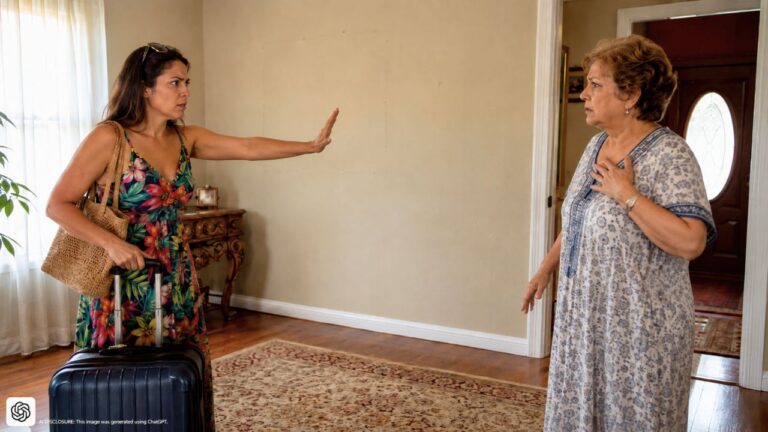
Grandparents Did Something That Changed Every Visit Going Forward — Then the Parents Said Supervision Was Now the Only Option
Photo credit: AI-generated image created using ChatGPT. Illustrative only.
Weekend drop-offs were supposed to be the easy part of parenting for this couple. The girls would spend Friday to Sunday with their grandparents, come home fed and entertained, and everyone got a little breathing room.
But lately, something felt off the moment the kids climbed back into the truck.
Their 10-year-old had gotten quieter over the last few pickups, and no amount of casual, “How was it?” seemed to crack it. Then one afternoon, she climbed in looking like she’d been crying, and her stepdad made a quick decision: Walmart could wait. Whatever happened at that house was coming home with them.
The problem started before the big blowup
In the the original post, the dad explained that he and his wife have been together eight years, married for five, and are raising two daughters. The younger child, 6, is biologically his. The older child, 10, isn’t—but he clearly considers her his daughter, full stop.
And he was the one noticing the shift first: the 10-year-old going quiet after weekends with her grandparents, refusing to say why. That kind of silence can be maddening, because it makes you question your instincts. Are you overthinking? Is she just tired? Did she have a normal kid disagreement?
Then it wasn’t subtle anymore. She got into the truck emotional, and after he pushed a little, she finally told him what had been happening at her grandparents’ house.
Her grandmother had been singling her out. No treats. Comments about her body. “Only allowed vegetables and chicken,” while the 6-year-old was offered whatever she wanted. The message wasn’t even hidden—her grandmother flat-out told her, “When you lose weight, you can enjoy these things in moderation.”
The donut incident changed everything
The moment that seemed to snap the whole situation into focus was donuts.
That morning, the grandparents brought them home. The 10-year-old, watching her little sister get treats she wasn’t allowed to have, snuck one and took it to her room. She took a bite, then panicked and tried to hide it behind the bed.
Her grandmother walked in and “flipped her lid,” scolding her for sneaking food and making a mess. But for the stepdad, it wasn’t about crumbs under a bed. It was about a child being pushed into secretive, ashamed behavior around food—while being told, in so many words, that she didn’t deserve what her sibling got because of her body.
By the time the dad was hearing it in the Walmart parking lot, he was done. He left the kids in the truck, called the grandmother, and unloaded. He admitted he was aggressive on the phone, and he was fully livid.
And the grandmother didn’t back down. Her response was that she “had to take matters into her own hands” because he, as the “stepfather,” didn’t care about her granddaughter’s health.
In one sentence, she managed to insult him, justify the food-policing, and imply she knew better than the parents. It also made it pretty clear this wasn’t a one-off “oops, I said the wrong thing” moment.
Dad tried to comfort his daughter—then got hit with a different argument
After the call, the dad focused on his kid. The 10-year-old seemed relieved just to get it out, like she’d been carrying it around all weekend. He told her to ignore her grandmother because it was inappropriate.
They went into Walmart, got groceries, and in a move that felt both tender and impulsive, he bought each daughter a small gift “just because,” partly to take the 10-year-old’s mind off what happened.
It’s the kind of parenting moment that’s less about the object and more about the message: I see you. You’re safe with me. You’re not in trouble for wanting a donut.
Then they got home, and instead of a united front, he walked right into a second fight—this time with his wife.
She wasn’t just upset about his tone with her mother. She took issue with the gifts, too. In her words, she couldn’t believe he “rewarded bad behavior” because the 10-year-old had disobeyed her mom’s rule about only eating healthy foods while at her house.
That was the line that made him feel like he was living on a different planet. To him, the kid wasn’t “disobeying.” She was being cornered into restriction, shame, and obvious favoritism.
Supervised visits became the new rule
So he drew a hard line: no more unsupervised overnight stays at the grandparents’ house.
His wife immediately called it unreasonable. She wanted him to apologize to her mother for his “explosive” phone behavior. He said he could apologize for the tone, but not for the plan to protect their child.
That’s where this blew past a typical in-law disagreement and into something messier. Because once one parent says, “This isn’t safe anymore,” and the other parent says, “You’re overreacting,” it stops being about the grandparents and starts being about trust inside the marriage.
And the dad wasn’t wavering. He added more context after people questioned whether the 10-year-old’s health was a real concern: he said she isn’t obese, had put on “a little weight” around Christmas or late winter, and a pediatrician appointment in February didn’t flag it.
He also suspected something else was going on—possible resentment from his mother-in-law toward the child’s biological father, with the child catching the fallout. Either way, he didn’t sound like someone interested in negotiating with someone who was willing to use food and shame as a weapon.
When more details came out, his stance got even firmer
As the conversation continued, he said additional things had come to light, and it changed how he felt about apologizing at all. He didn’t share those extra details in the material provided, but he was clear about where it left him emotionally.
Instead of “supervised visits only,” he said he strongly felt the girls should go no-contact with the grandmother. He’d “let gramps visit if he wants,” but he didn’t want the girls at the grandparents’ house.
It’s a major escalation, but the reasoning was obvious from his perspective: if a child is being singled out, monitored, and commented on in a way that makes her cry in the car afterward, then the weekend visits aren’t a fun tradition anymore. They’re an environment the child has to survive.
And in his mind, the grandparents didn’t just cross a line—they doubled down, questioned his role as a parent, and treated the kid’s body like a group project.
For now, the family is left stuck in that uncomfortable place where the kid has finally spoken up, the dad has finally intervened, and the mom is still focused on how the confrontation sounded instead of why it happened. The next visit isn’t just a scheduling question. It’s going to be a statement about who gets protected—and who gets appeased.