Her Family Wanted To Meet the Newborn at Church — Then the New Mom Said the Baby Wasn’t a Public Event
Two weeks after giving birth, “Mara” thought she was making a reasonable compromise. She and her husband had missed a few Sundays while they adjusted to feeding schedules, pediatric appointments, and the kind of exhaustion that makes time feel slippery.
Her mother suggested the family’s home church would be the perfect place for everyone to meet the baby at once. Mara pictured a quick hello after service, a few smiles from a safe distance, then back home. What she didn’t picture was her infant being treated like a scheduled attraction.
A simple plan turned into a group announcement
The first hint that things were drifting came midweek, when Mara’s sister texted asking what time she should “bring the cousins by to hold the baby.” Mara responded carefully: no holding, no kissing, no crowding, and they’d see how the baby handled being out.
Then an aunt messaged to say she’d told the women’s group to “wait around after the service so everyone can get their turn.” Someone else asked whether the pastor could “do a quick introduction.” Within hours, Mara’s phone was filling with plans she hadn’t approved.
Mara tried to pull it back. She told her mom she didn’t want a line of people, she didn’t want the baby passed around, and she didn’t want strangers leaning in close. Her mom insisted it would be fine because it was church, and everyone would be “respectful.”
The new mom set a boundary — and got pushback for it
By Saturday night, Mara had made a decision: if they went at all, they’d sit near an exit, leave immediately after the final song, and avoid the lobby. She texted her immediate family with the rules again, adding one more: no one would be making announcements about the baby.
Her mother replied with a long message about family traditions and how people were excited. An uncle chimed in about how “everyone just wants to celebrate.” Her sister sent a thumbs-up, but then asked if they could at least get one photo for social media.
That’s when Mara finally wrote the sentence she’d been circling all week: the baby wasn’t a public event. It wasn’t meant as an insult. It was the simplest way she could explain that her newborn’s health and her own recovery weren’t up for committee discussion.
Sunday brought the moment she was trying to avoid
Mara and her husband arrived a little late to avoid the pre-service mingling. The baby was in a covered carrier, and they slid into a seat near the back. For a few minutes, it worked.
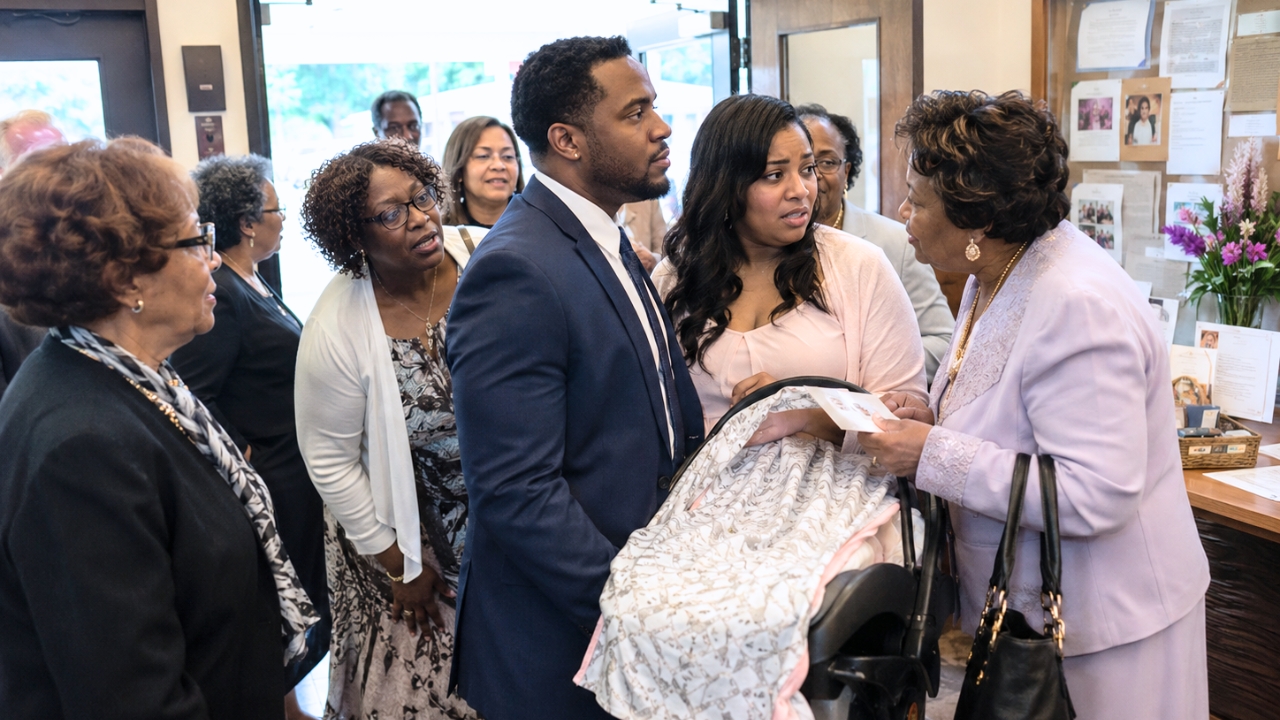
Then during greetings, Mara noticed people turning. After the service, the pastor headed toward them with a smile that suggested he’d been told to expect something. Mara’s mother and aunt were already there, gesturing toward the carrier like they were guiding traffic.
Mara’s husband stepped closer, angling his body so the carrier stayed shielded. Mara quietly told her mom they were leaving. Her mom, caught between wanting to show off and not wanting to look like the bad guy in public, hissed that they were embarrassing her.
In the lobby, the “quick hello” turned into a cluster. People leaned in. Someone tried to lift the cover for a better look. Another person reached toward the baby’s cheek with an unwashed hand. Mara backed up and repeated, firmly, that they weren’t doing this.
That’s when her aunt said something sharp about how Mara was “keeping the baby from the family,” loud enough for others to hear. Mara didn’t yell. She just left, heart racing, and cried in the car while her husband buckled the baby into the seat.
The fallout didn’t stay at church
That afternoon, Mara’s mom called and said Mara’s boundary had humiliated her in front of people she’d known for decades. Mara responded that she’d been humiliated too — not by church friends, but by her own family ignoring basic health rules for a newborn.
By evening, the messages shifted from guilt to pressure. Her sister said the cousins were disappointed and asked if the family could “stop by for just ten minutes.” An uncle suggested Mara was “overreacting” and that the baby needed to be “socialized.”
Mara’s husband, who had been quiet during most of the texting, finally sent his own message to the group: no unplanned visits, no showing up at the house, and no photos posted online. He wrote it calmly, but it landed like a door slamming.
That’s when Mara noticed a car she recognized from church slow past their house, then circle the block again. It could have been coincidence, but the timing made her stomach drop. She asked her husband to pull footage from their doorbell camera. It showed two relatives stopping briefly at the end of the driveway, then leaving when they saw no one come out.
They started treating it like a safety and privacy issue
Mara didn’t want drama, but she also didn’t want to spend the next month jumping every time a car door closed outside. She and her husband set their phones to silence except for a few trusted contacts. They told the pediatrician what had happened and asked for guidance they could share without turning it into an argument.
They also wrote a single message they could reuse: they were limiting contact, not doing in-person “meet the baby” gatherings yet, and anyone who wanted to help could drop off meals at the doorstep. They stopped debating each point, because the debating was the trap.
When one relative suggested they’d “just come to the porch,” Mara replied in writing that they didn’t consent to anyone coming by uninvited. Her husband saved screenshots and noted dates, not because they expected a legal fight, but because it made them feel less helpless.
Their church friend — someone not connected to the family side — offered a practical solution: if Mara wanted to return to service later, they could ask an usher to help them slip in and out without the social crush. Mara appreciated it, but she wasn’t ready to trust that the message would stick.
People kept circling one question: who gets to decide?
When Mara vented to a small group of friends, the reactions weren’t centered on whether her relatives meant well. They focused on how quickly “excitement” turns into entitlement when someone feels ownership over a baby.
Several friends told her to keep everything in writing and to avoid doorstep conversations that could be twisted into “she said, they said.” Others urged her to tighten privacy settings online and to tell relatives directly that any posted photos would mean a longer timeout from visits.
A couple of parents pointed out something Mara hadn’t wanted to admit: the church setting was part of the problem, because it created a stage. It wasn’t just family wanting a moment; it was family wanting witnesses, approval, and a kind of public validation that couldn’t be controlled once it started.
Mara didn’t end up filing a police report, but she did ask her husband to make sure their camera system was working and to keep the porch light on at night. The goal wasn’t punishment. It was peace.
In the following weeks, Mara stuck to short, planned visits with a limited number of people who could respect the rules. Her mom cooled off only after realizing the boundary wasn’t a negotiation and that showing up unannounced would backfire. The tension didn’t disappear, but the message finally got through: the baby would be introduced on the parents’ timeline, not as a group activity after Sunday service.