Bride Said No Children at the Wedding — Then Her Sister Tried To Bring Hers Anyway
By the time the bridal party was lining up for photos, the bride’s phone had already buzzed three times with the same warning from her coordinator: her sister was in the parking lot, and she wasn’t alone. The invitation had been clear, the RSVP had been confirmed, and the venue contract had been signed with one specific rule at the top. No kids.
The bride and her fiancé hadn’t made that choice to be dramatic. Their ceremony was scheduled for late evening at a renovated loft space with open stair rails, candles on low tables, and a cocktail-style reception with glassware everywhere. They were also paying per head, and their package included an on-site bartender and security, both of which the venue required for adult-only events.
Her sister knew all of it. She’d still shown up with her two young children dressed for a wedding, plus a diaper bag, a tablet, and a folded stroller.
The rule wasn’t about family—it was about a contract
Weeks earlier, the bride had sent a polite group message to immediate family explaining the boundary. She’d offered help finding childcare and even shared two vetted sitter services recommended by friends. She also told her sister, directly, that the venue would refuse entry to minors after 6 p.m. and that violating the policy could trigger extra fees.
The sister didn’t argue much at first. She said she understood, then began dropping hints about how hard childcare was and how “it would be different if it were her wedding.” The bride kept it simple and repeated the same line: she loved her nieces and nephews, but the event was adults only.
On the day of the wedding, the sister arrived early enough to slip in before most guests. The venue staff stopped her at the front doors once they saw the kids. That’s when she called the bride—twice—then switched to texting the bride’s mother to plead her case.
The parking-lot standoff became the first crisis of the day
The bride didn’t want to be the person in a white dress negotiating rules in the parking lot. She sent her maid of honor and the coordinator, hoping it could be handled quietly. The sister refused to leave the children with anyone outside the immediate family, and she refused to take them home because she’d “already driven all this way.”
What made it worse was that she hadn’t come alone as a guest. She’d brought a friend to “help with the kids,” assuming the extra adult would make it acceptable. That friend wasn’t on the guest list, and the venue’s capacity count had been tight enough that the couple had already trimmed invites.
The venue manager stepped in and reiterated the policy. The sister tried to argue that the kids wouldn’t “be in the way,” but the staff pointed to the contract and the fire code limit. The manager also reminded the family that the couple would be billed for additional security time if the entrance became obstructed.
Inside, the bride faced pressure from both directions
Back in the bridal suite, the bride’s mother urged her to “just make an exception” so everyone could calm down. Her fiancé, hearing the details for the first time, looked stunned and asked whether this was going to keep happening all night. The bride worried about the tone of the entire evening shifting from celebration to constant negotiation.
There were practical concerns, too. The seating chart didn’t have spots for children. The caterer had no kids’ meals. The rental company had delivered glass chargers and heavy centerpiece stands that were stable for adults but not designed for toddlers weaving through a crowd.
At the same time, the bride didn’t want to create a family rupture in the hours before walking down the aisle. She also knew what her sister was like when she felt embarrassed: loud, insistent, and willing to make a scene if she thought it would force people to give in.
The sister tried to force the issue at the door
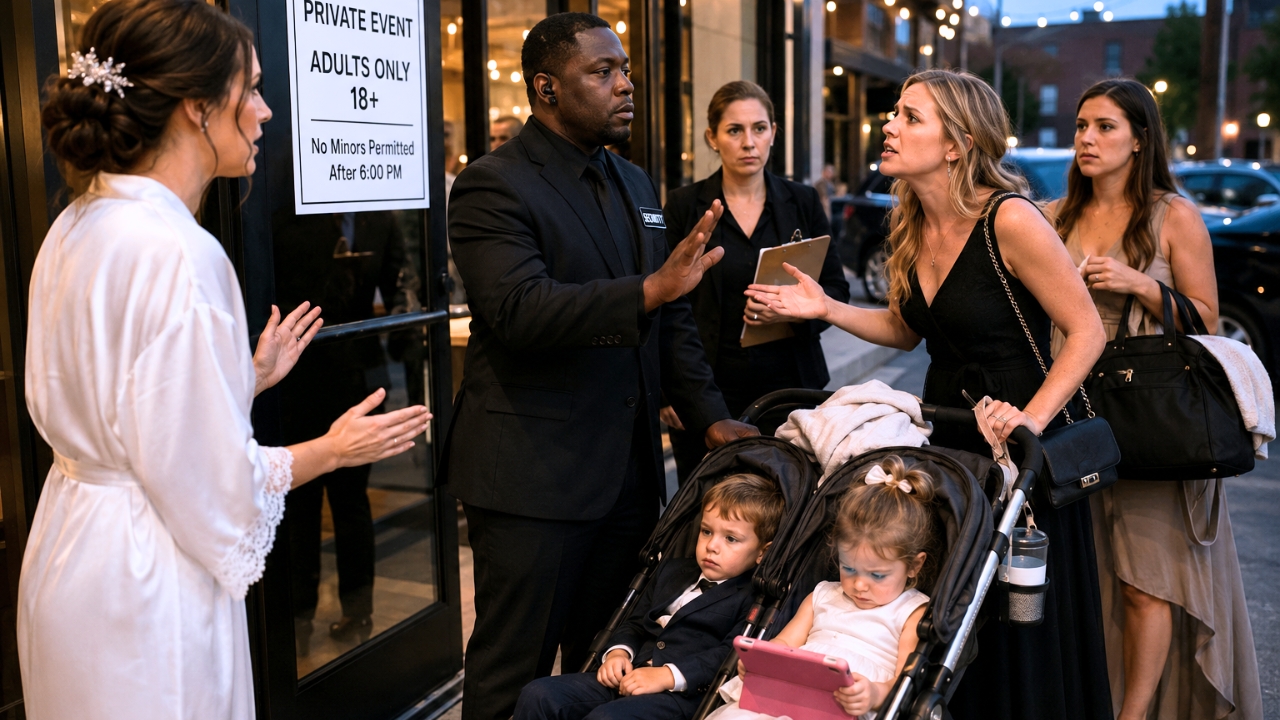
After about twenty minutes of back-and-forth, the sister attempted a different tactic. She waited for a cluster of guests to enter, then moved with them as if she belonged in the flow. A security guard stepped in front of the stroller and told her, calmly, that minors couldn’t come inside.
That’s when the moment turned from tense to disruptive. The sister raised her voice, drawing attention from guests in formalwear and a photographer trying to stage pre-ceremony shots. Several people stopped and stared, and a groomsman quietly closed the lobby doors to keep the noise from carrying into the main space.
The coordinator asked the sister to step away from the entrance. She refused, insisting someone needed to “fix this.” The venue manager told her she would have to leave the property if she continued blocking access, and the sister demanded to speak to the bride directly.
The bride finally went out, still in her robe, and said the same thing she’d said for weeks: the kids couldn’t come in. She offered two choices—use the sitter service on short notice, which the coordinator could help arrange, or attend the ceremony alone while the friend watched the kids off-site. The sister accused her of being cold and said she was being “punished for having a family.”
The money and liability questions quickly got real
With guests arriving, the venue warned the couple that if the entrance disruption continued, they’d need to extend security coverage and could face additional charges. The bartender also needed the lobby clear to bring in sealed inventory. The bride’s fiancé asked the manager for the charges in writing, and the coordinator started documenting everything on her phone, including timestamps and who was involved.
There was also the question of liability. The venue’s insurance policy for the evening was written for an adults-only event. Staff said the presence of minors could complicate things if someone got hurt near the stairs or around the glass setup. That wasn’t a moral judgment, just a risk calculation the venue was unwilling to bend on.
Eventually, the bride’s mother stepped outside and offered to leave with the sister and handle childcare herself, missing part of the ceremony if needed. The sister didn’t like that option either, because she wanted to attend and be seen attending. But time was running out, and the coordinator was making it clear the ceremony would start with or without them.
Commenters focused on proof, boundaries, and avoiding a bigger blowup
When people later heard what happened, the practical advice was remarkably consistent. They urged the bride and groom to keep everything in writing, including the venue’s policy, any fees, and any texts from the sister showing she knew the rule ahead of time. Several pointed out that family pressure often shifts toward the person who is easiest to guilt, not the person causing the disruption.
Others emphasized that it was smart to let staff and security be the “bad guy,” because it prevents an emotional family dispute from becoming the centerpiece of the wedding. A few suggested preemptively telling vendors not to accept last-minute changes from anyone but the couple, especially if the sister tried to add meals or seats on the fly.
And more than one person noted that showing up with an uninvited extra adult, plus children, wasn’t a misunderstanding. It was a plan.
In the end, the sister left the property with her friend and the kids about ten minutes before the ceremony began. She did not return for the reception, and she sent a short message later saying she felt “humiliated” and would be taking space. The bride walked down the aisle on time, but the empty seat where her sister would have been sat like a small shadow on an otherwise bright night.
Afterward, the couple paid an additional security fee for the extended entrance coverage, and the bride saved every message connected to the dispute. The celebration went on, but the family tension didn’t dissolve with the last dance. It simply moved to the next day, when everyone woke up and had to decide whether boundaries at a wedding would become boundaries for the rest of their lives.